Carrowkeel Summer Solstice
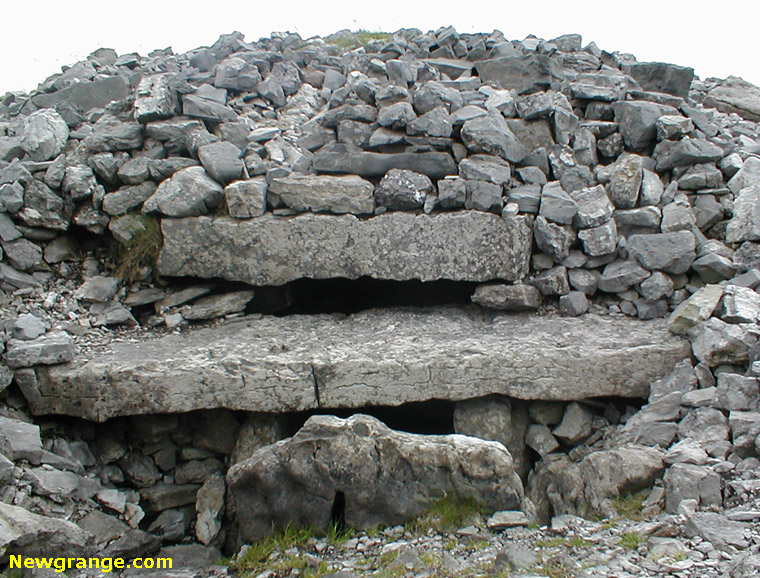 Carrowkeel Cairn G roofbox opening between horizontal lintels.
The Carrowkeel cairns are in the Bricklieve Mountains in County Sligo. Cairn G has a roofbox above the entrance, similar to Newgrange. The sun enters the chamber through the roofbox at sunset on the days around the summer solstice, illuminating the back of the chamber.
Carrowkeel Cairn G is generally considered to pre-date Newgrange, possibly by several centuries, although precise dating remains uncertain. It is smaller and simpler in design, with a passage approximately two metres long compared with about nineteen metres at Newgrange.
Carrowkeel Cairn G at Sunset on 20 June 2008
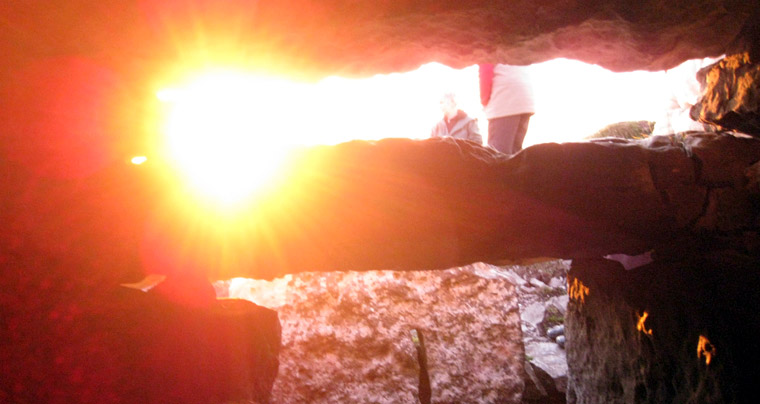 Summer Solstice Sunset illuminating Carrowkeel Cairn G - Photo Tony Christie.
Carrowkeel Cairn G is one of the most impressive monuments in the Carrowkeel passage tomb complex in the Bricklieve Mountains of County Sligo. Set high above the surrounding landscape, it stands in a remote and atmospheric setting that still feels cut off from the modern world.
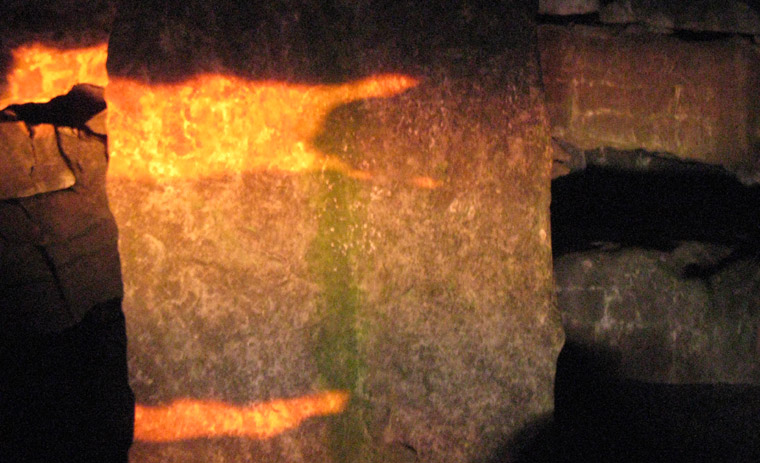 Sunbeam moving across the back of the chamber in Cairn G at Carrowkeel - Photo Tony Christie.
Among the Carrowkeel tombs, Cairn G is often described as the best preserved. Its cairn is about 21 metres in diameter, and although visitors must crawl through the entrance to get inside, the chamber itself is surprisingly spacious, with enough room for several people to stand.
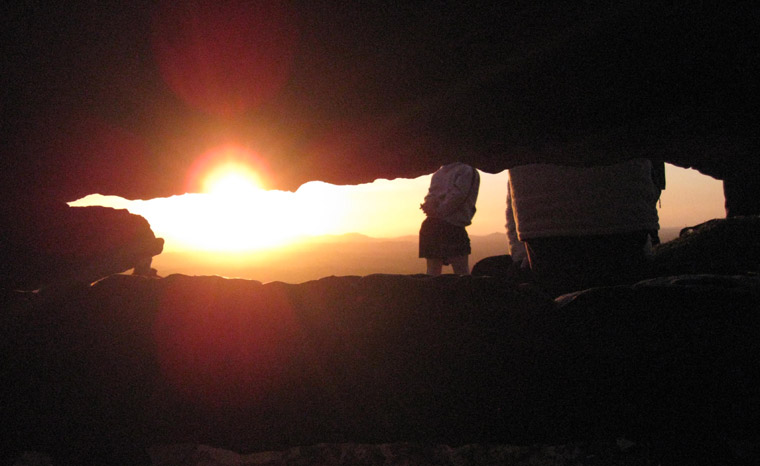 Summer Solstice Sun setting viewed from inside Cairn G at Carrowkeel - Photo Tony Christie.
What makes Cairn G especially remarkable is the quality of its construction. The chamber is formed by massive limestone orthostats that were carefully shaped and fitted with notable precision. Early excavators were struck by the skill of its builders, seeing in it not just practical engineering but a real sense of design and symmetry. When the tomb was opened in 1911, the floor and recesses were found to be paved with limestone flags, showing that this was a carefully planned monument rather than a simple pile of stones.
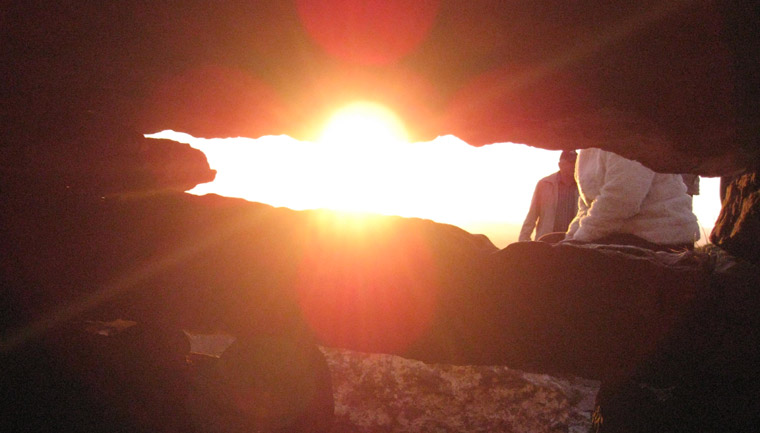 Sunset viewed through the roofbox from inside Cairn G in Carrowkeel - Photo Tony Christie.
Cairn G is also well known because of the light phenomenon associated with it. A feature above the entrance is often described as a roof box, drawing comparisons with Newgrange. Around the time of the summer solstice, the setting sun sends a beam of light into the passage and chamber, gradually moving across the interior stones. This effect has made Cairn G one of the best known archaeoastronomical sites in western Ireland, and each June it continues to attract people who come to witness the sunset illumination for themselves.
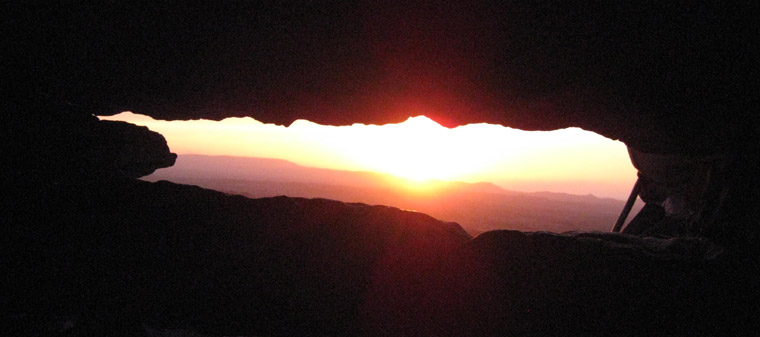 Summer Solstice Sunset at Carrowkeel Cairn G viewed through the roofbox - Photo Tony Christie.
Archaeologically, Cairn G is important not only for its architecture but also for what was found there. Bone fragments later dated by radiocarbon analysis showed that activity at Carrowkeel belongs to the Late Neolithic, with dates broadly spanning the period from the fourth to the third millennium BC. This helped correct earlier ideas that the tombs were Bronze Age in date.
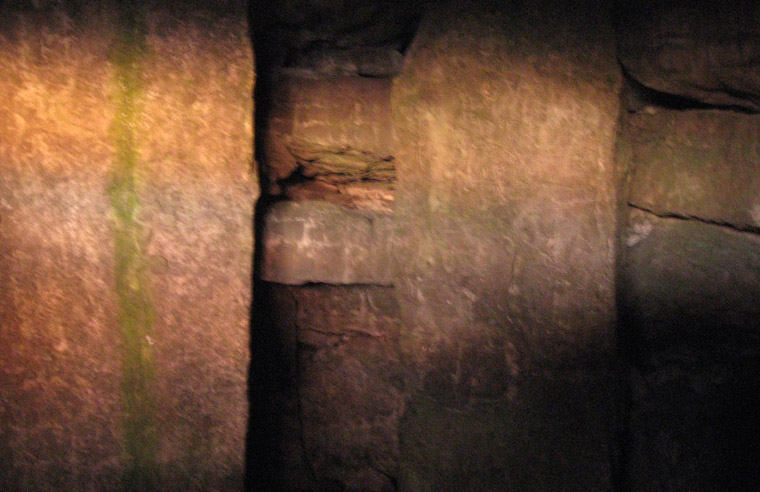 Sun moving across the back of the orthostats in the chamber of Cairn G at Carrowkeel - Photo Tony Christie.
Cairn G stands as both a beautifully built passage tomb and an important piece of evidence for the long ceremonial history of Carrowkeel, linking burial, landscape, and the observation of the sky in prehistoric Ireland.
Carrowkeel Cairn G - A beam of light from the summer solstice sunset enters through the roofbox.