European Megalithic Culture and the Boyne Valley
The megalithic monuments of Europe, and especially those of Ireland’s Boyne Valley, are among the most remarkable achievements of the Neolithic world. Built over 5,000 years ago, they reflect a shared Atlantic tradition revealed through radiocarbon dating rather than distant influence. In Ireland, early activity is also evident at Carrowkeel and Carrowmore in County Sligo, although the earliest dates are interpreted with caution. At the centre of this story lies Brú na Bóinne, where Newgrange, Knowth and Dowth together form one of the most important prehistoric landscapes in Europe.
Dating Neolithic Monuments
Archaeologists use several methods to date megalithic monuments, but the most important is radiocarbon dating, also known as carbon-14 dating. This method cannot date the stone itself, but it can date organic material such as charcoal, bone or wood recovered from excavations. In prehistoric archaeology, radiocarbon dating has transformed understanding of ancient sites and has often overturned earlier assumptions based only on the style of tombs or artefacts.
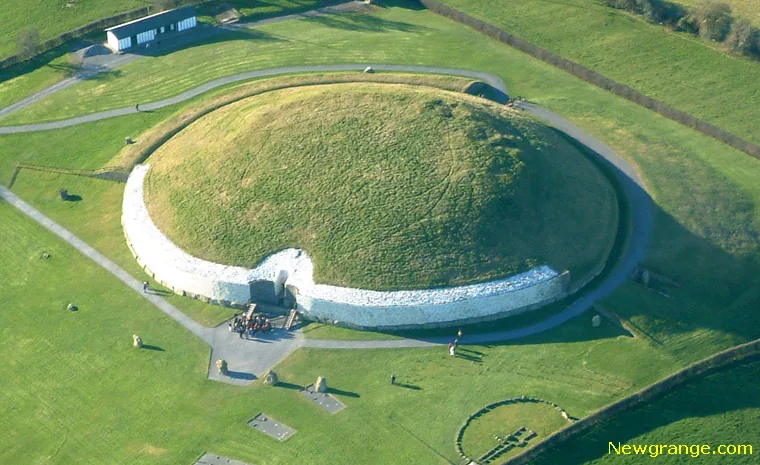 Newgrange Megalithic Passage Tomb located in the Boyne Valley, Ireland.
Radiocarbon results must always be interpreted with care. A sample may date activity that took place before a monument was built, during its use, or long after it had gone out of use. For that reason, archaeologists compare a number of dates from secure contexts rather than relying on a single early sample.
How Radiocarbon Dating Changed Interpretation
Before radiocarbon dating became widely available, many scholars believed that the megalithic monuments of western Europe had been inspired by the eastern Mediterranean or the Near East. Scientific dating showed instead that the great tombs of Atlantic Europe were themselves very ancient and belonged to the early farming communities of the Neolithic period. That discovery reshaped the chronology of prehistoric Europe.
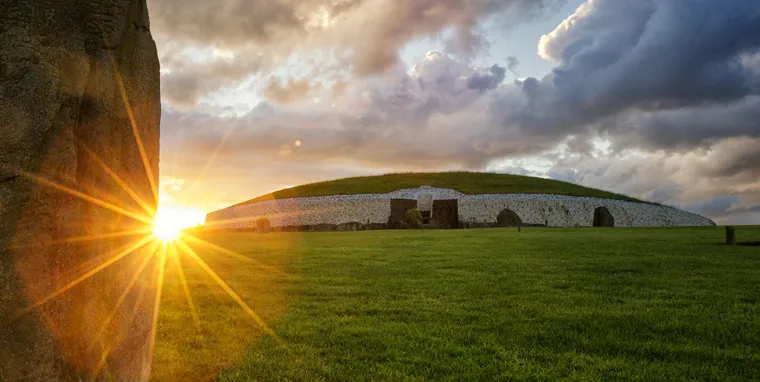 Newgrange Megalithic Passage Tomb located in the Boyne Valley, Ireland.
Megalithic Europe and the Atlantic Façade
Megalithic monuments are found across large parts of western Europe, with especially important concentrations along the Atlantic seaboard in Iberia, Brittany, Britain and Ireland. Archaeologists generally see this pattern as evidence of long-distance contact between early farming communities who shared ideas, architectural traditions and ritual practices over many centuries.
Rather than tracing all megalithic building back to a single point of origin, mainstream archaeology tends to view the tradition as a broad Atlantic phenomenon that developed in several regions during the Neolithic. The details are still debated, but the monuments are usually understood as part of a connected cultural world rather than the result of one simple line of diffusion.
Early Sites in Ireland
Ireland contains some of the most important early megalithic monuments in Europe. The Sligo megaliths of Carrowmore and Carrowkeel have produced radiocarbon dates placing their main phase of activity around 3500 BC, and the complexes are widely recognised among the earliest passage tomb cemeteries in Ireland. Some researchers have claimed that a few very early samples from western Ireland point to monument activity before this, but such dates are treated cautiously by most archaeologists because the material dated may belong to earlier occupation rather than to the construction of the tombs themselves.
For that reason, it is safer to say that Ireland was one of the major centres of megalithic building in Atlantic Europe, rather than to claim with certainty that all European megalithic culture began there. Even so, the Irish evidence is of outstanding importance in any discussion of the origins and development of these monuments.
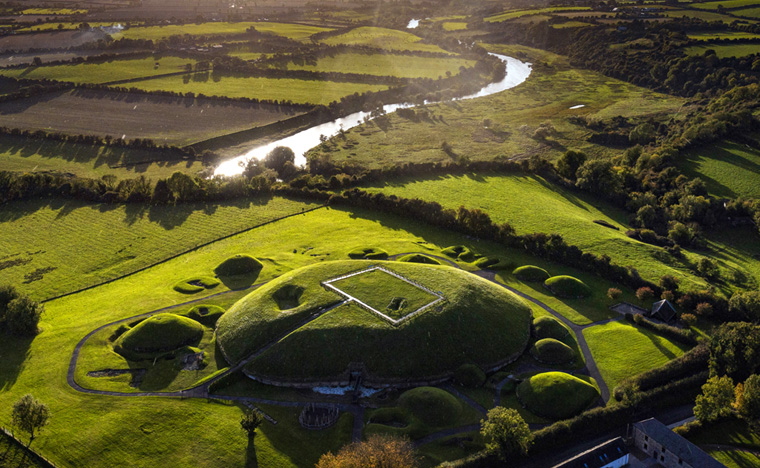 Knowth Megalithic Passage Tomb located in the Boyne Valley, Ireland.
The Boyne Valley in the Neolithic
The most celebrated concentration of megalithic monuments in Ireland is found in Brú na Bóinne in County Meath, where the great passage tombs of Newgrange, Knowth and Dowth were built around 3200 BC. These monuments stand among the masterpieces of Neolithic Europe and show an extraordinary command of engineering, planning and symbolism.
Newgrange is especially famous for the winter solstice illumination of its passage and chamber, while Knowth is renowned for its great mound, its two passages and its remarkable collection of carved stones. Dowth, although less fully explored, remains an essential part of the same ritual landscape. Together, these monuments demonstrate that the Boyne Valley was one of the foremost ceremonial centres of prehistoric Europe.
Megalithic Art in Ireland
The passage tombs of Ireland contain some of the finest prehistoric art in Europe. Spirals, lozenges, zigzags and other geometric motifs were carved onto kerbstones and chamber stones, especially at Knowth and Newgrange. The meanings of these carvings are still debated. They may have carried symbolic, ceremonial or cosmological significance, but archaeologists are cautious about attaching any single explanation to them.
Some writers have described the Boyne Valley as the spiritual capital of megalithic Europe. While that phrase is interpretative rather than scientific, it reflects the exceptional richness of the monuments, the scale of their art and the importance of the landscape in Irish prehistory.
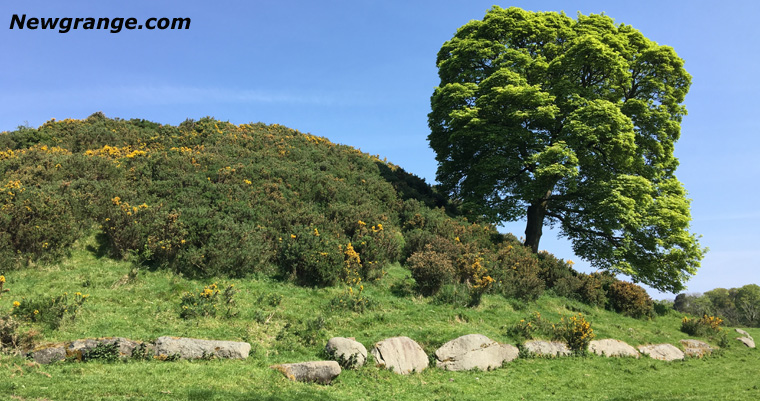 Dowth Megalithic Passage Tomb in the Boyne Valley, Ireland.
Myth, Memory and Later Interpretation
Later generations created legends to explain monuments whose true origins were already lost in time. Medieval writers, for example, connected Stonehenge with Ireland, and Irish tradition preserved stories about sacred places such as Tara and the Lia Fáil. These traditions are historically interesting because they show how ancient monuments continued to hold power in the imagination long after the Neolithic period had ended.
Modern archaeology, however, distinguishes clearly between myth and evidence. Legends may preserve echoes of the past, but the dating and interpretation of megalithic sites depend on excavation, scientific analysis and comparison with other archaeological evidence.
Megaliths and Celtic Language
Older writers sometimes linked the builders of megalithic monuments directly with the Celtic languages. Most scholars today place the emergence of Celtic much later, probably in the later Bronze Age or Iron Age, long after the great passage tombs of the Boyne Valley had been built. The people who constructed Newgrange, Knowth and Dowth belonged to earlier Neolithic farming communities, and the languages they spoke remain unknown.
Even so, the monuments continued to shape the cultural memory of later Ireland. They were reused, reinterpreted and woven into stories, helping to give places such as Brú na Bóinne and Tara their enduring significance in the Irish landscape.