Articles on Newgrange and the Boyne Valley
- A Passage to the Afterworld - the story of New Grange. Built around 3200 BC by farmers on the rich land of the Boyne, the mound is classed as a passage tomb and treated here as a house for ancestors. It gave the living a link to their deities and a place for ritual and celebration.
- Edward Lhwyd at Newgrange in 1699 - the first modern antiquarian account of the tomb. The Welsh naturalist wrote down the passage, the chamber and the carved basin soon after the entrance was found, and his assistant Will Jones drew the plan. The visit is where the modern written record of Newgrange begins.
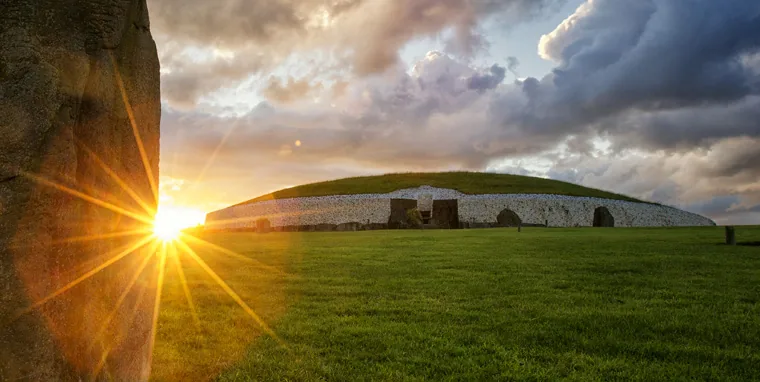 Newgrange UNESCO World Heritage Site.
- Neolithic Ireland: first farmers, people and megalithic monuments. Between about 4000 and 2500 BC, farming communities cleared woodland, made pottery, lived in timber houses and built more than 1,600 megalithic tombs. Newgrange, Knowth and Dowth belong to that age.
- Incest uncovered at the elite prehistoric Newgrange monument - Alison Sheridan. Ancient DNA from a man in the tomb shows a case of incest, which the 2020 study reads as a possible way to keep a dynastic line. The work follows Irish farming communities and the people placed in passage tombs over about 1,500 years.
- Prof. Michael J. O'Kelly who excavated and restored Newgrange. From 1962 to 1975 he showed that the passage was built so midwinter sunrise would reach the chamber through a special opening. He was Professor of Archaeology at University College Cork from 1946 until his death in 1982.
- Winter Solstice at Newgrange by Lucy Caldwell. She watches the 2024 midwinter sunrise through a phone, in bed, while the live chat fills with greetings from around the world. The shortest day becomes a gathering of people who will never stand in the chamber.
- Newgrange Excavation Report Critique - Alan Marshall. Marshall works through O'Kelly's 1982 monograph chapter by chapter, from the 1962 to 1975 excavation to the restoration and the specialist reports. He weighs how the text and the drawings are arranged and how far the interpretation holds.
- Computing the Winter Solstice at Newgrange - Rick Doble. Doble compares the Newgrange passage, used around 3000 BC as a dial for the winter solstice, with the later Roman method of sighting the sun at noon and working out the day. He argues that catching the light in the tomb was at least as precise.
- Newgrange: empowering the salmon of wisdom - Philip Coppens. Coppens sets the midwinter light beside stories of the Boyne as the White Cow, a river said to mirror the Milky Way and to give second sight. Salmon that granted wisdom and the glow of the quartz at sunrise belong to that same sacred bend.
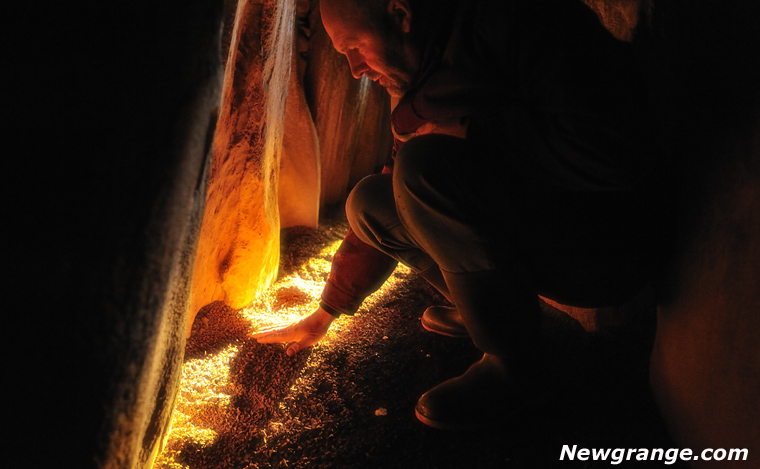
Touching the Light : Winter Solstice Sunbeam inside Newgrange - Photo by Ken Williams.
- Michael Fox created Knowth.com, publishes Newgrange.com and founded Boyne Valley Tours in 2010. The page follows his Loughcrew equinox film, the 2010 winter solstice inside Newgrange and the summer sunrise at Townleyhall.
- Clare Tuffy spent more than forty years with the Office of Public Works at Brú na Bóinne. The page follows her work on the visitor centre, the winter solstice lottery and the honorary doctorate from UCD in 2024.
- Knowth Equinox sunrise/sunset alignment? - Frank Prendergast and Tom Ray. Their surveys for the Royal Irish Academy series on Knowth tested the idea that the two passages face equinox sunrise and sunset. The passages are offset from both. Confusion between magnetic north and true north on older plans had kept the idea going.
- Dowth: Where Darkness, Stone and Memory Meet - Harry Warren. Published in Ireland's Own in February 2026, the piece follows a January afternoon at the mound. Warren stays with the winter cold, the kerbstones and a tomb that has stood in the bend for about 5,000 years.
- Ireland's burial mounds hold many mysteries - Jim Sajo. Sajo sets the Boyne bend, a short drive from Dublin, as the home of Stone Age farmers who raised stock, tended crops and built passage tombs. A long corridor leads to a cross-shaped chamber, long read as the start of a journey to the Other World.
- Reflections on Loughcrew and Newgrange - Tim O'Brien. O'Brien, author of Light Years Ago, watched the equinox sunbeam in Loughcrew Cairn T from 1986 and then the winter solstice beam at Newgrange. He records how the patch of light moves and what he thinks the two monuments were built to measure.
- Stonelight Archives - Pioneering research of Martin Brennan and the Stonelight team. The archive gathers pieces by Martin Brennan, Toby Hall, Jack Roberts and others on the purpose of the Irish megaliths, from field notes of the late 1970s onward. Light, shadow and the carved stones run through it.
- Spirals within Spirals: Stones have Stories to Tell - James Nemec. Nemec's essay, written after a visit to Knowth, treats the carved spirals as stones that still have stories to tell. He writes about meeting Newgrange and Knowth with respect and with a sense of humour.
- Newgrange: Ireland's ancient answer to the pyramids - Laura Harrison McBride. McBride reads the mound, built about 5,000 years ago, as a passage tomb that also served rituals of rebirth and a link with ancestors. The winter solstice alignment sits at the centre of that account.
- The Bull of Newgrange: Newgrange may be a metaphor for Halley's Comet - Gilbert de Jong. Seen from above, de Jong reads the mound as a bull's skull with horns, and the grass circle between them as a sun disc. He takes that horned bull as a metaphor for Halley's Comet.
- The Irish Origins of the European Megalithic Culture. Radiocarbon dates place the Boyne tombs in a shared Atlantic tradition, with early activity also at Carrowmore and Carrowkeel in County Sligo. Newgrange, Knowth and Dowth stand together as one of the great prehistoric landscapes of Europe.
- Loughcrew Equinox Reflection - Sally McKenna. McKenna follows the autumn equinox beam into Cairn T, across a carved stone of interlocking cells with a circle in the middle. Written in 2008, the piece ties that light to the farming year and to keeping time with the seasons.
- Samhain - The Celtic roots of Halloween. Samhain marked the end of summer and the start of winter, around 1 November, and the festival began on the night before. The boundary with the Otherworld was thought to thin, so spirits, ancestors and fairies could cross.
- Ireland in prehistory - A concise account by Desmond Johnston. Johnston runs from the end of the Ice Age and the first houses on the Bann, through the megalithic period around 4000 BC, to the myths later written down in the monasteries. Because Rome never ruled Ireland, more of that older tradition survived to be recorded.
- Some Thoughts on the Celts - Origin, Religion and Language by Desmond Johnston. Johnston traces the habit of calling Stonehenge and Avebury Druid temples to William Stukeley, who did not know those monuments were thousands of years older than the Celts. The notes keep Celtic origin, religion and language apart from the Neolithic stones.
- Aspects of the Megalithic Era - by Desmond Johnston. Johnston maps stone monuments along the Atlantic coasts, from Iberia and France to Ireland, Britain and Scandinavia, with further pockets on the Mediterranean. Most fall between about 5000 and 1500 BC, and many in the west are older than the pyramids.
- Monuments and Access - The interpretation of Neolithic Monuments by Dr. Liam Kilmurray. Kilmurray questions the view that passage tombs and henges were closed to most people, with entrances and recesses marking who could go in. He treats access itself as the question the monuments pose.
- Messages from the Monuments - How Neolithic Monuments Communicate About Religion and Status by Paul K. Wason. Wason argues that the monuments say more about religion and status than is usually allowed, because of the way they communicate. He separates the monument as a medium, the message the builders intended and the subtext an archaeologist reads.
- We Have Never Been Material - Andrew Cochrane. Cochrane's 2007 paper takes objects from Fourknocks and the Mound of the Hostages as active in how those tombs were seen and used. Similar materials recur, yet no single rule governs how they were combined or placed.
- The Stone Age Cairn L at Loughcrew is featured in the March 2015 edition of Astronomy Ireland in an article by Ann Dunne "Irish Recorded Oldest Known Eclipse 5355 Years Ago". Dunne reports Paul Griffin's reading of carvings on three stones as a solar eclipse of 30th November 3340 BC, older than Chinese records from 2800 BC. Of 92 eclipses he tracked, only that one fits the petroglyphs as seen from the hill.
- The Valley of the Boyne - from 'The Charm of Ireland' by Burton E. Stevenson, published in 1914. Stevenson takes a car from Drogheda around the bend, to the Battle of the Boyne, the tombs at Dowth and Newgrange and the abbeys of Mellifont and Monasterboice. The chapter is a visitor's day on the river in the years before the excavations.
- Vale of the Boyne and Royal Meath - published in 1898 for the Great Northern Railway Company. Carswell of Belfast issued the guide for travellers on the line from Dublin to Drogheda and the branch west to Oldcastle. It pairs the scenery of the vale with the antiquities a tourist of the 1890s was expected to stop for.
Downloadable Papers
- The 2020 Newgrange DNA study. Lara M. Cassidy and colleagues sequenced genomes from Irish tombs, including a man at Newgrange born of a first-degree incestuous union. They read distant kin links between the great passage tombs as a sign of rank.
- Pigs, pannage and the winter solstice at Newgrange - Eric Guiry and colleagues, 2025. Pig bones outside the sealed tomb belong to a short burst of slaughter around 2600 to 2450 BC. The animals were fattened on autumn nuts and killed in the weeks around midwinter, so gatherings at the entrance continued after the chamber closed.
- The 'King' of Newgrange? A critical analysis - Research Article 2025. The petrous fragment NG10 is from a child of a very close incestuous union, and that finding fed the 2020 headlines. The chamber had been disturbed for centuries, and the human remains are a mix of burnt and unburnt bone from several people.
- Social and Genetic Relations in Neolithic Ireland: Re-evaluating Kinship 2025. People placed in the great passage tombs were usually distant relatives, often no closer than sixth cousins. Kinship here was built through shared labour, seasonal gatherings and the long work of the monuments.
- Winter Solstice Phenomenon at Newgrange: Research Report 2024. High-resolution photographs and video, commissioned by the National Monuments Service, follow sunlight from the roof-box along the passage and into the chamber. The record shows how the tomb was built to catch the midwinter sunrise.
- Megalithic art on the Great Circle at Newgrange - Ken Williams, 2023. Picking on four of the Great Circle stones had been missed for decades, hidden by lichen and flat light. Oblique lighting and photogrammetry pick out the marks, which match techniques already known on the kerb and in the passage.
- Beyond Newgrange: Brú na Bóinne in the later Neolithic. Stephen Davis and Knut Rassmann place later Neolithic monuments on the ground between the passage tombs and the Boyne. Henges, timber circles, palisades and avenues show in LiDAR and in the cropmarks of the dry summer of 2018.
- Newgrange from the air, the 2018 interim report by Tom Condit and Mark Keegan. Drought in June and July 2018 turned buried ditches and post-holes into cropmarks on the floodplain below the tomb. The report maps the Geometric Henge, the enclosures beside it and a long palisade running towards the ridge.
- Brú na Bóinne World Heritage Site Management Plan, 2017. The plan sets out how the Bend of the Boyne is looked after, a core of about 780 hectares and a buffer of 2,500 hectares around Newgrange, Knowth and Dowth. Conservation of the monuments sits alongside farmland, research and the visitors who come to a site inscribed in 1993.
- Boyne Valley Landscapes Project, Phase III final report, 2010. LiDAR, geophysics and viewsheds at Brú na Bóinne. Megarry marked 127 possible new sites from the LiDAR, and Barton tested several with magnetometry and earth resistance. The viewshed work asks what the three tombs see of one another, of the Boyne and of Tara and Loughcrew.
- Brú na Bóinne Research Framework: the 2008 Consultation Draft. Jessica Smyth's consultation draft for the Heritage Council sets out what was known about the World Heritage Site in 2008, the gaps in that knowledge and 42 questions for future research. The page summarises the draft. It is not an account of later work.
- Brú na Bóinne World Heritage Site Research Framework, 2009. The Heritage Council prepared this framework for the Department as a set of research questions for the Bend of the Boyne. Passage tombs, megalithic art and the long occupation of the river bend are treated as one landscape.
- Rediscovering the Winter Solstice Alignment at Newgrange - Robert Hensey. Hensey traces how the winter solstice alignment became accepted after 1967 and suggests the roof-box was built when the passage was lengthened. He weighs older reports of midwinter light and how far they shaped the reconstruction of the outer passage.
- Irish Passage Tomb Motifs - Andrew Cochrane on water, colour and the carvings at Newgrange. Spirals, lozenges, arcs and cup-marks were added and overwritten over time, so the decorated surfaces stay unfinished. Hardness, colour, texture and the setting of the kerb all take part when someone stands in front of the stone.
- Brú na Bóinne - Heritage Tourism Sustainability - Bettina Graham. Visitor numbers at Brú na Bóinne have to be held against conservation of the monuments and the life of people who live beside them. The essay uses the Brú na Bóinne Development Plan 2000 and the Meath County Development Plan 2007 to 2013.
- Newgrange - A Womb Not a Tomb - Geraldine Moane. Moane takes Marija Gimbutas as a way back into the Ireland that built Newgrange and reads the spirals, triangles and passage as goddess imagery. The winter solstice beam enters a chamber she understands as a place of birth and return.
- Shadow casting phenomena at Newgrange - Frank Prendergast, 1991. The tall stones opposite the entrance cast sunrise shadows onto the triple spiral of Kerbstone 1 at different seasons. GC1 reaches it at winter solstice, GC-1 in February and October and GC-2 around the equinoxes.
- Aspects of Ritual Deposition in the Late Neolithic and Beaker Periods at Newgrange - Charles Mount. The animal bone and objects around the timber circles are treated as ritual deposits of the Late Neolithic and Beaker periods. Pits, post-holes and the large number of pigs point to ceremony focused on the mound.
- The Ritual Origins of the Roof-Box at Newgrange - Laura E. Freeman Marr. Freeman Marr follows the roof-box from its rediscovery in O'Kelly's excavations to the winter solstice as a public ritual. The thesis sets Neolithic ideas of the opening beside the way tourism now interprets it.
- Newgrange, County Meath - R. A. S. Macalister, 1929. The Penny Guide describes the bend of the Boyne and the chamber from what could be seen in 1929. Macalister dates the cemetery to the Bronze Age. The page sets those paragraphs beside later excavation and a Neolithic date of around 3200 BC.
- The Bronze Age in Ireland - George Coffey, 1913. Coffey sets Irish copper, bronze and gold in a European spread of forms, from flat axes and lunulae to swords and shields. He takes the Newgrange spiral as a motif carried from the Aegean along the amber route through Scandinavia.
Boyne and Beyond Conference 2022
Inspired by the legacy of the late Professor George Eogan this international conference examines the Boyne Valley monuments in the context of the wider prehistoric world.