Neolithic Ireland
The Neolithic, or New Stone Age, transformed Ireland. Between about 4000 and 2500 BC, farming communities settled the island, cleared woodland, made pottery, lived in timber houses and built more than 1,600 megalithic tombs. It is the age of Newgrange, Knowth, Dowth and hundreds of other stone monuments still visible in the landscape today.
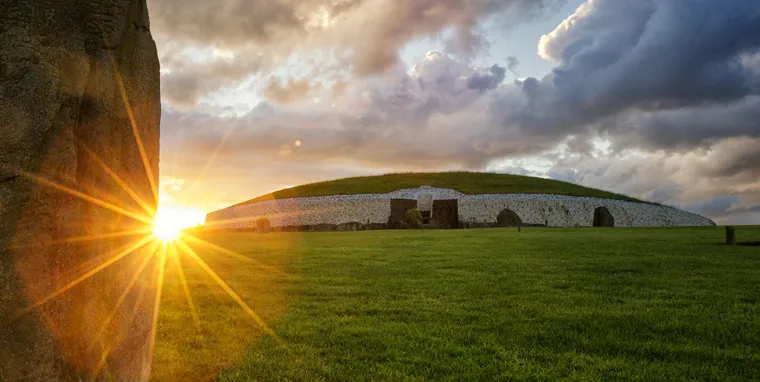 Newgrange passage tomb in Brú na Bóinne, one of the great monuments of Neolithic Ireland.
Farming did not arrive as a single invention. Cereal growing, cattle, sheep and pigs, polished stone axes, pottery and more permanent houses appeared together as a connected way of life. Dates are approximate and rest mainly on radiocarbon evidence. They continue to be refined as new sites are excavated and analysed.
When was the Neolithic in Ireland?
Before farming arrived, Ireland was inhabited by Mesolithic hunter-gatherers (c. 8000 to 4000 BC). They settled the island several thousand years after the end of the last Ice Age, leaving camps and stone tools across Ireland. One of the best-known sites is Mount Sandel near Coleraine, dating to around 8000 BC. Despite extensive research, there is still no accepted evidence for a lasting Palaeolithic population in Ireland.
The Irish Neolithic is often divided into broad phases. In the Early Neolithic, from about 4000 to 3500 BC, farming spreads, rectangular timber houses are built, early pottery appears, and court tombs and portal tombs begin to be constructed. In the Middle Neolithic, from about 3500 to 3000 BC, farming intensifies, early passage tomb cemeteries develop, and large field systems such as the Céide Fields in County Mayo show organised land division on a striking scale.
Newgrange, Knowth and Dowth, the great developed passage tombs of Brú na Bóinne, were built toward the end of this period, mainly around 3300 to 3000 BC. In the Late Neolithic, from about 3000 to 2500 BC, those tombs continued in use while new ceremonial architecture appeared, including henges, timber circles and palisades, often with Grooved Ware pottery. Around 2500 BC, Beaker pottery and the first metalworking mark the move into the Chalcolithic and Early Bronze Age.
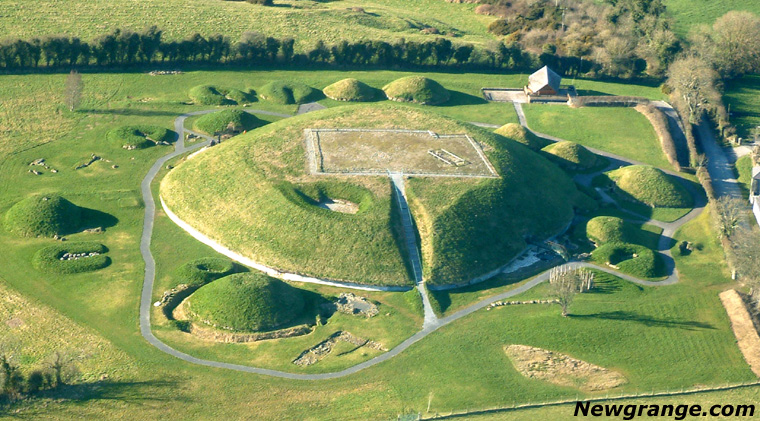 Aerial view of Knowth, the largest passage tomb complex in Brú na Bóinne.
The people of Neolithic Ireland
Neolithic communities were Ireland's first farmers. They raised cattle, sheep and pigs, grew emmer wheat and barley, and used polished stone axes to open woodland for fields and settlement. Pollen records show a clear fall in tree cover and a rise in grasses and herbs from around 4000 BC, the first major human reshaping of the Irish landscape. Farming was not the whole story. Hazelnuts, wild fruits, fish and shellfish still appear in the archaeological record, especially near coasts and rivers, alongside the new agricultural diet.
Population figures for prehistoric Ireland are rough estimates based on settlement density, monument building and dated archaeological activity. For the Mesolithic, most archaeologists envisage a few thousand people at most, with density models often suggesting around 5,000 to 8,000 across the island. For the Neolithic, the evidence points to a population in the tens of thousands, commonly put around 70,000 when farming was well established.
Activity was not steady: radiocarbon records show a strong Early Neolithic rise after farming arrives, then a downturn after about 3500 BC, so numbers would have varied through the period. Much higher peaks proposed from some radiocarbon models remain debated, because they are hard to reconcile with the known settlement evidence.
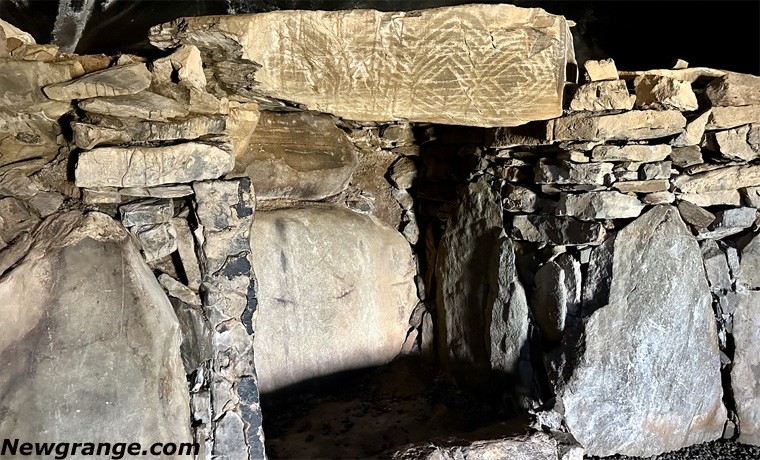 Carved lintel in the chamber at Fourknocks.
Settled life brought more substantial houses. Excavations across Ireland have revealed the remains of many rectangular timber dwellings, often six to eleven metres long, with plank or wattle-and-daub walls, thatched roofs and central hearths. Some sites preserve only one house. Others show small clusters, suggesting varied community sizes. Everyday crafts were largely local: coil-built pottery fired in open fires, flint tools for cutting and scrapers for hide and wood, and later evidence for spinning fibres such as flax.
Polished stone axes were central to clearance and carpentry. Distinctive porcellanite axes from sources in County Antrim, including Tievebulliagh and Rathlin Island, were exchanged widely across Ireland and into Britain. High-quality jadeite axes from Alpine sources also reached Ireland, showing that prestige objects could travel remarkable distances. These were not Celts. Celtic languages and Iron Age cultures belong to much later periods of Irish prehistory.
Ancient DNA indicates that early farmers were genetically distinct from the earlier Mesolithic population and that farming arrived mainly with new people moving through Britain and north-west Europe. The change was not a simple wipe-out. Some hunter-gatherer ancestry appears within Neolithic communities, pointing to a degree of contact and mixing even as farming became dominant. People, ideas and materials continued to move along Atlantic and Irish Sea networks.
 The carved flint mace-head from Knowth, one of the finest portable objects of Neolithic Ireland.
Building monuments such as Newgrange and Knowth required planning, craft skill and the cooperation of large communities. Stones were gathered from local glacial deposits and from more distant sources, while the scale of the tombs shows an impressive ability to organise labour. Recent genetic research also suggests that those buried in the great passage tombs did not simply belong to a single ruling family. For a fuller discussion, see Social and Genetic Relations in Neolithic Ireland.
Types of Neolithic monument
Ireland has one of Europe's richest megalithic landscapes, with more than 1,600 recorded tombs. The main classes of the farming period are court tombs, portal tombs, passage tombs and wedge tombs. These traditions overlap in time rather than forming a neat sequence of separate invasions. Linkardstown-type burials, with a central stone cist under a mound, form another Early to Middle Neolithic funerary tradition, mainly in the east and south-east.
Court tombs
Court tombs are among the earliest megalithic tombs in Ireland and are closely tied to the first farming communities. An open, usually east-facing court leads into a roofed gallery, often divided into chambers and originally covered by a long cairn. They are concentrated in the northern half of the island, especially in the north-west. Cremation was common, and finds typically include early Neolithic pottery and flint tools. Creevykeel in County Sligo is one of the finest surviving examples.
 Creevykeel court tomb, County Sligo, with its open court leading to the burial gallery.
Portal tombs
Portal tombs, often called dolmens, have a massive capstone raised on tall entrance stones that frame a simple chamber. They are especially familiar in folklore as the beds of Diarmuid and Gráinne. Available dates place them among the earlier megalithic monuments in Ireland, and related forms across the Irish Sea point to maritime connections with western Britain. Poulnabrone in County Clare and Proleek beneath the Cooley Mountains are among the best known examples.
 Proleek Dolmen, a Neolithic portal tomb near the Cooley Mountains.
 Poulnabrone portal tomb on the Burren, County Clare.
Passage tombs
Passage tombs have a stone passage leading to a chamber, covered by a round cairn or mound and often edged with kerbstones. Chambers may be simple or cruciform, and many roofs were built by corbelling, overlapping stone courses until the space was closed. Simple passage tombs appear by about 3750 BC at sites such as Carrowmore in County Sligo. Later, more elaborate developed tombs include the great mounds of Brú na Bóinne and the hilltop cemeteries of Loughcrew and Carrowkeel.
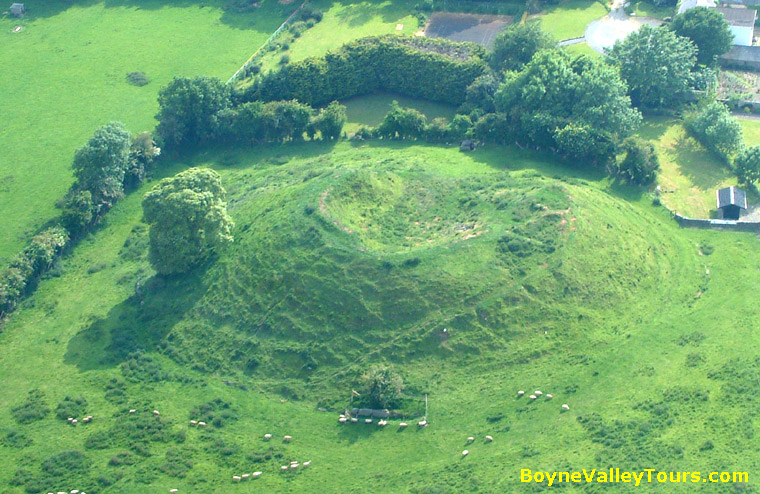 Dowth, the third great passage tomb of Brú na Bóinne.
These monuments were places of burial, ceremony and gathering. Many contain carved megalithic art: spirals, lozenges, chevrons, circles and other geometric motifs. Characteristic finds include coarse decorated pottery of Carrowkeel type, bone or antler pins, pendants, quartz and, in some chambers, large stone basins. At Newgrange, the roof-box above the entrance admits the midwinter sunrise into the chamber, one of the clearest prehistoric solar alignments in Europe.
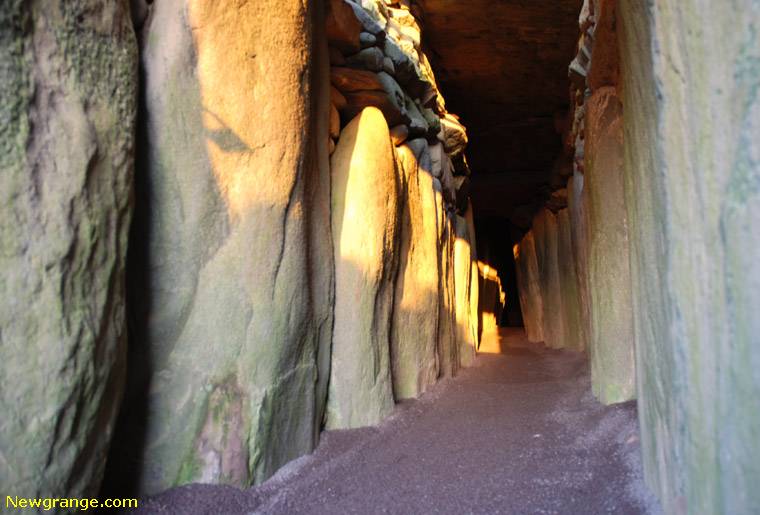 Winter solstice light in the passage at Newgrange.
 Fourknocks passage tomb, County Meath, noted for its chamber carvings.
Wedge tombs
Wedge tombs are the most numerous megalithic tomb type in Ireland, with more than 500 recorded examples. They take their name from a gallery that is usually wider and higher at the entrance and tapers toward the rear, often under a simple cairn, with many entrances facing west or south-west. Most are found in the west and south-west, though examples also occur elsewhere, including beside the portal tomb at Proleek in County Louth. Dating places them mainly around 2500 to 2000 BC, at the end of the Neolithic and the beginning of the Bronze Age, when Beaker pottery and the first metalworking appear in Ireland.
 Proleek wedge tomb, County Louth, close to the better known Proleek Dolmen.
Later Neolithic ceremonial monuments
After the great passage tombs were built, people continued to create ceremonial architecture in earth and timber. In Brú na Bóinne this includes henges, embanked enclosures, timber circles and large palisaded circuits, often linked with Grooved Ware pottery. These monuments show that the Boyne Valley remained a major ritual landscape well after Newgrange and Knowth were completed. For a fuller account of this later phase, see Beyond Newgrange.
 Reconstructed timber circle beside the great mound at Knowth.
Brú na Bóinne and the wider island
Brú na Bóinne, the Bend of the Boyne in County Meath, is Ireland's finest surviving Neolithic landscape and a UNESCO World Heritage Site. The famous passage tombs of Newgrange, Knowth and Dowth stand among numerous smaller satellite tombs, while aerial photography and LiDAR continue to reveal henges, timber circles and other ceremonial monuments hidden beneath the surrounding fields. Visitors today usually begin at the Brú na Bóinne Visitor Centre.
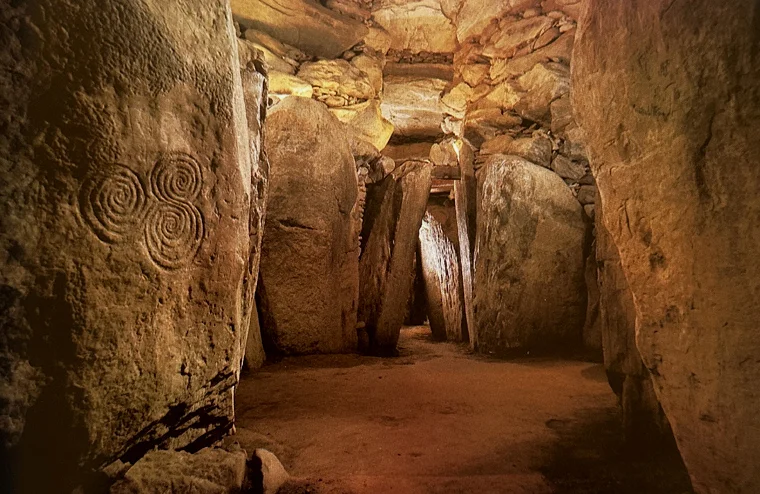 The triple spiral carving inside the chamber at Newgrange.
Important Neolithic cemeteries also survive elsewhere: Loughcrew on the hills of Meath, Carrowmore and Carrowkeel in Sligo, Fourknocks near the coast, and many court, portal and wedge tombs across the island. Sites such as the Céide Fields show that farming landscapes could be organised on a large scale far beyond the Boyne Valley. Together these places reveal that Neolithic Ireland was a network of farming communities linked by shared beliefs, engineering skill and long-distance exchange, whose monuments have survived for more than five thousand years.