A Pocket Guide to Newgrange and the Boyne Valley
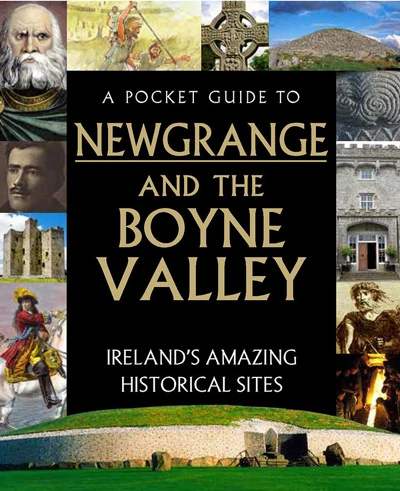
Older than Stonehenge, older than the Pyramids, Newgrange in Co. Meath was built over 5,000 years ago. This remarkable Neolithic structure by the legendary River Boyne has fascinated visitors for millennia, but became a significant tourist site after its excavation and partial reconstruction by archaeologist Michael J. O'Kelly in the 1960s and 70s.
Regarded as Ireland's greatest national monument, Newgrange has entered Irish mythology through its associations with ancient deities, and today it continues to fascinate archaeologists and visitors alike. A Pocket Guide to Newgrange and the Boyne Valley contains everything you need to know about one of Ireland's most significant historical landmarks.
Purchase at Amazon.com or Amazon.co.uk
Over the centuries, the burial mounds gradually disappeared into the undergrowth and were forgotten. However, their location, the Boyne Valley, has played an important role in Irish history and mythology. The setting for some of the country's most vivid Celtic legends, the Boyne Valley was also significant when Christianity came to Ireland in the fifth century. At that time, this area was included in the kingdom of Brega, whose kings referred to themselves as Rí Cogba, Kings of Knowth.
When St Patrick returned to Ireland, he is believed to have landed at the mouth of the Boyne at Drogheda, and there is speculation that his famous Paschal fire, reputed to have been lit on the Hill of Slane, may in fact have been located at Knowth. The legend of St Patrick and the shamrock is also centred on the Hill of Slane. It is there that the saint is said to have plucked a shamrock to explain the Trinity to Christian converts, after which the whole hill was covered in shamrock.
The arrival of Christianity brought large monastic foundations which, in turn, became repositories of great wealth, ripe for plunder by Viking and native Irish raiders. Some of these forces were large. In 837, at least 120 Viking ships were recorded on the Rivers Liffey and Boyne.
In the middle of the 12th century, Christianity began to have a strong effect on the local landscape, especially with the establishment of the large Cistercian foundation of Mellifont, near Drogheda in County Louth, just north of the Boyne Valley. The Cistercians would eventually control much of the land in Brú na Bóinne, where they founded Bective Abbey. The monks were enthusiastic agriculturalists and were known for creating farms, or "granges", in outlying areas of their extensive landholdings, and this gave Newgrange its name.
By the late 12th century, when the Anglo-Normans arrived in Ireland, Knowth was in the middle of a Cistercian farm. The Cistercians were not alone in bringing Christian influence to the Boyne Valley. In 1180, the Augustinian order established a priory at Duleek, also near Drogheda, on the site of an earlier abbey where King Brian Ború lay in state after his death at the Battle of Clontarf in 1014, a battle in which the Vikings suffered a heavy defeat. At the end of the 12th century, the Anglo-Normans built a church dedicated to St David at Dowth. It has since been replaced by a 14th to 15th century structure, and the site was later gifted to the Augustinians.
A relentless campaign by the native Irish against the Anglo-Norman settlers led to the creation in 1488 to 1489 of the Pale, a large area centred on Dublin and including parts of Louth, Meath and Kildare. It extended from Castle Roche in the north, about 10 kilometres north-west of Dundalk, to Carrickmines Castle in the south, on the border between Counties Dublin and Wicklow. Its northern and western borders were broadly defined by the course of the River Boyne. The Pale was protected by fortified ditches and ramparts, augmented with defensive tower houses, which shielded the resident population from attack. Brú na Bóinne was located n the middle of the Pale, with two fortified tower houses at Dowth.
With the Protestant Reformation in the 16th century came the dissolution of the monasteries and the establishment of a military administration at Dublin Castle. Although the confiscation of church lands was not as widespread within the Pale as in other areas of Ireland, and some Catholic landowners did manage to retain their estates, the lands of Mellifont Abbey, including those at Knowth and Newgrange, were seized by the Crown and granted to the Protestant Moore family.