Newgrange FAQ
Newgrange is one of Ireland’s most important prehistoric monuments and a key site within the Brú na Bóinne UNESCO World Heritage landscape. Below are quick answers to common questions about visiting, tickets, the winter solstice, and what archaeology has revealed.
What is Newgrange?
Newgrange is a large Neolithic passage tomb built around 3200 BC. The monument takes the form of a great circular grass-covered mound, constructed from earth and stone and edged by large kerbstones. A stone passage runs from the entrance to the heart of the monument, measuring about 19 metres (62 feet) in length, and leads to a cruciform inner chamber with a corbelled roof that still remains watertight today.
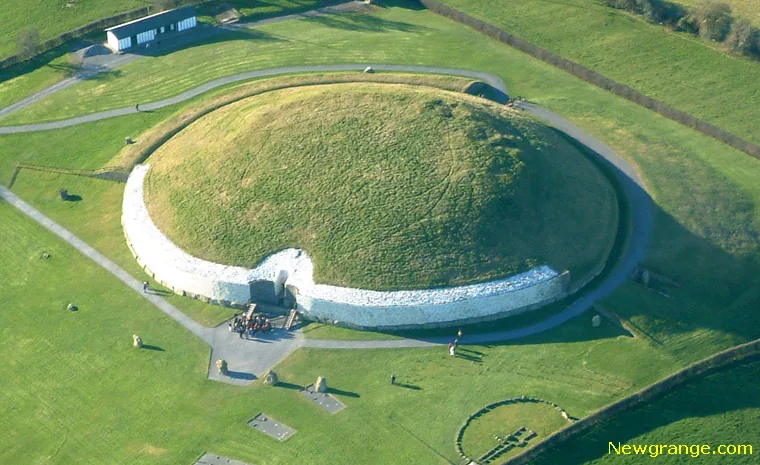 Newgrange Stone Age Tomb | UNESCO World Heritage Site.
Who built Newgrange?
Newgrange was built by Neolithic farming communities who lived in the Boyne Valley. They were skilled builders and artists, and the monument’s scale suggests careful planning and strong social organisation.
Has Newgrange always looked the way it does today?
The mound was excavated and restored in the 1960s and 1970s. While the kerbstones and internal structure are original, the white quartz façade is a modern reconstruction based on how the monument may have appeared in prehistory.
Where is Newgrange located?
Newgrange is in County Meath, within the Brú na Bóinne landscape. For maps and travel guidance, see Directions. There is no direct access at the monument itself. All visits are managed through the Brú na Bóinne Visitor Centre.
Do I need tickets to visit Newgrange?
Yes. Access to Newgrange is through the Brú na Bóinne Visitor Centre and entry to Newgrange is by guided tour. Purchase tickets Online.
Can I prebook?
Pre-booking is essential as numbers are limited. Tickets can sell out quickly, especially in peak season.
To check availability and book tickets, go to Online Booking.
When do tickets go on sale online?
Online booking opens in advance on a rolling window, depending on the time of year:
1st January to 31st March: online booking available 7 days in advance only.
1st April to 1st November: online booking available 30 days in advance only.
2nd November to 31st December: online booking available 7 days in advance only.
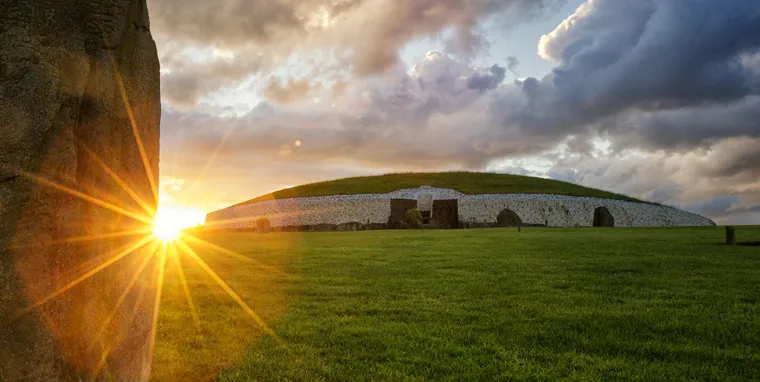 Newgrange UNESCO World Heritage Site.
Schedule and tour options
Winter Schedule: November to February. The Newgrange Tour + Exhibition is the only tour option during this period and it includes access inside the chamber at Newgrange.
From 1st March to 1st November the main option is the Brú na Bóinne Tour + Newgrange Chamber, which includes Knowth. Knowth is closed in winter.
What is included in the tours?
Newgrange Tour + Exhibition: A guided tour of Newgrange including chamber access, plus the exhibition in the Visitor Centre. Knowth is not included. Duration is approximately 2 hours.
What is the running order of the tours?
All tours begin at Brú na Bóinne Visitor Centre. The time you booked online is the time you are expected in the Visitor Centre.
The first part of the visit is the self-guided exhibition. Approximately 30 minutes has been allocated in the Visitor Centre and then you are brought via shuttle bus to Newgrange or Knowth and Newgrange, depending on the tour type. The Newgrange guided tour includes the chamber.
Do infants and children need tickets?
Yes. Children aged 11 and under are free, but they still need a ticket and must be included in the online booking.
There is an option during the booking process to include Free under 12s. Failure to include children may result in you not being permitted on tours.
Children aged 12 to 17 are charged at the child rate. Unaccompanied minors (under 18) will not gain admission.
How do bookings work for 14 tickets or fewer?
For 14 tickets or fewer, all visitors must be booked online, including infants and children.
How do bookings work for group sizes of 15 to 30 people?
For bulk group ticketing (15 to 30 people), you must request group booking by email through the Visitor Centre. Groups cannot use the online booking system.
How do I understand the online booking colours?
If the date or time shows in blue: this tour is available to book. The number of tickets remaining on the tour is shown in brackets.
If the date or time shows in red: this tour is booked out.
If the date shows in white: this is not available to book, either because the tour is not operating that date or it is outside the booking window.
It shows sold out. Can I still visit or are there walk-in tickets?
All monument tickets are made available for online booking. If it shows sold out, there are no tickets available.
The Visitor Centre does not take a waitlist for cancellations. When cancellations do occur, they are released back online again. This can happen at any stage, but it is worth checking between 8:30am and 9:30am.
You can also visit the Visitor Centre exhibition only. The doors open at 9:00am, or at 9:30am in March, April and October, and exhibition tickets can be purchased on arrival.
Sometimes tours to the outside of Newgrange (no chamber access) operate on the day. These are organised on the day, cannot be pre-booked, and are sold first come, first served.
Do you have walk-in tickets on the day?
Walk-in tickets are available for the Visitor Centre exhibition daily. The doors open at 9:00am, or at 9:30am in March, April and October, and tickets can be purchased on arrival.
Do you take waitlists for cancellations?
No. The Visitor Centre does not take a waitlist for cancellations. If cancellations occur, they are released back online. This can happen at any stage, but it is worth checking between 8:30am and 9:30am.
I need to cancel or reschedule my online booking
Online tickets are non-transferable.
However, if you re-book the new preferred available date or time and email the Visitor Centre with the new booking reference and the original booking reference, a refund can be issued to the card used for the original payment.
A refund will only be issued if the Visitor Centre is contacted with the above information before the tour time has passed, in order to resell the tickets to other visitors.
I need to add extra people to my online booking
You need to book additional tickets online for the extra number of people required, including infants and children.
If there is not enough space on the tour, you need to rebook for a new time with the total number of tickets required. Then email the new booking reference and the original booking reference to request a refund for the original booking.
A refund will only be issued if the Visitor Centre is contacted before the tour time has passed, in order to resell the tickets to other visitors.
How can I book with an OPW Heritage Card, English Heritage, or Friends of Manx National Heritage?
You can book online by selecting the appropriate option at the end of the price choices.
On arrival, you show your card to staff on duty. You can also purchase an OPW Heritage Card at reception.
When are refunds possible?
Online tickets are non-transferable or refundable as per the terms and conditions agreed at the time of booking.
In certain circumstances refunds are permitted, including where tickets can be resold. Refunds will not be processed once the time of the tour has passed, for late arrivals, or for uncollected tickets.
Can I store my luggage at the Visitor Centre?
There is no luggage storage facility at Brú na Bóinne Visitor Centre.
I would like to go on my own. Why do I have to take a tour?
All access to Newgrange and Knowth is through Brú na Bóinne Visitor Centre and is by guided tour only. The primary purpose is to manage the flow and high volume of visitors, as the monuments are old and vulnerable.
The guides help preserve the monuments, create awareness of the importance of Ireland’s ancient heritage, and enhance visitor understanding of Brú na Bóinne.
There is a park-and-ride system in operation from the Visitor Centre to the monuments. Visitor numbers are limited on the shuttle buses and tickets need to be pre-booked online. This rewards visitors with a tranquil, almost unspoilt environment, while protecting the monuments and preserving their setting in the World Heritage landscape.
Can I visit Newgrange without going inside?
Access is controlled to protect the monument. The only access to Newgrange is on a guided tour from the Visitor Centre, and it includes going inside the chamber.
How long does a visit take?
About 2 hours for a visit to Newgrange and about 3 hours to visit Newgrange and Knowth. This includes time at the exhibition in the Visitor Centre.
Is Newgrange suitable for children?
Yes, many families visit Newgrange. The passage is narrow and the chamber is dimly lit, so it is helpful to prepare children for a short enclosed space and to follow the guide’s instructions at all times.
Is Newgrange accessible?
The passage and chamber have uneven surfaces and limited space, so access inside is not suitable for everyone. The Visitor Centre can advise on current arrangements and alternatives. See contact information.
What is special about the winter solstice at Newgrange?
Around the winter solstice, sunrise light enters a roof box above the entrance and reaches the chamber floor for a short period, but only on sunny mornings. Learn more on Winter Solstice.
Why is the roof box important?
The roof box is a specially constructed opening above the entrance that lets sunlight enter the passage at midwinter. Its precision and durability show remarkable planning and engineering for a monument built over 5,000 years ago.
Can visitors see the winter solstice illumination?
Places inside the chamber during the solstice period are extremely limited and are allocated by lottery. Each person drawn can bring a guest. Everyone is welcome to gather outside the entrance to the Newgrange mound on the mornings of 19th to 23rd December inclusive. See more information.
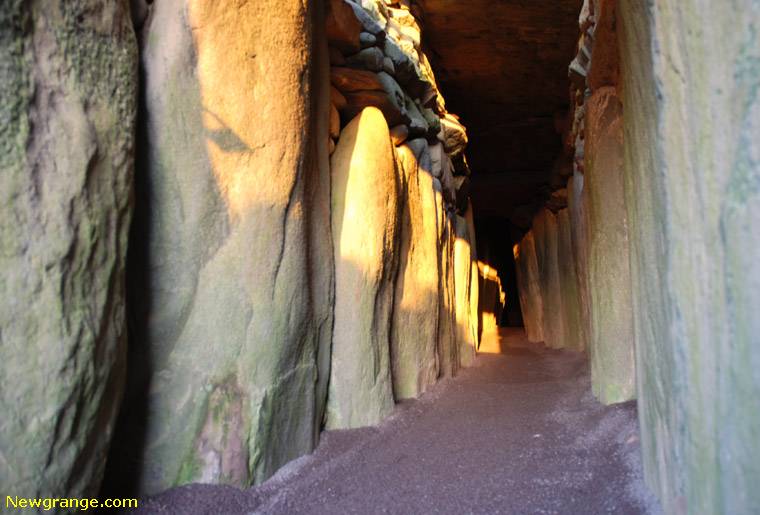 Winter Solstice Illumination at Newgrange.
How can I be in the chamber during the winter solstice at Newgrange?
Each year there is a lottery draw to be in the chamber at Newgrange for sunrise on the winter solstice mornings. The dates are 19th to 23rd December inclusive. Each person drawn can bring a guest.
To enter the winter solstice lottery, complete the online application form on the solstice lottery page.
Was Newgrange built before Stonehenge?
Yes. Newgrange was built around 3200 BC, making it older than Stonehenge and older than the Great Pyramid of Giza.
Is Newgrange older than the pyramids?
Newgrange was built around 3200 BC, which is earlier than the Great Pyramid of Giza. This is one way to put its age and engineering achievement into context.
What has archaeology found inside Newgrange?
Excavations identified cremated human remains and other evidence that Newgrange was used as a tomb, as well as a ceremonial monument. The structure, alignment, and art show careful planning and skilled stonework.
Was Newgrange used only as a tomb?
No. While it was used for burial, the monument’s scale, art, and winter solstice alignment suggest it also served as an important ceremonial and seasonal gathering place.
How many people were buried in Newgrange?
Excavations found the cremated remains of a relatively small number of individuals, suggesting burial was selective and symbolic rather than for a large population.
What is megalithic art?
Megalithic art is the abstract carving found on stones at monuments like Newgrange, Knowth, and Dowth. Motifs include spirals, circles, arcs, and lozenges. The entrance stone at Newgrange is a good example of megalithic art.
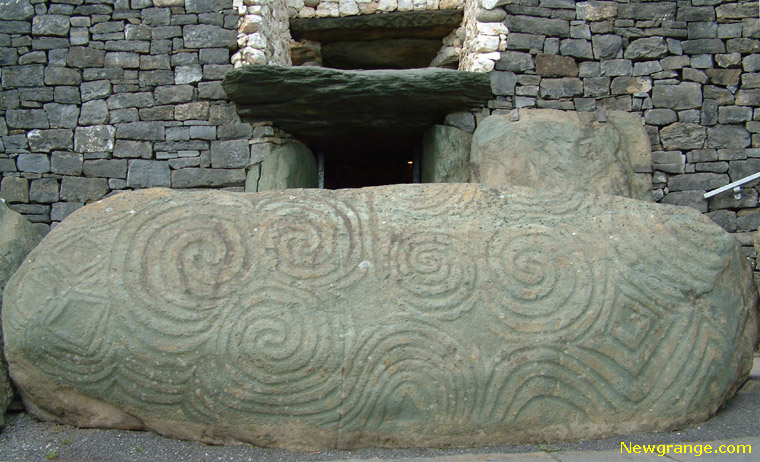 Megalithic Art on Newgrange Kerbstone K1 - The Entrance Stone.
What are Knowth and Dowth?
Knowth and Dowth are major related passage tombs in the same landscape. Together they help show that Newgrange was part of a much larger ceremonial complex.
Is Newgrange aligned only to the winter solstice sunrise?
Yes, Newgrange is aligned only with the winter solstice sunrise, while Dowth is aligned with the winter solstice sunset, and Knowth is aligned with the equinoxes. Taken together, these monuments point to a wider seasonal and ceremonial framework across the landscape rather than a single, isolated alignment.
Where can I find further reading?
Start with Books and Articles for accessible background and detailed discussions. For the tri-spiral motif featured in the Newgrange chamber, see Tri-Spiral.
This FAQ is intended as a helpful guide for visitors. Ticketing and access arrangements can change, so always confirm details at Heritage Ireland.