Newgrange Tri-Spiral
The tri-spiral is carved on orthostat C10, on the right-hand side of the end recess in the chamber at Newgrange. It is one of the best-known carvings in Irish megalithic art. It is also called a three-spiral, a triple spiral, a triskele or a triskelion. The design is Neolithic, and it predates the arrival of the Celts in Ireland by about 2,500 years.
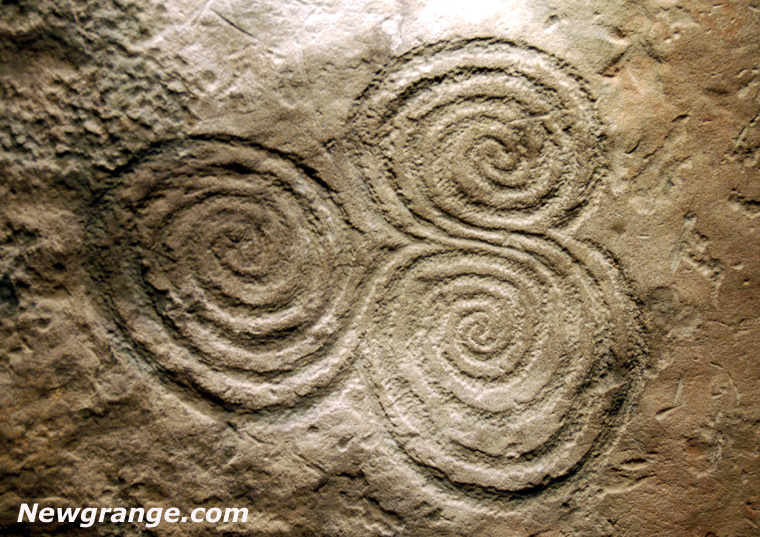 Newgrange Tri-Spiral - Iconic symbol of Irish Stone Age Art.
The design
Claire O'Kelly called this carving a three-spiral. Each of the three spirals is a pair of parallel coils, the same arrangement as a double spiral on the entrance stone. The two spirals on the right turn back on themselves. The outer coil of the left-hand spiral is opened so that it runs around the other two and meets again. The lines are picked in broad, shallow channels, and the bands between them stand proud.
The motif measures about 30 by 28 cm (12 by 11 inches), less than one-third the size of the tri-spiral on the entrance stone. The spirals on that kerbstone are laid out differently.
Pick-dressing
The tri-spiral was cut on a part of the face that was largely left undressed. Much of the rest of orthostat C10 is covered with pick-dressing, produced by repeatedly striking the stone with a pointed stone tool. That later dressing extends towards the left of the design and takes in a little of its edge. The rest of the spirals were left standing. The southern face carries a smaller spiral and an oval.
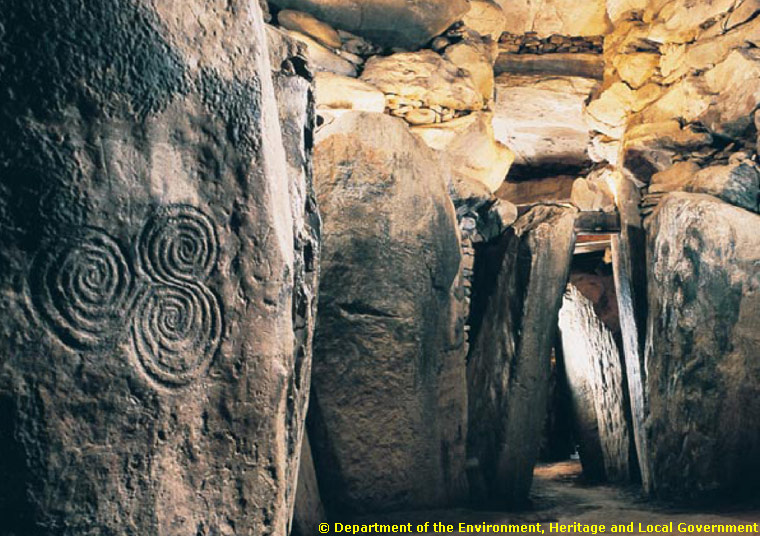 Newgrange Chamber showing the famous Tri-Spiral engraving.
Prof. Michael J. O'Kelly excavated and restored Newgrange between 1962 and 1975. The excavation is published in Newgrange: Archaeology, Art and Legend.
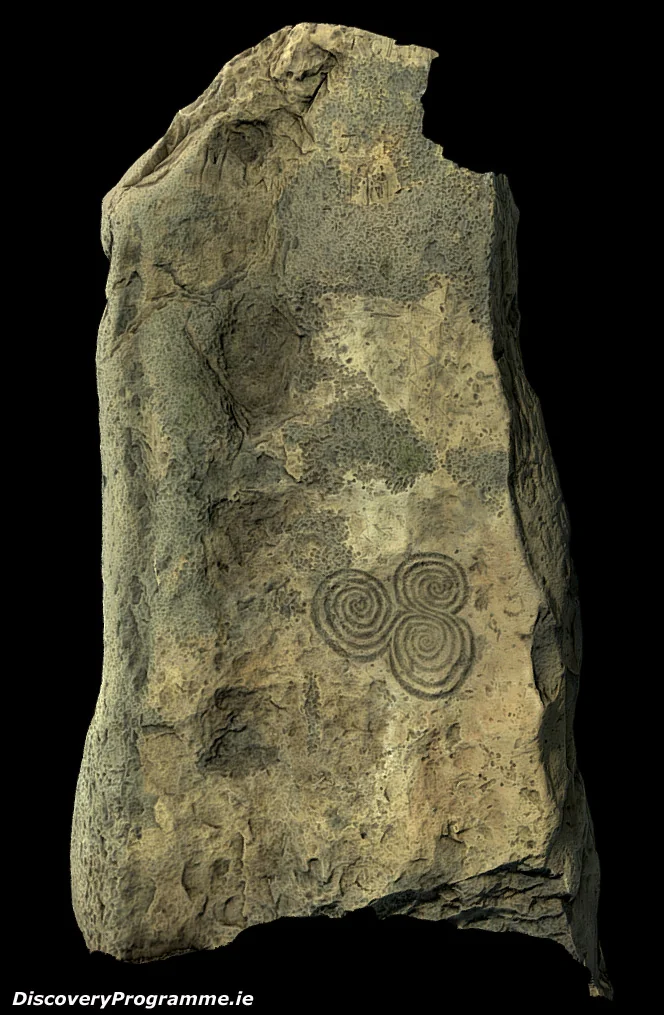 Orthostat C10 in the Discovery Programme model.
What the Newgrange tri-spiral means
The meaning of the tri-spiral is not known. The carving is more than 5,000 years old, and Claire O'Kelly's account describes the motif without giving it a meaning. She recorded a local belief that the rising sun used to light this stone in the end recess. Michael J. O'Kelly took that account seriously enough to test it. He doubted that the sun reached the carving, and the passage faces southeast, so he watched the winter solstice sunrise. On 21 December 1969 a beam came through the roof-box, crossed the chamber floor and reached the front edge of the basin stone in the end recess. C10 stands on the right-hand side of the recess, out of the path of that beam, and the carving shows in light reflected from the floor. He left the meaning of the carving open.
Later writers have offered interpretations. Some take the three arms as life, death and rebirth, or as the turning of the seasons. Others treat the number three as past, present and future, or as birth, life and death. Because the carving is in a passage tomb, it has also been linked with burial and with ideas about the dead. The excavation recovered cremated human bone, so the mound was used for the dead. The bone does not explain the carving.
Those interpretations were made long after the stone was cut. There is no Neolithic account of the tri-spiral, and nothing in the excavation record fixes a meaning. The Celtic triskelion is a much later symbol, and the meanings attached to it belong to that later tradition, some 2,500 years after this carving.