Newgrange Kerbstone K1 - The Entrance Stone
Kerbstone K1 at Newgrange is the first stone encountered at the entrance to the monument and is widely regarded as one of the most important pieces of megalithic art in Ireland. Positioned beneath the roof-box and aligned with the passage, it forms a visual and symbolic threshold between the outer world and the interior chamber. The stone’s location was clearly deliberate, marking the point of transition into a carefully constructed ceremonial space.
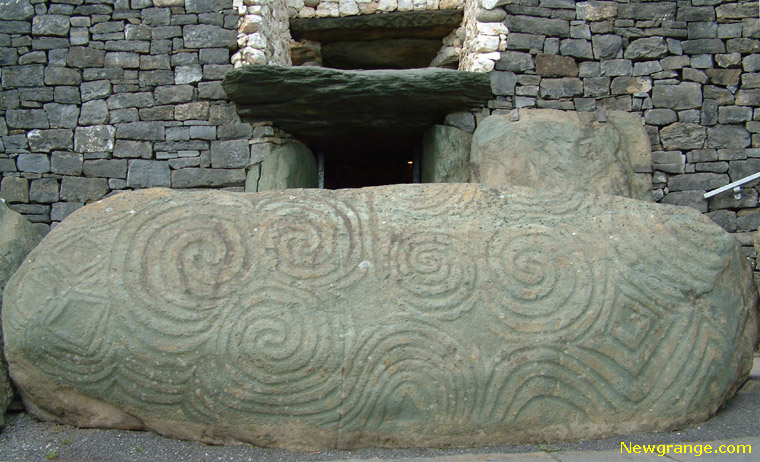 Newgrange Kerbstone K1 - The Entrance Stone.
The decoration on K1 is dominated by large, deeply carved spirals, accompanied by arcs and curvilinear motifs. These designs are part of the broader artistic tradition associated with passage tombs across Ireland, particularly in the Boyne Valley. The spirals are executed with remarkable confidence and precision, suggesting that the carvers were highly skilled and that the motifs carried specific meaning, even if that meaning is no longer fully understood today.
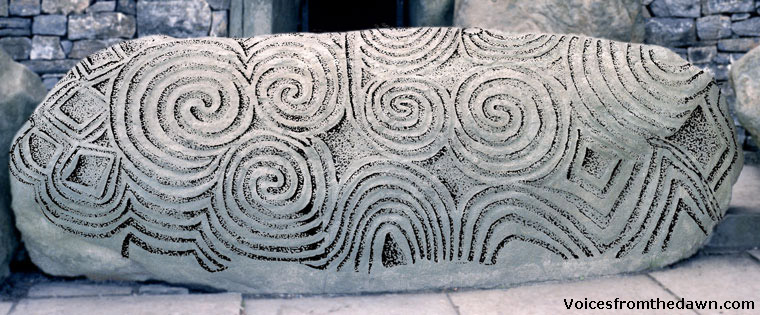 Newgrange Entrance Stone K1 with graphic overlay by Voicesfromthedawn.com.
Many researchers have noted that the position of K1 beneath the roof-box may not be accidental. At sunrise around the winter solstice, sunlight enters the passage through the roof-box and travels inward to illuminate the chamber. Some scholars have suggested that the spiral motifs on K1 could symbolise movement, cycles, or the journey from darkness to light, echoing the solar event that occurs each year. While such interpretations remain speculative, the alignment of architecture and art at this point is striking.
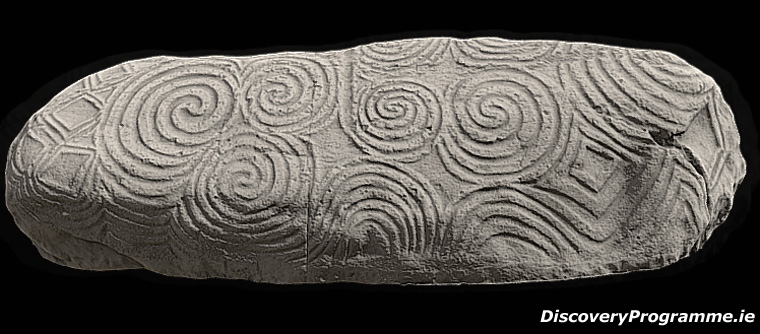 Digitised image of Newgrange entrance kerbstone by The Discovery Programme.
Kerbstone K1 can also be considered in the wider context of the decorated kerb at Newgrange, where ninety seven stones form a continuous boundary around the mound. Only some of these stones are decorated, which makes the presence of elaborate carvings on K1 even more significant. Its placement at the entrance, combined with its bold and highly visible motifs, indicates that it was intended to be seen and perhaps to communicate something important to those approaching the tomb.
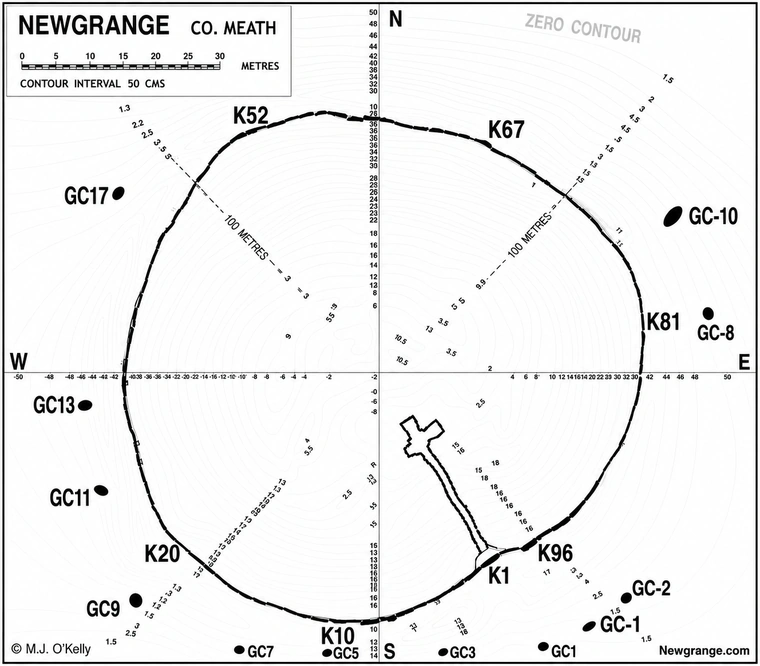 Plan of Newgrange Mound adapted from Newgrange - Archaeology, Art and Legend.
Newgrange | Brú na Bóinne
Newgrange is a prehistoric monument located in the Boyne Valley within Ireland's Ancient East, and is part of the Brú na Bóinne archaeological complex. Constructed around 3200 BCE, it is a large circular mound with a passageway leading to a central chamber. Newgrange is renowned for its winter solstice phenomenon, where sunlight penetrates the passage and illuminates the inner chamber, demonstrating an ancient understanding of astronomy.
Brú na Bóinne encompasses several prehistoric monuments, with Newgrange and Knowth being the most prominent. Brú na Bóinne is recognised as a UNESCO World Heritage Site, reflecting its importance in understanding the Neolithic period and the development of ancient Ireland.
Kerbstones are large stones that form a ring around the base of passage tombs in Ireland, and they are a distinctive feature of sites like Newgrange and Knowth. Many of the kerbstones, particularly at Knowth, are adorned with intricate megalithic art, featuring geometric patterns, spirals, and symbols.