A Pocket History of Ireland
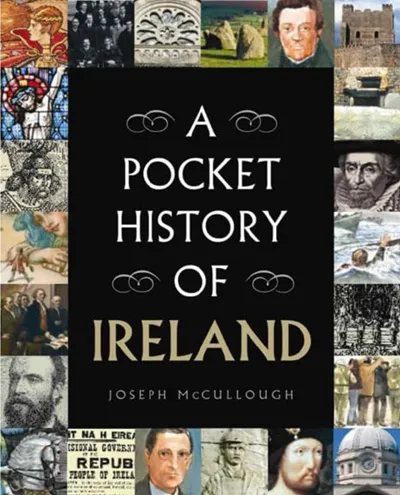
Encompassing stories of some of Ireland’s best known characters as well as key moments in Ireland’s past, this pocket history recalls the country’s struggles through dark times, its successes, its people and places. The wealth of Irish culture and tradition is described as well as the key events and people that have shaped the country today.
From prehistoric times to the present day this comprehensive history presents the story of Ireland in bite-size chunks. With illustrations throughout this is an attractive and practical guide to Ireland`s colourful history.
Purchase at Amazon.com or Amazon.co.uk
The Celts
Along with their iron-based technology, the Celts brought a new culture to Ireland which, over the ensuing centuries, would evolve into the traditional Gaelic way of life. According to the Ancient Greeks, the people living in the Alpine regions to the north were Keltoi, meaning barbarians; however, history now remembers these Celtic barbarians as the dominant power in Western Europe in the early Iron Age.
Around 1,200 BC, the Celts began a massive expansion which took them into Ireland. Traditionally, historians placed the Celtic invasion of Ireland around 500 BC, but modern archaeology suggests that a slow migration is the more likely scenario. The first Celts to arrive in Ireland are thought to have come from the Iberian Peninsula and settled in the south and the west. They spoke a language called Q-Celtic.
Over the following centuries these Celts mixed with the earlier inhabitants, slowly absorbing some of their language and culture. This linguistic evolution resulted in Irish Gaelic, the language that came to dominate the entire island. This language and its accompanying culture would eventually create a divide between the Irish Celts and those in the rest of Europe.
At some point, the Irish adopted the term Gaels in order to distinguish themselves from foreigners. This word may derive from the Welsh term for Irishman, Gwyddel, itself derived from the word for wild or savage. According to Irish legend, Gael comes from Gaedheal Glas, a grandson of the Biblical Noah, who created the Irish language.
Celtic Society
The Celts settled in small farming groups based around the family unit called the gelfhine. This consisted of all the male descendants of a common grandfather. Women became members of their husband's gelfhine. In times of crisis, a larger group, the derbfhine, would gather. Composed of the male descendants of a common great-grandfather, the derbhine was the basic legal unit of Celtic society. Property belonged to the derbhine rather than to one individual.
Several hundred years after the Q-Celtic people arrived, another group of Celts came from Britain and settled in the North. Although culturally similar, these new people had made several advances, most notably in artwork. Unlike most European art, Celtic artwork made little attempt at realistic depiction. Instead it drew inspiration from the natural world to create intricate geometric patterns.
This early art later developed into the maze-like tangles seen on Celtic crosses and jewellery. The Celts often displayed their artwork on jewellery such as torques, but it also adorned weaponry, where it may have served a heraldic or religious purpose. Eventually, the dominant Q-Celtic in the south absorbed these newcomers, adopting their cultural advancements, but supplanting their language.
According to archaeological record, the Celts arrived in Ireland gradually, and not as part of any invasion or mass migration. It is unlikely that the Celts ever outnumbered the Bronze Age Irish. But, perhaps because of the superiority of their iron-based technology or because of the close organisation of their family units, their culture came to dominate the entire island, and brought all the inhabitants together into a Gaelic whole.