Knowth and Brú na Bóinne
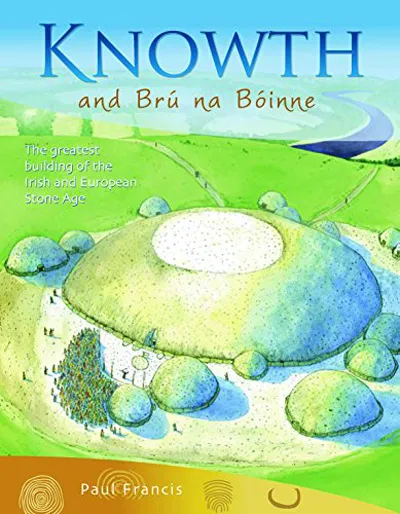
Knowth and Brú na Bóinne from the Irish Built Heritage Series by Paul Francis is a clear and accessible introduction rather than an academic study. Aimed at general readers and visitors, it places strong emphasis on illustrations and visual explanation, making it easy to understand the site and its wider context within the Boyne Valley.
Its main strengths lie in its readability, concise presentation, and useful visual content. It provides a helpful overview of Knowth, covering key themes such as passage tomb construction, archaeology, and the significance of the monument.
Purchase at Amazon.com or Amazon.co.uk
Built over five thousand years ago in the Neolithic (New Stone Age), Knowth was, for several hundred years, the greatest building in the world and, for four thousand years, the largest building in Ireland. Bigger than, and every bit as complex as, its more famous neighbour Newgrange, Knowth served as a burial place, a temple, and a statement in stone of the religious energy of the Neolithic people who built it.
Five hundred years after it was completed, the Neolithic people and their culture were gone. Knowth, however, was reborn again and again as a home, a fort, and a burial place. It has been, at one time or another, the residence of the High King of Ireland, the target of a Viking fleet, a Norman stronghold, and a major European battleground. In modern times, it has also been the site of the largest archaeological excavation ever to take place in Ireland.
Today, over five thousand years after Knowth was built, it has once again taken its rightful place among the great monuments of the world.
Knowth Through the Millennia
Knowth was constructed in the Neolithic period, broadly contemporary with Newgrange, around 3200 BC. While its great mound and passage tomb belong to this early prehistoric phase, the site did not fall out of use. There is evidence for later activity in the Bronze Age and Iron Age, followed by significant settlement during the Early Christian period, when the mound was reused as an enclosed settlement, with houses and souterrains built on and around it. In the Norman period, Knowth became the site of a motte, further demonstrating its continued strategic importance.
This long sequence of occupation reflects Knowth’s enduring importance within the landscape. The illustrations from Knowth and Brú na Bóinne by Paul Francis help to visualise how the site may have appeared across the millennia, from its origins as a Neolithic ceremonial centre to its later roles in early medieval and medieval life.
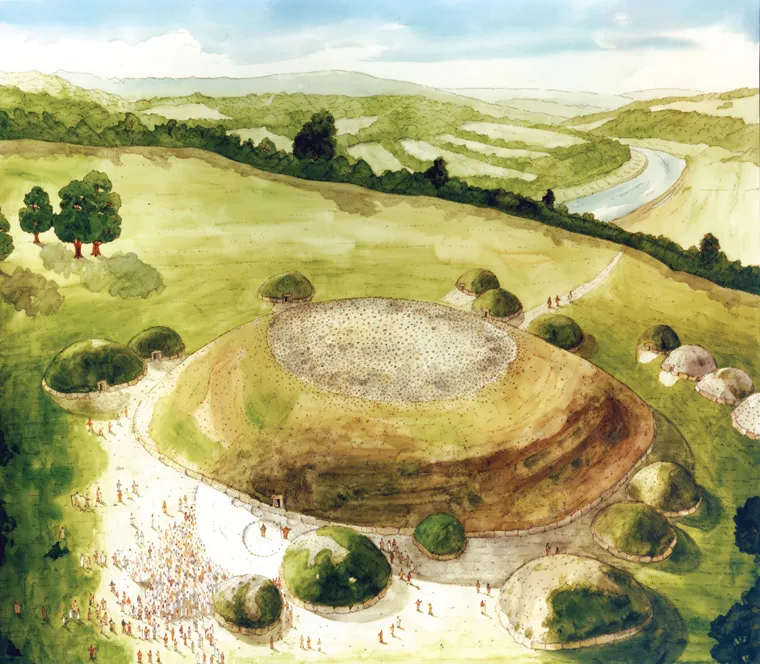 Neolithic Knowth, circa 3000–2000 BC | Illustration by Paul Francis from Knowth and Brú na Bóinne.
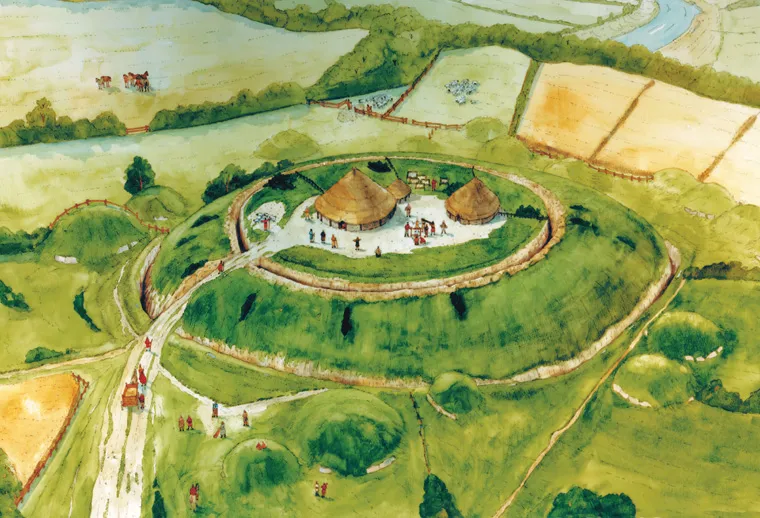 Iron Age Knowth, early centuries CE | Illustration by Paul Francis from Knowth and Brú na Bóinne.
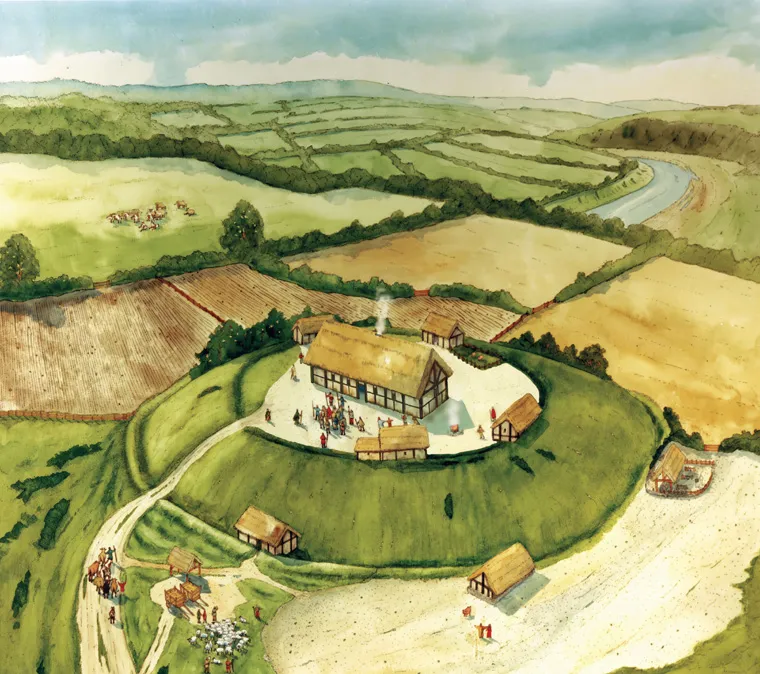 Early Christian Knowth, 8th to 12th century CE | Illustration by Paul Francis from Knowth and Brú na Bóinne.
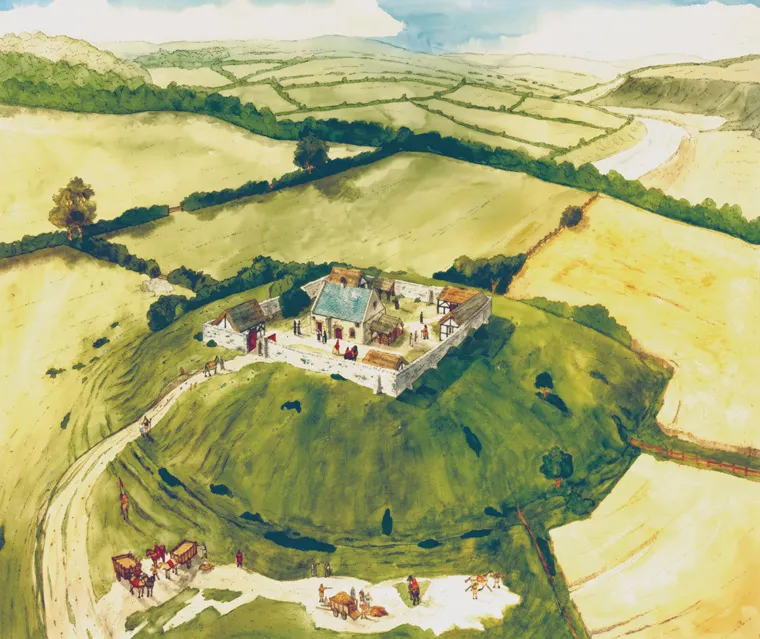 Norman Knowth, 12th to 14th century CE | Illustration by Paul Francis from Knowth and Brú na Bóinne.
Knowth and the Landscape of Brú na Bóinne
About 15km before the River Boyne enters the Irish Sea on the east coast of Ireland, it is forced to turn south by a ridge of high ground. The river slowly returns to its original eastward course in a great curve or bend. The Boyne is joined by another smaller river, the Mattock, which flows into it at about this point. This is Brú na Bóinne, or in English, the Palace of the Boyne, 780 hectares in area, surrounded and protected on nearly all sides by water.
People living in the Neolithic Age (New Stone Age), over 5,000 years ago, chose Brú na Bóinne to be a place of special religious significance. They built, over many generations, the three great monuments of Knowth, Dowth and Newgrange.
Located on the three highest points in Brú na Bóinne, the mounds (tumuli) were meant to be seen from the river and dominate the surrounding landscape. By the time they were completed (3000 BC) they were the greatest buildings in the ancient world.
The rituals and festivals associated with the three monuments have long been forgotten, but enough cremated bone and artefacts remained in their chambers for archaeologists excavating in modern times to define them as tombs, although they had many other purposes, such as focal points for the community and markers of wealth and territory.
Today, Brú na Bóinne is a UNESCO World Heritage Site, protected and managed by the Irish state. At its heart are the three great tombs of Knowth, Dowth and Newgrange, but modern archaeology has discovered many other ritual sites in the landscape of Brú na Bóinne, including over 40 smaller ‘satellite’ passage tombs, several henge features, a cursus (thought to be a processional route), and numerous other monuments built in other eras, such as ringforts, monastic settlements and medieval castles.