Beyond Newgrange: Brú na Bóinne in the later Neolithic
Based on research by Stephen Davis and Knut Rassmann published in the Proceedings of the Prehistoric Society (2021), Download the full PDF.
Newgrange, Knowth and Dowth are the best known monuments in Brú na Bóinne, but they were only part of a much larger ceremonial landscape. Recent aerial photography, LiDAR survey and geophysical research have revealed a remarkable range of later Neolithic monuments spread across the fertile ground between Newgrange and the River Boyne. These discoveries show that activity in the Boyne Valley did not end with the construction of the great passage tombs. Instead, communities continued to reshape the landscape with henges, timber structures, palisaded enclosures and processional avenues.
The picture that is now emerging is of a complex sacred landscape in which older monuments remained important while new forms of ceremonial architecture appeared. Much of this later activity only became visible through modern survey techniques, especially during the dry summer of 2018 when buried features showed clearly as cropmarks. Together these discoveries greatly expand our understanding of prehistoric Brú na Bóinne and its importance within Neolithic Europe.
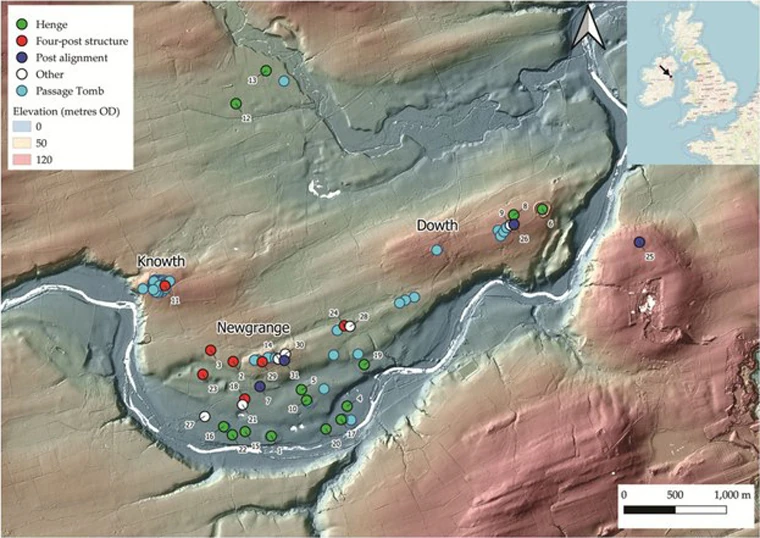 LiDAR survey map of Brú na Bóinne showing Newgrange, Knowth, Dowth and newly discovered later Neolithic monuments in the Boyne Valley.
A Broader View of Brú na Bóinne
Brú na Bóinne occupies a great bend in the River Boyne in County Meath and is one of the most important prehistoric landscapes in Europe. The great developed passage tombs of Newgrange, Knowth and Dowth were built toward the end of the fourth millennium BC and remain the most visible symbols of the World Heritage Site. Yet the archaeological evidence now shows that the area around these tombs continued to be developed in the following centuries, especially during the later Neolithic.
Research discussed in the study Beyond Newgrange: Brú na Bóinne in the later Neolithic highlights how non-invasive survey methods have transformed knowledge of the site. Large scale geomagnetic survey, LiDAR analysis and aerial photography have identified previously unknown ceremonial enclosures and timber monuments, particularly in the landscape between Newgrange and the River Boyne.
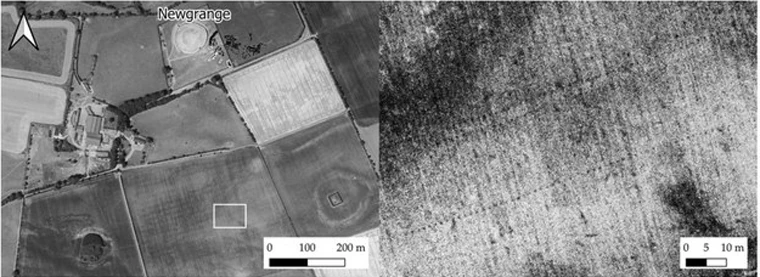 Aerial archaeological image of the Newgrange area in the Boyne Valley showing the wider ceremonial landscape around the famous passage tomb.
Henges, Enclosures and Sacred Space
One of the most important classes of monument revealed by recent work is the henge or embanked enclosure. In Brú na Bóinne these monuments usually survive as low circular earthworks or cropmarks and were not defensive structures. Instead, they seem to have defined special spaces for ceremony, gathering and movement within the landscape.
Sites such as Dowth Henge, Site P near Newgrange and other newly recognised enclosures show that ceremonial architecture in Brú na Bóinne became increasingly varied after the main passage tomb phase. Some enclosures had low banks, some had ditches, and others may have relied partly on timber construction. Their design suggests that formal entrances and carefully structured approaches were important elements in how these places were experienced.
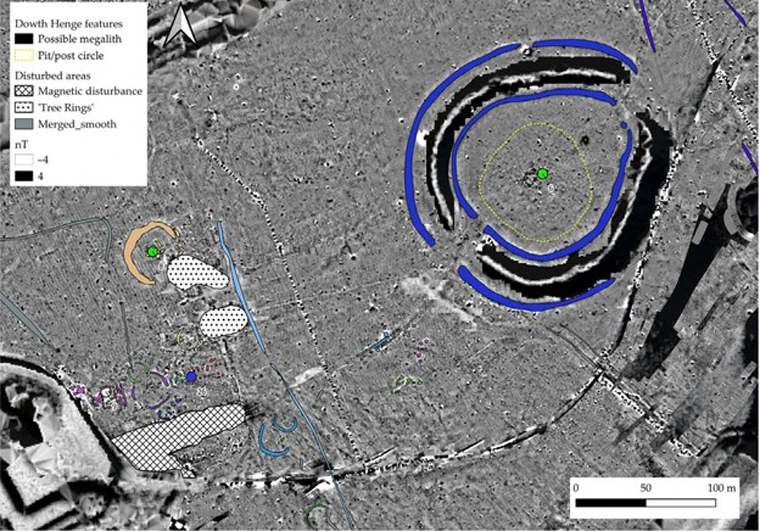 Dowth Henge in Brú na Bóinne shown by archaeological survey, one of the major later Neolithic ceremonial enclosures in the Boyne Valley.
Dronehenge and the Cropmarks of 2018
The exceptionally dry summer of 2018 brought one of the most dramatic breakthroughs in recent Boyne Valley archaeology. Cropmarks appeared in fields around Newgrange, revealing buried monuments that had never been fully understood before. Among the most striking was the site popularly known as Dronehenge, first identified by aerial photographers Anthony Murphy and Ken Williams during drone surveys of the Brú na Bóinne landscape. Their images revealed a previously unknown geometric enclosure preserved as cropmarks in the fields close to Newgrange.
Dronehenge appears as a carefully planned circular monument with segmented ditches and an annex-like feature. Its design has strong similarities with nearby ceremonial enclosures, suggesting that these monuments formed part of a wider ritual landscape that continued to develop after the construction of the great passage tombs. Although almost invisible at ground level, Dronehenge stands as one of the most remarkable recent discoveries in Brú na Bóinne.
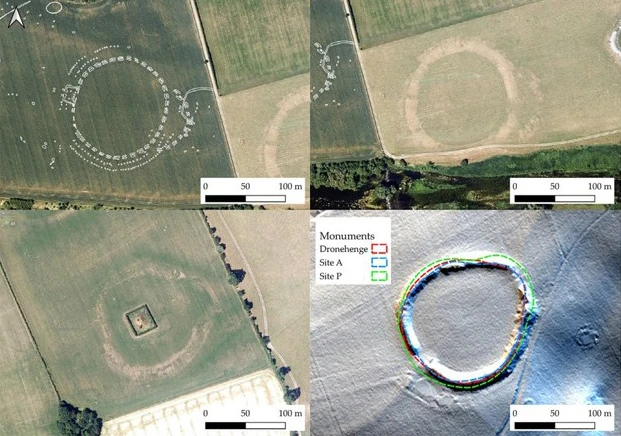 Henges/embanked enclosures in Brú na Bóinne: top left: Dronehenge near Newgrange revealed by aerial cropmarks, bottom right: Dowth Henge.
Timber Monuments and Four Post Structures
The later Neolithic landscape of Brú na Bóinne also included timber architecture on a significant scale. Archaeologists have identified several so called four post or square in circle monuments in the area between Newgrange and Knowth. These usually consist of a central arrangement of four substantial posts, often surrounded by circular settings of pits or postholes.
These monuments may have supported roofed timber structures or acted as ceremonial focal points. Their careful orientation and repeated design motifs suggest that they were more than simple practical buildings. Some may represent monumentalised timber architecture that echoed the form, symbolism and spatial order of the earlier passage tombs.
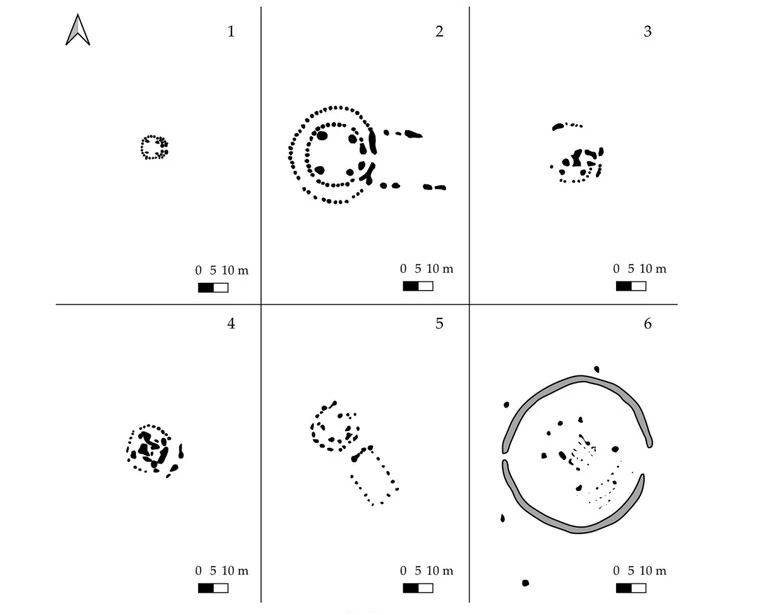 Plans of four post timber monuments from Brú na Bóinne, showing the diversity of later Neolithic ceremonial architecture around Knowth and Newgrange.
The Great Palisade at Newgrange
Perhaps the most extraordinary recent discovery is the Great Palisade, a huge timber enclosure associated with the Newgrange area. Aerial evidence suggests that this vast palisaded circuit enclosed a large part of the Newgrange precinct and defined an enormous ceremonial space. If this interpretation is correct, the monument would have required an immense quantity of timber and labour.
The scale of the Great Palisade hints at a level of organisation and monument building every bit as impressive as the construction of the passage tombs themselves. Rather than marking a decline after the great stone monuments, the later Neolithic landscape of Brú na Bóinne now appears equally ambitious, but expressed through timber and earth instead of stone.
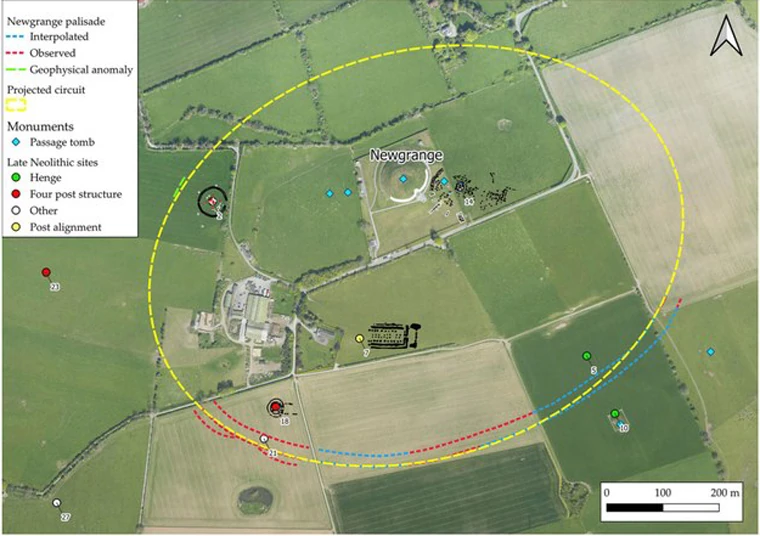 Aerial archaeological image showing the Great Palisade around the Newgrange precinct in Brú na Bóinne.
Beyond the Famous Tombs
These discoveries transform how Brú na Bóinne should be understood. Newgrange, Knowth and Dowth remain the central monuments of the landscape, but they were accompanied by a broader ceremonial world of henges, timber settings, palisades and avenues. The later Neolithic communities of the Boyne Valley were still building on a monumental scale and were still deeply engaged with the sacred geography of the bend in the Boyne.
Modern survey technology has made much of this hidden landscape visible for the first time. As more work is carried out, Brú na Bóinne continues to emerge not simply as the home of a few famous tombs, but as a richly layered ceremonial landscape whose complexity extends far beyond Newgrange alone.
Based on research by Stephen Davis and Knut Rassmann published in the Proceedings of the Prehistoric Society (2021), Download the full PDF.