The Shortest History of Ireland
James Hawes's The Shortest History of Ireland distils thousands of years of Irish history into a fast-paced and highly readable narrative that is both accessible and thought provoking. Based on the latest archaeological, historical and genetic research, the book traces Ireland's story from the first hunter-gatherers who arrived after the Ice Age through the Neolithic builders of Newgrange, the coming of Christianity, Viking settlement, the Norman invasion, English rule, famine, revolution, independence and the challenges of modern Ireland.
Richly illustrated with maps, photographs and diagrams, it presents complex ideas in a clear and engaging style that appeals to both newcomers and readers already familiar with Irish history.
Hawes challenges many traditional interpretations by placing Ireland at the centre of a much wider European and Atlantic story rather than viewing its past solely through the lens of Britain. He explores Ireland's enduring connections with continental Europe and the profound influence of the Irish diaspora, particularly in North America.
The result is a fresh perspective that reshapes how readers understand Ireland's place in history. Hawes concludes by suggesting that, as Ireland continues to move beyond the legacy of empire, its remarkable past provides the foundation for an optimistic future.
Purchase at Amazon.com or Amazon.co.uk.
Mesolithic and Neolithic periods
Ireland is an outlier in the archaeology of western Europe. During the last great Ice Age, vast glacial sheets, advancing and retreating for 100,000 years, scraped it virtually clean. The only human trace from those icy millennia is a butchered reindeer bone from a cave in County Cork, from around 30,000 BC, when hunters wearing snowshoes of birch twigs could track the herds all the way from Russia to Ireland.
The glaciers finally melted around 12,500 BC, leaving Ireland once again an island (hence no snakes: by the time it was warm enough for them, they couldn't get across). Over the planed-down mountains and gravel-filled valleys, forests took hold. Palaeolithic folk came in boats, perhaps first as seasonal hunter-tourists. We now get a butchered bear bone from County Clare, from around 10,500 BC. Eventually the visitors became resident Mesolithic hunter-gatherers, who had little contact with the rest of the continent.
While the lonely Mesolithic Irish hunted and gathered, people elsewhere were starting to clear land, mark it, sow it or stock it, then sit tight to defend the fruits of their labours from wild beasts and other humans. This whole new way of life - the Neolithic Revolution - spread westwards across Europe until it finally got to Ireland around 4000 BC.
The migrant farmers who brought it had (it seems) darkish skins and blue eyes - plus a survival advantage, the 13920*T allele, which let them drink milk as adults, providing vitamin D in gloomy climes. So they also brought a non-native species that turned out to be perfect for Ireland: cattle. In the Neolithic, most of today's pasture was vast, broadleaf forest, home to wolves, boars and bears. Even if you slashed and burned this woodland for farming, the soil was too heavy for ploughs made of wood or bone. So early farmers tended to stay on higher ground, where the trees were fewer and the soil thinner. Their upland tombs stand sentinel to this day, as at Carrowkeel in County Sligo. When they needed to cross the forests - say, for hunting, trading, warring or marrying - they stuck to the eskers, winding ridges of sand and gravel where the glaciers had once paused.
Over millennia of use, these raised paths became maintained trackways, even laid with wooden planks for wheeled vehicles, the Irish slí (path/way/road) ultimately comes from the word for felling trees. The most important, later called Eiscir Riada (the ridge for driving herds) or simply An tSlí Mhór (the Great Road), ran more or less from modern Dublin to Galway. It seems to have been a cultural divide from very early on, no doubt because the great lowland forests it wound through were very hard to cross for much of the year: sea-borne influences came from different shores to different parts of Ireland, but archaeologists see a clear, overarching north-south division.
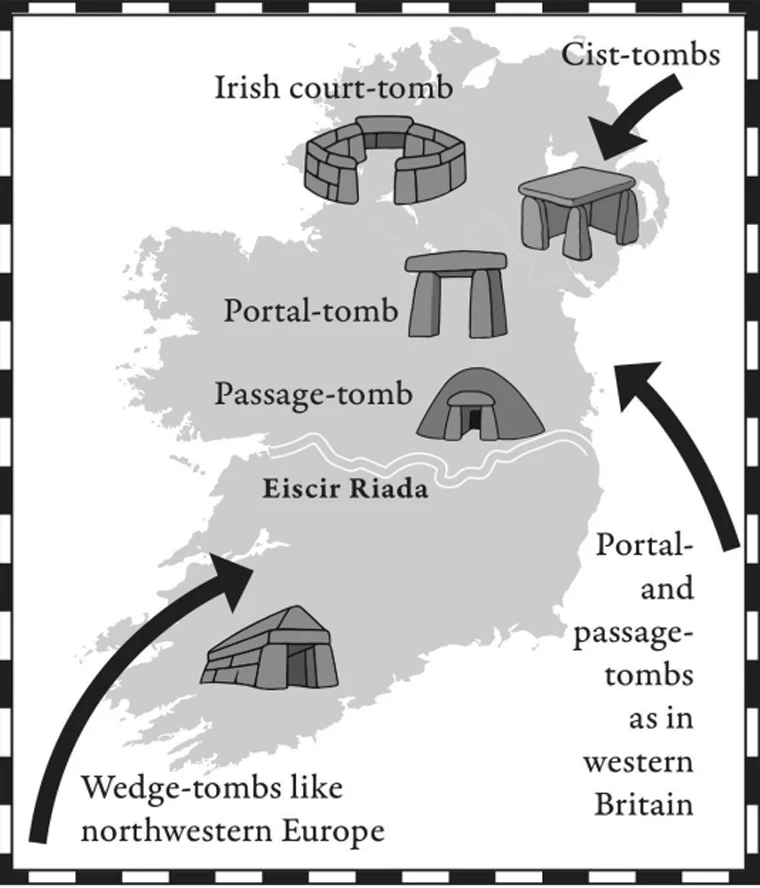
All save five of the 329 Irish court-tombs at present known are situated in the northern half of the country. Passage-tombs are largely confined to the northern half of the country. The distribution of the portal-tombs, like that of the court-tombs, is concentrated largely in the northern half of the country. From Survey of the Megalithic Tombs of Ireland by Professor Ruaidhrí de Valera and Dr Seán Ó Nualláin.
The most famous Neolithic passage-tomb is Newgrange, designed to lead the sun's rays straight down the central tunnel on the shortest day of the year. The people who built it were keen on family lineage, to a literally unhealthy degree.
"We identify the adult son of a first-degree incestuous union from remains that were discovered within the most elaborate recess of the Newgrange passage tomb. It seems what we have here is a powerful extended kin-group, who had access to elite burial sites in many regions of the island." Dr Lara M Cassidy, Trinity College Dublin.
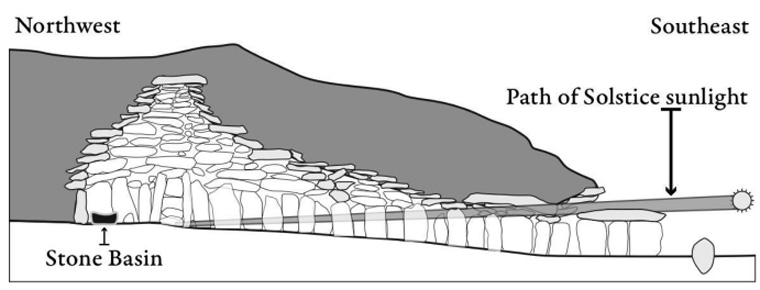 Newgrange | Path of Solstice Sunlight.
Around 2400 BC, this Neolithic Ireland was disrupted by new migrants. DNA shows that these newcomers were the biological ancestors of most modern Irish people.
We know they brought the first gold and copper metalwork. We assume it was also they who brought a branch of the common Indo-European language, with a whole new cultural package of gods and sagas.
But however different their DNA, language and culture, they adopted what already existed in Ireland: many sites, including Tara and Newgrange, continued in use. Soon, precious tin from Cornwall was added to the copper and, with Ireland’s first international trade set-up, the Bronze Age was under way.
The vast majority of the Irish are descended from the waves of migration that fanned out across Europe out of an area north of the Black and Caspian seas from around 5,500 years ago... The R1B haplotype is dominant across western Europe but the numbers are stratospheric when it comes to Ireland... Around 84% of the male population on the island have the marker.
Irish News, June 2023New technology changed the Irish landscape. With bronze ploughshares, farmers could work the heavier soils left when lowland forests were cleared, so the trees started to come down. Burning off woodland was fine until the climate, which had been warmer even than today, got cooler and wetter. Land cleared by fire is especially liable to form drainage-resistant iron-pan layers: groundwater levels rose, and much new farmland was abandoned.
This explains the dream-like way entire Neolithic settlements are found under today’s iconic blanket-bogs, which are often neither ancient nor natural but the relics of Bronze Age farming techniques which became unsustainable in a changing climate.