The mysteries of Ireland's burial mounds
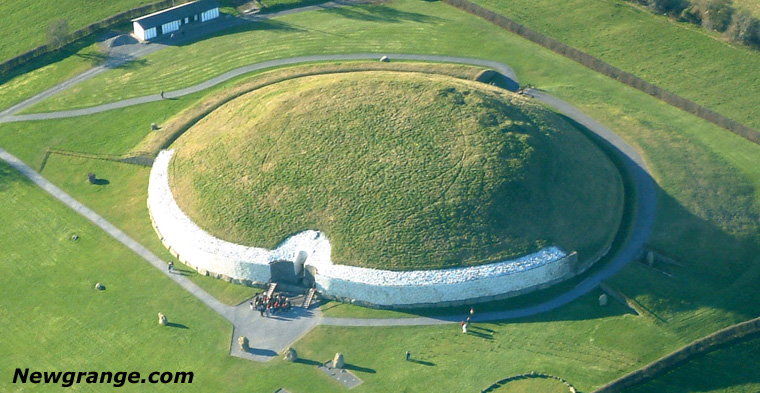 The Newgrange passage tomb has been designated a World Heritage Site by UNESCO.
About a 30-minute drive from Dublin, there is a fertile valley nestled in a meandering loop of the Boyne River in Ireland's Ancient East.
In the Stone Age, an advanced civilisation made this tranquil spot home. Settlers raised livestock and tended their crops. As accomplished artists and engineers, they also built sacred enclosures.
Today, many ancient mounds are scattered across the island of Ireland. The most intriguing are called passage tombs, owing to a long corridor leading to a central cross-shaped chamber. Archaeologists long believed the dead were left in these chambers to begin their journey to the Other World.
That association with burial rites overshadowed another aspect of these enigmatic cairns. Rife with symbols and astronomical alignments, today they are recognised as temples with great ritual significance.
Construction, done without benefit of the wheel or metal tools, took more than 20 years, according to experts. Workers dragged 200,000 tons of loose stones to the mound, digging them from the earth by hand and hauling them 30 miles to the hilltop.
Artisans carved elaborate swirls, zigzags, diamonds, spirals and other geometric designs into the stones. Workers are said to have cut their hands, smashed fingers and feet, fell to disease and drowned in the river while creating these monuments.
The most important is Newgrange. Carbon dating shows it to be one of the oldest man-made constructions on Earth, older than Egypt's ancient pyramids by some 700 years and Stonehenge by 1,000.
Built around 3200 B.C., the heart-shaped hill occupies more than an acre and is surrounded by 97 massive curbstones, some richly decorated with geometric carvings. The tomb is 36 feet high and has a diameter of 280 feet.
The heart is the inner chamber where three recesses (small rooms) form a cross. The intricate corbelled ceiling reaches a height of 20 feet, although the narrow entry passage is much lower. Overlapping stones form a conical dome, topped by a single capstone. This ceiling has been intact more than 5,000 years and still keeps the inner chambers dry.
One of the most impressive features of Newgrange can be seen during the winter solstice. At this time, the sun’s rays penetrate a unique roof box, crawl slowly up the tight 62-foot-long pathway and light up the central burial chamber.
Much about passage tombs remains a mystery. No written language existed at the time of their construction. Sophisticated measuring devices had not yet been imagined.
How could they have designed so precise a structure? Whose remains were left inside? What form of ceremony accompanied interment? What was the significance of the winter solstice?
The last question in particular draws a lot of interest. There is a high demand from visitors who want to see what the interior looks like at this time. A lottery is held to determine who will be admitted: In 2019, nearly 30,500 applications were submitted.
In September, 60 names are drawn, the winners gaining access to this mystical and memorable place.
is a freelance writer living in northern Italy.
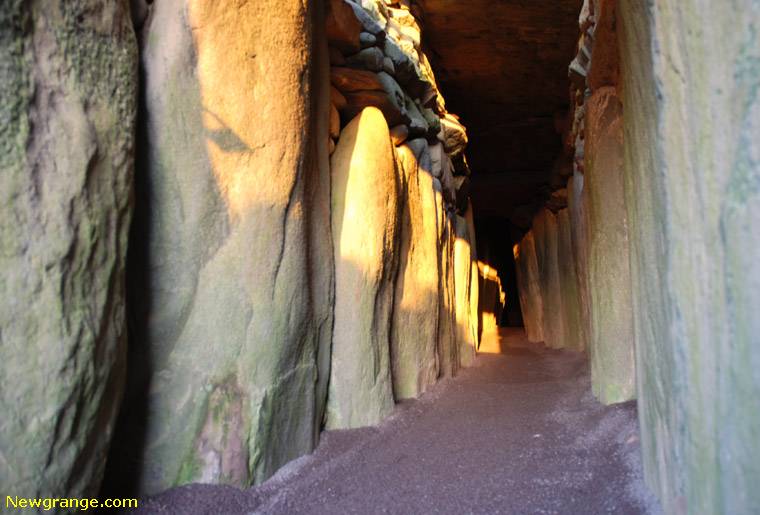 Winter Solstice Illumination viewed from the Newgrange entrance.
Newgrange – Brú na Bóinne
Newgrange is one of the finest surviving examples in Europe of a Neolithic monument known to archaeologists as a passage tomb or chambered cairn. Constructed around 3200 BC, according to the most reliable radiocarbon dates, it is more than 5,000 years old. This remarkable age places Newgrange over six centuries older than the Great Pyramids of Giza and more than a thousand years older than Stonehenge.
Rising from the fertile lands of the Boyne Valley, Newgrange stands as a testament to the ingenuity, organisation, and spiritual vision of the Stone Age farming communities who built it. Though originally described as a tomb, it is now widely understood to have been far more than a place of burial. Newgrange functioned as an ancient ceremonial monument, combining astronomy, ritual, social authority, and belief in cycles of death and renewal.
Newgrange and the Boyne Valley
Newgrange occupies a prominent position on a low ridge within a great bend of the River Boyne, approximately 8km (5 miles) west of Drogheda. This landscape, known today as Brú na Bóinne, has been a place of significance throughout Irish history. In later centuries it would witness pivotal events such as the Battle of the Boyne in 1690, while mythology and legend associate the area with the earliest foundations of Irish kingship and belief.
Alongside its sister monuments Knowth and Dowth, Newgrange forms part of one of the most important prehistoric landscapes in Europe. In 1993, the three monuments were collectively designated a UNESCO World Heritage Site in recognition of their outstanding universal value and cultural legacy.
A Monument of Stone and Light
Newgrange was built at a time when stone was the primary material available for tools and construction. Despite this, the monument displays extraordinary engineering skill. The great circular mound measures approximately 85 metres in diameter and rises to a height of around 13 metres, covering more than an acre of land.
A stone built passage just over 19 metres long leads into a cruciform chamber with three recesses, all capped by a corbelled roof that has remained watertight for over five millennia. Encircling the base of the mound are 97 massive kerbstones, some decorated with intricate megalithic art. Among the most celebrated carvings are the entrance stone, Kerbstone 1, Kerbstone 52 and Kerbstone 67.
The famous triple spiral motif, carved both at the entrance and within the chamber, has become one of the defining symbols of Newgrange and of Irish prehistoric art.
The Winter Solstice Alignment
Newgrange is best known for its precise alignment with the rising sun at the winter solstice. Above the entrance to the passage is a specially constructed opening known as the roof box. On mornings around December 21st, sunlight enters through this opening and travels along the passage, gradually illuminating the floor of the chamber.
For approximately seventeen minutes, the chamber is filled with golden light, marking the shortest days of the year and the return of the sun. A detailed survey carried out by Dr Jon Patrick in 1972 confirmed that this alignment was an original feature of the monument, carefully designed to maximise both the accuracy and duration of the solstice illumination.
The beam of light is narrow, measuring only about 34 centimetres at the entrance and narrowing further as it reaches the chamber. It is believed that the light originally struck the rear orthostat and may have been reflected onto other decorated stones within the chamber.
Archaeology, Art, and Myth
Excavations at Newgrange have uncovered a wide range of artefacts, from stone basins and worked flint to more curious discoveries such as Roman coins. The presence of Roman material has long intrigued archaeologists and suggests that Newgrange retained significance long after its original period of use.
In Irish mythology, Newgrange is known as Síd in Broga and is closely associated with the Tuatha Dé Danann. The monument was believed to be the dwelling place of the Dagda Mór and later the home of his son Aengus Óg. It is also said to be the place where the great hero Cúchulainn was conceived, linking Newgrange with birth, lineage, and kingship as well as death and renewal.
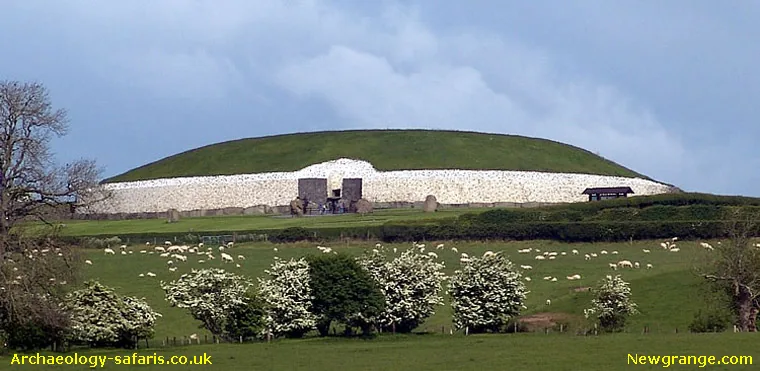 Newgrange - Ireland Field Trip by Archaeology Safaris.
Newgrange Today
Access to Newgrange is strictly controlled and is available only by guided tour through the Brú na Bóinne Visitor Centre at Donore, on the south side of the River Boyne. There is no direct public road access to the monument. Each year, up to a quarter of a million people visit Newgrange, drawn by its age, artistry, and unique relationship with the sun.
Demand to witness the winter solstice illumination from inside the chamber is extremely high, and access is allocated by an annual lottery. Nevertheless, many people gather outside the monument on solstice mornings to watch the sunrise and share an experience that echoes rituals performed here more than 5,000 years ago.
A Monument to Immortality
Newgrange continues to inspire deep reflection. For many visitors, it evokes a powerful sense of connection with distant ancestors and with the enduring human desire to understand time, death, and renewal. More than a tomb or an astronomical instrument, Newgrange stands as a monument to continuity.
Its message has survived millennia of change and upheaval, reminding us that the hopes, fears, and spiritual aspirations of our Neolithic ancestors are not so distant from our own. With the winter solstice approaching each year, Newgrange once again invites us to pause, to observe the turning of the year, and to reflect on the enduring power of light returning from darkness.