Riddles of the Boyne Valley
An article by Tony O'Riordan | Printed in The Irish Times - January 1981
The Boyne Valley Vision
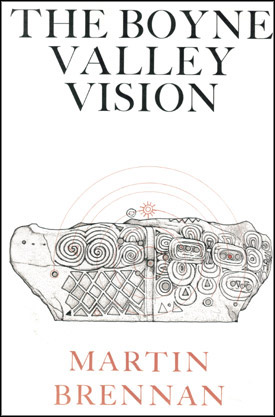
Whatever may be said about Martin Brennan's theory, he tells his story well. In what may be a deliberately stylised version of an old-fashioned detective novel, he writes of his growing belief in the mystery of the Boyne Valley's megalithic tombs and of his gradual solving of his personal riddle of the sphinx. Phrases occur like "I felt that Newgrange was such a centre but I could not prove it then" and "On March 17th St. Patrick's Day 1979, I decided to change my tactics." Chapters end: "Providing the seeds of an idea that bore a strange and wonderful fruit" / "with this key and the grid system I could begin to crack the code". "Nevertheless it took time before I could entirely appreciate the nature of my findings. The whole picture emerged in pieces." As in the best fiction, accidental events help; "It happened by chance that on Easter Monday we went to the airport to see off some friends". This, of course, leads to the finding of another piece of the jigsaw.
Martin Brennan is not, I believe, a trained archaeologist but he has majored in Visual Communications. His researches in rock inscriptions have taken him to Mexico and to Japan, where the scholar Kimitaro Kitamura urged him (rather oddly, to me) to study ancient Irish culture. No one will deny that he has done so. He moves freely among the Fiannaiocht and Ruraiocht. (Red Branch) cycles and quotes Jonathan Swift on Sliabh na Caillighe, among more familiar quotations. But more than that, he moves from Loughcrew to Yucatan taking in Mycenae, the Inca civilisation and the Pyramids. The archaeologists who will take him on (and they will) had better get their facts right.
Mr. Brennan writes: "the exact bearings of passages in the mounds are not always accurate on ground plans used by archaeologists." He has a theory that "geometry did not begin on the banks of the Nile; it began on the banks of the Boyne." He believes that the megalithic builders of the mounds at Newgrange and elsewhere made the first survey of Ireland over 5,000 years ago and that the positioning of many of our stone circles and of standing stones was not accidental but related to a complex whole. Newgrange is the centre of a meridian, of a complex sundial that, not only told time in the conventional sense that a sundial does, but in addition, that the builders of Newgrange had designed so that it could measure sidereal time and space and understood the twenty-year great conjunctions of Saturn and Jupiter and track the Lunar and other cycles.
He makes an impressive case, one that I will mark "not proven," but with respect, he could not be the first amateur in the original sense of the word (pace Schliemann) to upstage the academic. At the same time, I would like to see more research done into the actual foundation of Newgrange and Dowth and Knowth, not only by archaeologists but by engineers as well. Is it possible that the builders were able to design these structures so that they would not have moved in thousands of years? After all, the Annals of Ulster record an earthquake early in 768 A.D. in any event, earth tremors would, one would think, alter the extraordinary fine setting of the stones at Newgrange and Dowth that let in slanting sun at the Winter Solstice.
Whatever doubts there may be about his theory, there can be none but that we are going to hear a lot more about Mr Brennan. His work is going to upgrade the importance of the mounds of the Boyne Valley, "Ireland's most precious possessions." To quote him again: "The accepted view is that these mounds are the work of people living in barbarian Europe. But who are the barbarians: the people who built the mounds or the people who tried to destroy them to build roads. We have done Neolithic man an injustice in not recognising his achievement. We have thus also done ourselves an injustice because we have misjudged the development of human culture and the origins of science."