Newgrange, Guest Photographs II
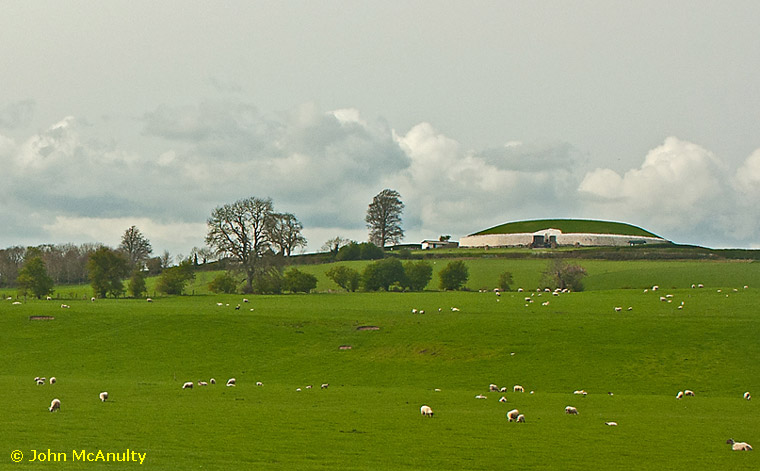 Sheep grazing at Newgrange | Photo by John McAnulty.
Human remains recovered from Newgrange were mainly cremated and fragmentary. This suggests selective burial rather than use as a communal cemetery. The monument’s primary role was likely ceremonial.
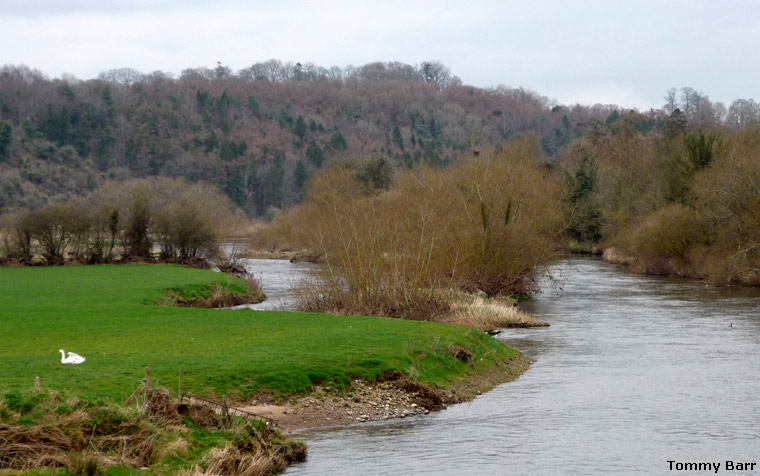 The River Boyne from the pedestrian bridge at the Brú na Bóinne Visitors Centre | Photo by Tommy Barr.
Artefacts found at Newgrange include beads, pendants, and bone objects. These items hint at ritual activity and craftsmanship. Many materials were sourced from distant locations.
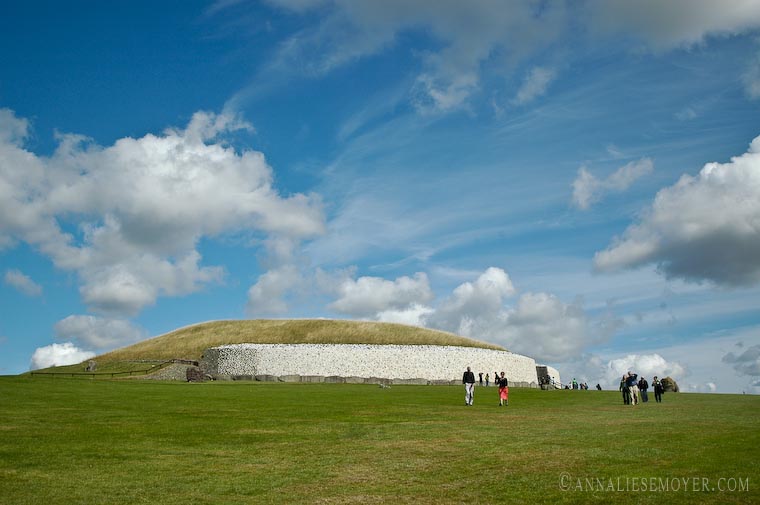 Newgrange with a deep blue sky and white cloud backdrop | Photo by Annaliese Moyer.
In Irish mythology, Newgrange is known as Brú na Bóinne and is associated with powerful deities. It is described as a dwelling of the gods and a gateway to the Otherworld. These mythological traditions preserve echoes of the monument’s ancient prestige and importance.
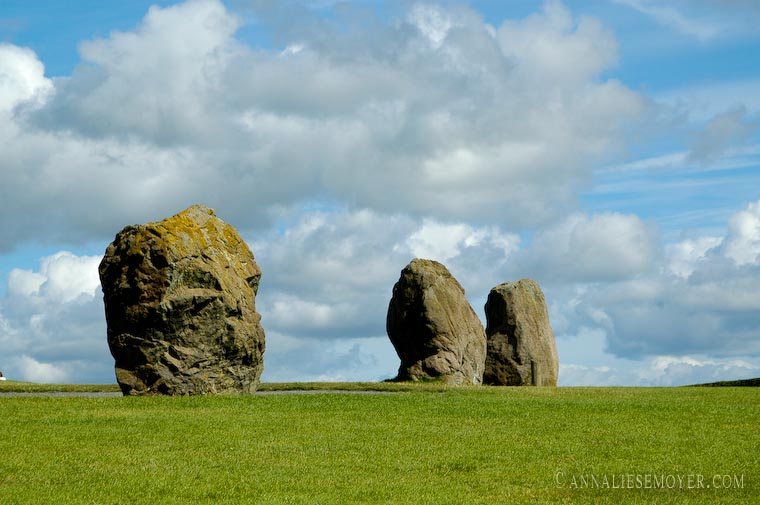 Standing Stones at Newgrange | Photo by Annaliese Moyer.
The nearby monuments of Knowth and Dowth are closely related to Newgrange. Together they form a triad of major passage tombs. Each displays unique architectural and astronomical features.
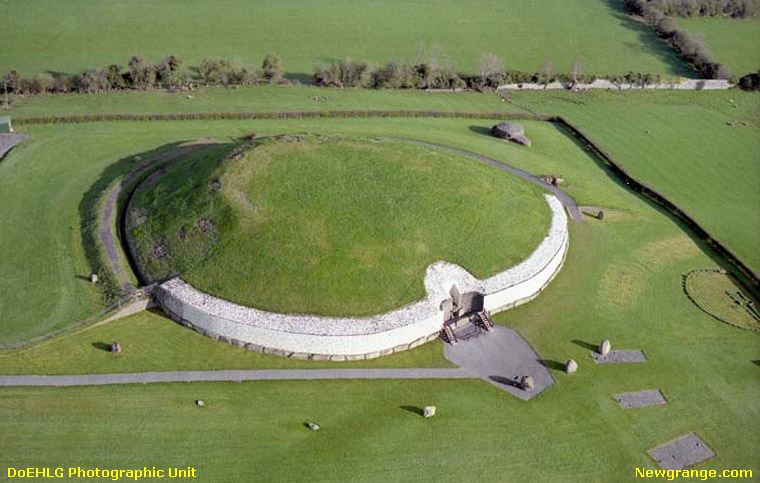 Newgrange | Photo by the Photographic Unit, Dept. of the Environment, Heritage and Local Government.
The Brú na Bóinne valley contains more than 90 recorded prehistoric monuments. This density is exceptional by European standards. It reflects sustained ritual activity over millennia.
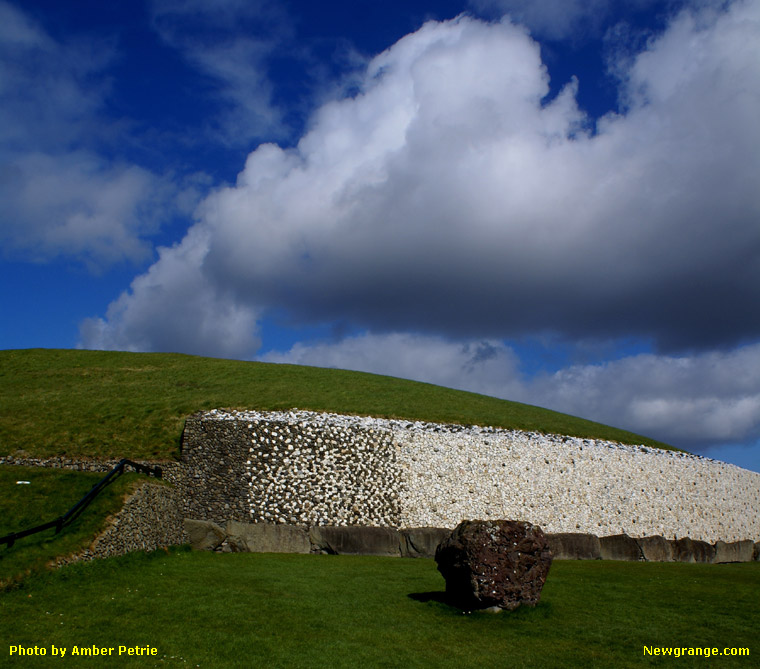 Newgrange | Lovely contrast of the cloudy blue sky with the green grass | Photo by Amber Petrie.
About Newgrange
Newgrange was constructed around 3,200 BC, more than 5,000 years ago during the Neolithic period. This makes it older than both Stonehenge and the Egyptian pyramids. The monument takes the form of a large circular mound containing a long stone-built passage leading to inner chambers. Around the base of the mound is a ring of massive kerbstones, many of which are carved with prehistoric art.
Although archaeologists originally described Newgrange as a passage tomb, it is now understood to be far more than that. Many researchers regard it as an ancient temple, a place of astronomical, spiritual, religious and ceremonial significance.
The passage and chamber are precisely aligned with the rising sun on mornings around the winter solstice. Newgrange is the best known monument within the Brú na Bóinne complex, alongside the closely related passage tombs of Knowth and Dowth, and together they form part of the Brú na Bóinne UNESCO World Heritage Site. Newgrange also shares strong similarities with other Neolithic monuments across western Europe, including Gavrinis in Brittany, Maeshowe in Orkney and Bryn Celli Ddu in Wales.
After its period of use, Newgrange was deliberately sealed and remained hidden until the passage and chamber were rediscovered in 1699. Extensive archaeological work took place in the twentieth century, and the front of the monument was reconstructed during the 1970s.
The Neolithic communities who built Newgrange were farmers who cultivated crops and kept livestock such as cattle near their settlements. They had not yet developed metal technology, so their tools were made from materials such as stone, wood, antler and bone.