The Iron Age Post Enclosure at Lismullin
Public Lecture on Thursday 18 November 2010
The Iron Age Post Enclosure at Lismullin in Co. Meath was discovered by archaeologists in 2007 during development works for the M3 Motorway.
You are invited to a public lecture in which Frank Prendergast (DIT School of Spatial Planning and UCD School of Archaeology) will present exciting new findings on the methods used to construct and align the enclosure, and its likely ceremonial function.
Date: Thursday 18th November 2010 @ 6.30 pm
Venue: Michael O'Donnell Theatre, DIT, Bolton Street campus
An Innovation Dublin event at DIT
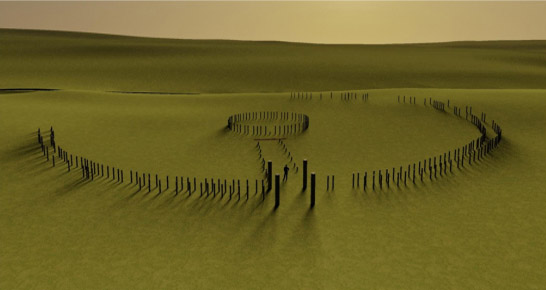 Iron Age Post Enclosure at Lismullin - Image by A.C.S. Ltd.
The Lismullin Ceremonial Enclosure
The discovery at Lismullin proved to be one of the most significant archaeological finds made during construction of the M3 motorway. The post enclosure was an open-air ceremonial site located in the Gabhra Valley beneath the Hill of Tara. It was designated a National Monument shortly after its discovery.
The monument consisted of a large circular arrangement of timber posts with a smaller enclosure at its centre. An entrance avenue formed part of the carefully planned layout of the site. Archaeological research has interpreted Lismullin as an exceptional Iron Age ceremonial enclosure rather than a domestic settlement.
Harvesting the Stars
Further research by Frank Prendergast examined the archaeoastronomy of Lismullin and identified a relationship between the alignment of the entrance avenue and the rising of the Pleiades star cluster in the autumn night sky.
The Pleiades have attracted the attention of many cultures because of their prominence in the night sky and their recurring seasonal reappearance. The astronomical interpretation of Lismullin formed part of the later publication Harvesting the Stars: A Pagan Temple at Lismullin, Co. Meath, published by the National Roads Authority in 2013.
The research raised important questions about why the enclosure was constructed in this location and whether its design and orientation were connected with seasonal ceremonies or rituals associated with the agricultural year.