Calling Macha Home
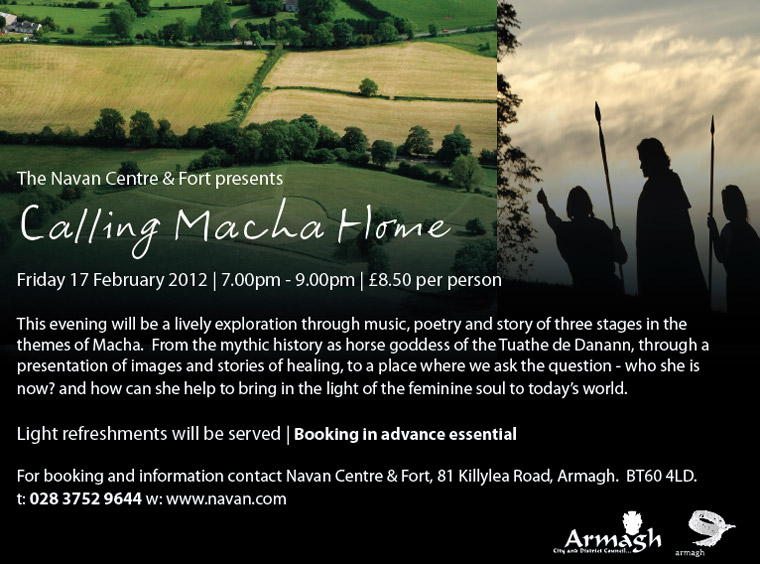
The Navan Centre and Fort presents Calling Macha Home on Friday 17th February 2012 from 7.00pm to 9.00pm, tickets £8.50 per person.
This evening will be a lively exploration through music, poetry and story of three stages in the themes of Macha. From the mythic history as horse goddess of the Tuatha Dé Danann, through a presentation of images and stories of healing, to a place where we ask the question - who she is now? and how can she help to bring in the light of the feminine soul to today's world.
Light refreshments will be served. Booking in advance essential, contact Navan Centre and Fort.
 Calling Macha Home - Navan Centre and Fort.
The Navan Centre and Fort
The Navan Centre and Fort, just outside Armagh City, is one of Ireland's most important ancient sites. The great earthwork is traditionally identified with Emain Macha, the legendary capital of Ulster and the royal stronghold celebrated in the stories of the Ulster Cycle.
In early Irish literature, Emain Macha is associated with King Conchobar mac Nessa, the warriors of the Red Branch and the hero Cú Chulainn. Archaeology, however, reveals a long and complex history extending far beyond the medieval tales. Navan Fort stands within a remarkable prehistoric landscape that includes ceremonial monuments and other important sites dating from the Bronze Age and Iron Age.
The most extraordinary archaeological discovery at Navan Fort was a huge circular timber structure, about 40 metres in diameter, built around 95 BC. At its centre stood a massive oak post surrounded by concentric rings of timber uprights. The structure appears to have been deliberately filled with stones and set on fire before being covered by a mound of earth. Archaeologists generally interpret this remarkable sequence as evidence of large-scale ceremonial or ritual activity rather than an ordinary settlement.
The Navan Centre introduces visitors to the archaeology, mythology and history of Emain Macha. Guided tours explore the ancient fort, while exhibitions and audiovisual displays tell the stories of the Ulster Cycle. Visitors can also experience interpretations of Iron Age life, including traditional crafts, cooking and other aspects of life more than 2,000 years ago.
Navan Fort is sometimes compared with other great ancient centres of Ireland, including Tara, Rathcroghan and Knockaulin. Like these sites, its significance appears to have extended far beyond everyday occupation. Archaeological research increasingly presents Navan as part of a complex ceremonial landscape that developed over many centuries and became a powerful symbol of kingship, ritual and identity in ancient Ulster.