Saint Patrick and the Spring Equinox
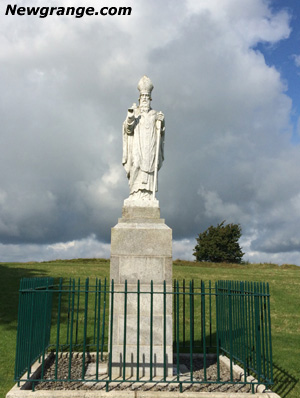 Saint Patrick statue on the Hill of Tara.
Saint Patrick's Day is celebrated within a few days of the Spring Equinox, could it be that the Spring Equinox Festival was Christianised to Saint Patrick's Day and that this knowledge has been lost over time?
Saint Patrick's Day is celebrated in Ireland and around the world on 17th March, the reputed date of his death in 461 AD. It wasn't until the 1600s that Saint Patrick's feast day was placed on the universal liturgical calendar in the Catholic Church, so the date had been passed down from generation to generation for over 1,000 years.
The early Christian church in Ireland incorporated pre-Christian spirituality and festivals into the 'new religion', it is conceivable that the Spring Equinox festival became Christianised and rebranded as Saint Patrick's Day.
The Spring Equinox is the beginning of the 'light' half of the year where the sun is strongest and the days are longer than the nights. Saint Patrick brought the 'light' of a different sun, the son of God to Ireland, the adaptable Irish Celts may have simply rebranded the Spring Equinox festival to Saint Patrick's Feast Day.
Early Irish Celtic Christianity with its unique mix of Christian and pre-Christian beliefs and practices continued in Ireland until the Celtic monasteries were suppressed in the 12th century. By the time the date for Saint Patrick's Day was placed on the universal liturgical calendar in the 1600s the connection with the Spring Equinox would have been lost.
Saint Brigid
Another example of the Christianisation of an older festival is Saint Brigid's Day at the beginning of February. In pre-Christian Celtic times Imbolc was a time to celebrate the goddess Brigid, associated with inspiration, healing, and smithcraft. After the arrival of Christianity in Ireland in the 5th century AD, this festival became linked with Saint Brigid, who founded a monastery in Kildare.
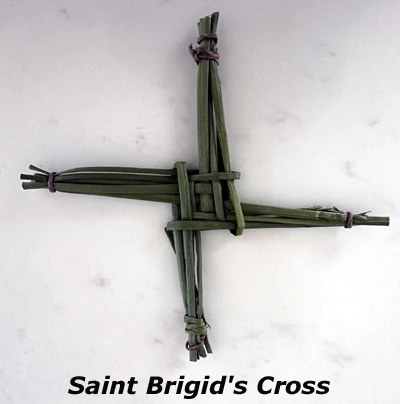 Saint Brigid's cross.
Saint Brigid, traditionally said to have been born at Faughart near Dundalk, Co. Louth, became one of Ireland’s most important early saints. She established her monastery at Kildare, where she spent much of her life. Over time, the earlier festival associated with the goddess Brigid was absorbed into the Christian calendar as Saint Brigid's Day.
The Saint Brigid's Cross is one of the most recognisable symbols of Ireland. Although now seen as a Christian emblem, it may have roots in earlier traditions linked to the goddess. Typically made from rushes, it features a woven square centre with four projecting arms.
The cross was traditionally hung in homes, often in the kitchen, to protect against fire and misfortune. It remains a familiar presence in many Irish households, particularly in rural areas.
In Christian tradition, the cross is linked to a story in which Saint Brigid wove it at the bedside of a dying pagan chieftain. As she explained its meaning, he is said to have asked to be baptised.
Loughcrew Equinox
At the 5000 year old Loughcrew megalithic cairn T in Ireland, the rising sun on the mornings around the equinoxes (March and September) illuminate the passage and chamber. The backstone of the chamber with its engraved sun symbols is bathed in a blaze of golden light during the 50 minute illumination. Read more about the Loughcrew equinox
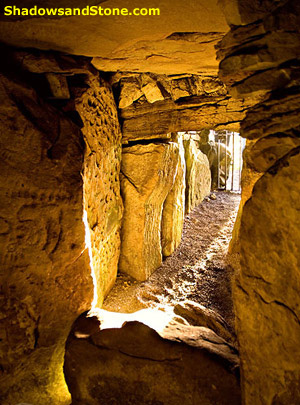 Equinox sunlight in the passage of Cairn T.
Loughcrew Equinox Archive
- March 2014 Spring Equinox.
- September 2012 Autumn Equinox.
- September 2011 Autumn Equinox.
- March 2010 Spring Equinox.
- September 2009 Autumn Equinox.
- March 2009 Spring Equinox.
- September 2008 Autumn Equinox.
- September 2008 Autumn Equinox.
- March 2008 Spring Equinox.
- September 2007 Autumn Equinox.
- September 2006 Autumn Equinox.
- September 2005 Autumn Equinox.
- March 2005 Spring Equinox.
- March 2005 Equinox Video.
- September 2004 Autumn Equinox.
- March 2004 Spring Equinox.
- September 2002 Autumn Equinox.
See also the main Loughcrew Equinox page.