The Celtic World: A History
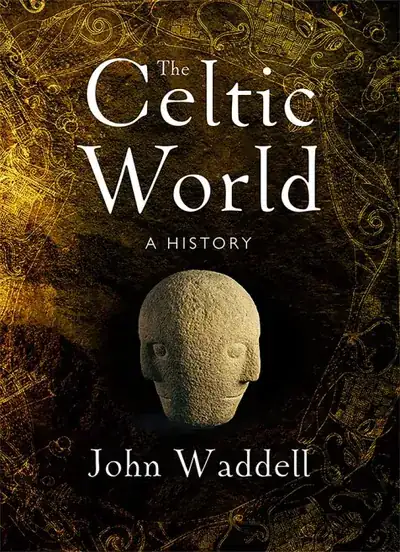
The Celtic World: A History by John Waddell examines how ideas about the ancient Celts have developed and changed. Published by Four Courts Press in February 2026, this illustrated book places Ireland within a much wider European story.
Understanding the Celtic past
Who were the Celts, and how have we come to understand them? Waddell follows the changing interpretations of Celtic-speaking peoples, from inherited origin stories to the evidence of archaeology and language. His geographical scope reaches from Ireland to Asia Minor.
Discoveries in France and Germany form part of this account of a diverse, interconnected past. The book considers the legacy of Celtic art, surviving languages and early Irish and Welsh literature.
Art, language and the evidence for the Celts
Illustrated examples include the three-faced Corleck stone head from County Cavan and the Glauberg statue discovered near Frankfurt. Such objects give a visual dimension to the book's exploration of Celtic identity and the changing interpretation of the ancient past.
Waddell also examines the evidence of language, from Celtic inscriptions on the European continent to Ireland's ogham stones and early Irish literature. These discoveries provide another perspective on the connections between Celtic-speaking communities.
Purchase at Amazon.com or Amazon.co.uk.
Book Review
By Rachel Pope
John Waddell’s new book, a beautifully illustrated historiography of Celtic Iron Age studies, is a very valuable addition to the literature. To begin, Waddell discusses Celtic identity as debated territory, stating that, for him, a Celt is someone who speaks a Celtic language: allowing the term its broadest definition. Despite this, the book is most focused on pre-Roman Iron Age Europe.
Chapter 1 integrates early Irish texts (7th-11th centuries) with the origins of Celtic linguistics (16th-18th centuries) in an elegant discussion of 11th-century genealogies that document an Irish descent from three migratory groups (Galeóin, Fir Domnann, and Fir Bolg). Settlement by Míl from Spain was also recorded: ‘the people who came to Ireland before the Gaels’, their own origins being in Scythian Europe.
In Chapter 2, Waddell presents the 16th-century translation of De Bello Gallico as a turning point from which George Buchanan (1506-1582) links pre-Latin languages in Britain and Gaul, and between Ireland and Spain. There is a very fine run-through of ‘eccentric’ 18th-century Celtic studies – viewed as a struggle between early scholarship and the creativity of Romanticism.
Chapter 3 places the origins of modern study in the mid-19th century with acceptance of the academic field of Celtic Studies across Europe, and the introduction of archaeology. Growing national interest in Celtic heroes (for example Vercingétorix and Boudica) takes place amid later 19th-century finds and increasing interest in Celtic art.
The first half of Chapter 4 is a brief commentary on the ‘racial lunacy’ of the 1840s-1860s, discussing craniometry, the Anglo racism levelled at the Irish and Welsh, and the search for an Aryan race.
Next comes the early 20th century: Déchelette and invasionist theory, with the usual discussion then of Bersu, Wheeler, (Christopher) Hawkes, and Jacobsthal – all male scholars. While we hear, briefly, Maud Cunnington’s important words on invasionism, neither her development of a British ceramics scheme nor her 1932 critique are discussed. We do not hear of Tessa Verney Wheeler either, and there is only a passing mention of Nora Chadwick. There then follows a large, descriptive run-through of later 20th-century archaeology, again tending to focus on male scholars and male burials. An intellectual watershed is given as the 1991 Venice exhibition, with Celts as ‘the origins of Europe’ leading to the critique that ‘Celtic’ was a cultural term applied in early scholarship, and too broadly, for an area of extraordinary cultural diversity. Waddell frames this as English prejudice, rather than as a central tenet of modern archaeological method: complicating the link between language and ethnicity.
Simply put, I would buy this book for Chapter 7 alone, which gives us linguistic progress since the 1970s on the publication of inscriptions (400 in Lepontic and Cisalpine Gaulish, several hundred in Celtiberian, hundreds in Late Iron Age Gaulish), with a measured comment on Tartessian. He discusses two curse tablets in Celtic and 77 Celtic names from Bath, Goidelic names in Ptolemy’s 2nd-century AD Geography, 400 ogham stones in Ireland beginning in the 5th-6th centuries AD, ogham glosses in Latin manuscripts (7th-9th centuries AD), as well as Old, Middle, and early modern Irish.
Chapter 8 finishes the book with early 21st-century studies primarily on Celtic art, before turning to a narrative based on Barry Cunliffe’s work defining the Atlantic fringe, late Bronze Age connections, and Bronze Age origins to Celtic languages, ending in a disappointingly traditional model of male warriors moving with their ‘female companions’. The volume ends with a positive discussion on Celtic museums.
Waddell does an excellent job of introducing early Irish literature as ‘the most substantial body of written material in a non-Latin tongue in western Europe’. It is a substantial introduction, too, to the so-called ‘nativism’ of 1940s-1960s saga studies, subsequently critiqued from the point of view of the texts instead of as being a product of 8th-century AD Christianity – a postmodern internalisation of the colonial narrative, perhaps, and now modified in a measured ‘hybrid’ understanding of the texts.
Overall, an important step towards further integration of Irish and British studies.
Purchase at Amazon.com or Amazon.co.uk.
About John Waddell
John Waddell is a former Professor of Archaeology at the University of Galway. His other books include Archaeology and Celtic Myth and Pagan Ireland: Ritual and Belief in Another World.