On the History and Antiquities of Tara Hill
On the History and Antiquities of Tara Hill by George Petrie brings together measured survey, Irish manuscripts and local knowledge to investigate one of Ireland’s best known royal landscapes. Presented to the Royal Irish Academy in 1837 and published in 1839, his research became an important reference for the study of Tara.
Explore Petrie’s Memoir on Tara
The complete scan includes the original text, illustrations and plans. It contains 213 scanned pages, including the journal cover information and plates.
How Petrie Investigated Tara
The study grew out of research intended to accompany the Ordnance Survey map of Co. Meath. Captain Bordes directed the initial measured survey. Petrie, Thomas Larcom and John O’Donovan then examined the hill, checking the map and looking for features that had been missed.
Petrie describes two stages of fieldwork. The team first checked the surviving remains without using the written descriptions to guide their identifications. Only after this examination did they return to the manuscripts and compare their accounts with the ground. His aim was to avoid reshaping the evidence to fit a preconceived theory.
Manuscripts and Place Names
O’Donovan translated Irish documents that helped the team interpret Tara’s earthworks. These included material from the Dindshenchas, the medieval literature of place-name stories, preserved in manuscripts such as the Books of Ballymote and Lecan. Petrie also drew on annals, saints’ lives and other historical accounts.
The Study reproduces extensive passages alongside translations and commentary. These sources connect the hill’s mounds, wells, roads and enclosures with named rulers, saints and legendary figures. Their descriptions helped Petrie reconstruct a landscape whose older names had often been forgotten.
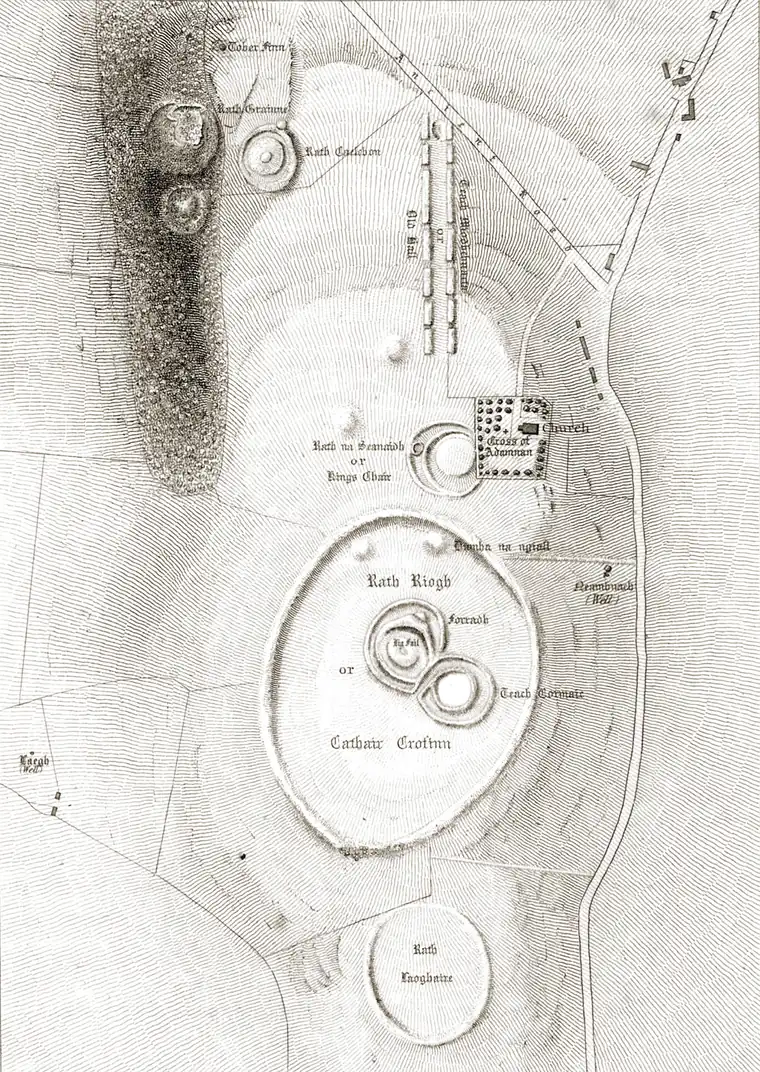 Hill of Tara: the 1837 Ordnance Survey plan based on Petrie’s research.
Kingship, Gatherings and Christian Tradition
A substantial part of the Study examines Tara’s reputation as a royal centre. Petrie discusses the traditions of its kings, the assemblies known as the Feis of Tara, and accounts of rulers including Cormac mac Airt. He also considers stories about St Patrick and the events associated with Tara’s abandonment as a royal residence.
He did not accept every traditional claim without question. At several points he challenges exaggerated accounts or interpretations based on doubtful translations. Even so, his reconstruction relies heavily on the historical value he assigned to medieval texts.
The Monuments and Their Stories
Petrie works through the named features of Tara, comparing their positions and appearance with the manuscript descriptions. The discussion includes:
- The royal enclosures: Ráth na Ríg, the Forradh, Teach Cormaic and Ráth Lóegaire.
- Mounds and memorials: the Mound of the Hostages and other features associated with burials, heroes and events in the traditional accounts.
- The Banqueting Hall: the long earthwork identified with Teach Midchúarta, discussed alongside literary descriptions of feasting and the ordering of royal society.
- Wells and routes: springs, roads and approaches that placed the hill within a wider landscape of travel and tradition.
The study also considers gold torcs and nearby monuments, including Ráth Meave. Its plans and drawings preserve evidence of the hill’s appearance in the nineteenth century, as well as Petrie’s interpretation of the names and stories attached to it.
Petrie’s Conclusions and Later Research
In his conclusion, Petrie placed most of the monuments he discussed within the third century AD and linked Tara’s prominence particularly with Cormac mac Airt. He argued that its vanished buildings had largely been made of wood and clay, while rejecting the idea that these materials necessarily implied crude construction.
His proposed chronology should be read as a nineteenth-century interpretation. Modern archaeology identifies monuments from widely separated periods: the Mound of the Hostages is a Neolithic passage tomb, while the so-called Banqueting Hall is generally interpreted as a ceremonial avenue. Medieval names and stories cannot, by themselves, establish when a prehistoric monument was built or how it was first used.
The Study remains valuable for its documentation, its publication of manuscript evidence and its account of the survey process. Reading it today offers an insight into both Tara’s traditions and the development of Irish archaeology.