2009 Calendar of Irish Megalithic Monuments
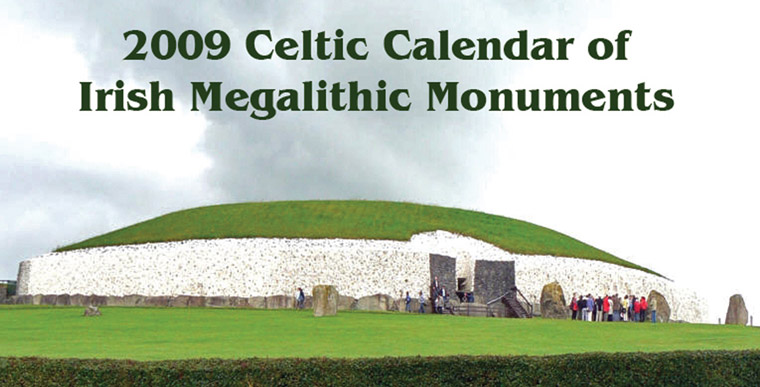 2009 Calendar of Irish Megalithic Monuments.
This 2009 Calendar of Irish megalithic monuments includes sites such as Newgrange, Knowth, Dowth, Loughcrew, Tara, and Carrowmore. All monthly pages come with additional photos and detailed site information. Calendar date tables include the seasonal Celtic festivals, the Equinoxes, the Solstices, and the lunar phases.
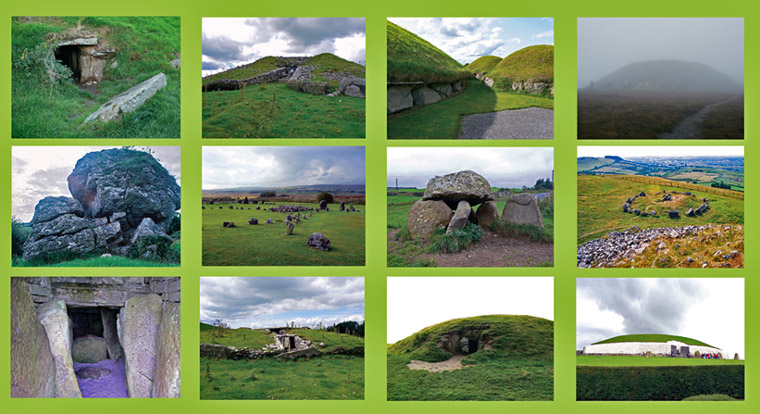 Thumbnail Images of Monthly Photographs.
This beautiful and unusual calendar portrays ancient Irish monuments built by man in the Stone Age out of giant (megalithic) stone. All monthly pages come with additional photos and detailed site information. Calendar date tables include the seasonal Celtic festivals, the Equinoxes, the Solstices, and the lunar phases.
Seasonal Festivals, Equinoxes and Solstices
The calendar marks the turning points of the year that mattered most to the builders of Ireland's megalithic monuments. Long before written records, people tracked the sun and moon to plan farming, ritual gatherings, and the great passage tombs that still stand at Newgrange, Knowth, Dowth, Loughcrew, Tara, and Carrowmore. Many of those same dates later entered the Celtic festival calendar.
The Solstices
The winter solstice, around 21 December, is the shortest day of the year. At Newgrange, the rising sun enters the passage through the roof-box and illuminates the inner chamber, one of the most famous astronomical events in prehistoric Europe. See also the winter solstice archive on Knowth.com.
At neighbouring Dowth, the setting sun of the winter solstice lights the passage of Dowth South. Research by Anne-Marie Moroney, described on Dowth sunsets, confirmed this alignment to complement the Newgrange sunrise. Photos from the 2011 Dowth winter solstice show the beam reaching the chamber backstone.
The summer solstice, around 21 June, is the longest day. Observations from Townley Hall across the Boyne from Knowth have recorded the midsummer sun setting behind the great mounds of Brú na Bóinne. Further afield, Carrowkeel in County Sligo and the Hill of Tara also draw watchers at midsummer.
The Equinoxes
The spring and autumn equinoxes, when day and night are of equal length, fall around 20 March and 22 September. At Loughcrew Cairn T, a beam of equinox sunlight moves across carved symbols on the chamber backstone, a discovery associated with the work of Martin Brennan and the Stonelight team. Sally McKenna's Equinox Reflection explores the balance of light and dark at this season.
The Celtic Festivals
Later Celtic tradition divided the year into four main festivals, each marking a shift in the farming and ritual year. Samhain, at the end of October, opened the dark half of the year. The great fire festival at Tlachtga is described in Tlachtga: Celtic Fire Festival, and the entrance to the Mound of the Hostages at Tara is aligned with the rising sun around Samhain.
Imbolc, in early February, marks the midpoint between the winter solstice and the spring equinox and is linked with the goddess Brigid and the first signs of spring. Beltane, on 1 May, welcomes summer with bonfires on hilltops such as Uisneach. Lughnasadh, in early August, is the harvest festival associated with the god Lugh and the assembly at Tailteann (Teltown) in Meath.
Together, the solstices, equinoxes, and cross-quarter festivals form the seasonal framework that the 2009 calendar sets out month by month. Martin Brennan's study of megalithic astronomy, The Stones of Time, remains a key reference for understanding how ancient Irish monuments were built as calendars in stone.