Whooper Swans return to the Boyne Valley
Thanks to Claidhbh Ó Gibne of the Boyne Currach Heritage Group for these photographs of Whooper Swans (Cygnus cygnus) on their return to the Boyne Valley from their breeding grounds in Iceland.
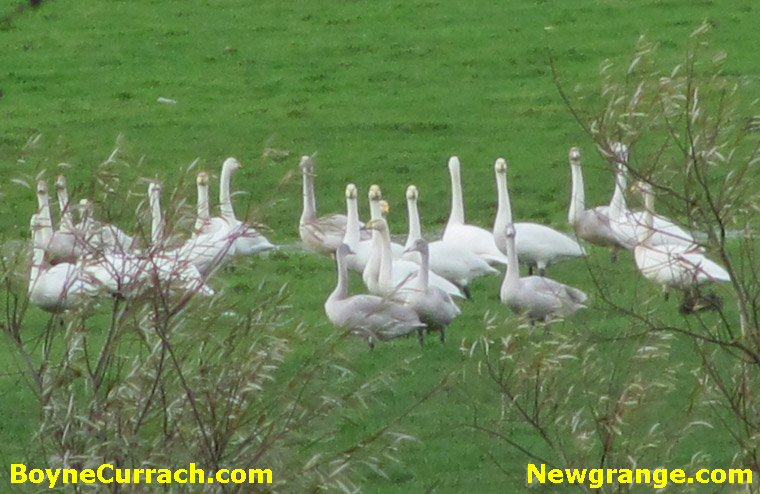 Whooper Swans (Cygnus cygnus) on their return to the Boyne Valley from their breeding grounds in Iceland.
Claidhbh counted 30 adult whooper swans and 9 juveniles on November 14th 2010. The adults have a distinctive yellow beak with a large black tip, the yellow patch hasn't yet developed on the juveniles whooper swans, their beak patch is pale white with a pink tint.
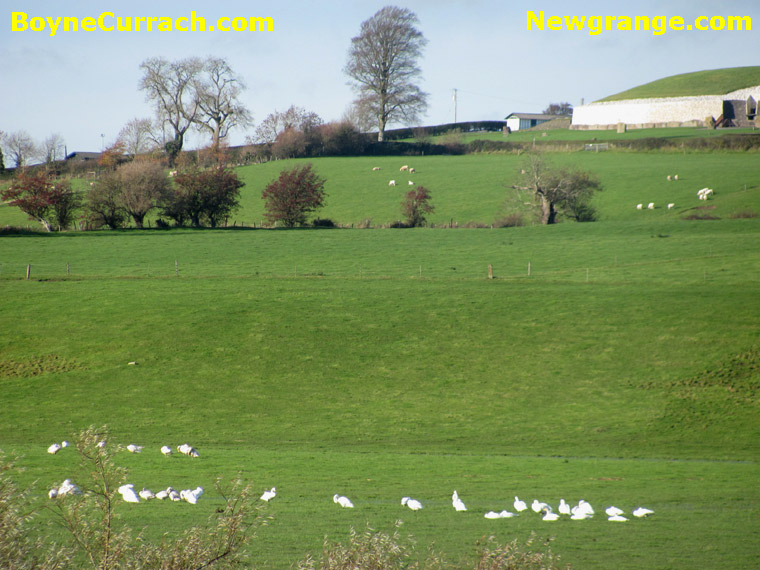 Whooper Swans on the banks of the Boyne at Newgrange.
Whooper Swans in the Boyne Valley
The Boyne Valley offers exactly the kind of winter habitat that draws Whooper Swans back from Iceland each year. The slow-moving River Boyne provides sheltered water for roosting, while the pasture and stubble fields on either side of the valley supply grazing through the colder months.
Flocks are often seen along the stretch of river below Newgrange and around the wider Brú na Bóinne landscape, where the great passage tombs stand on the bends of the Boyne. It is a striking contrast: birds that have crossed the Atlantic settling on the same riverbank that has drawn people to this valley for more than five thousand years.
County Meath holds some of the most reliable winter records for Whooper Swans in eastern Ireland. The birds photographed here in November 2010 were part of a flock of 39 counted by Claidhbh Ó Gibne of the Boyne Currach Heritage Group, whose work on the river has long connected the living heritage of the Boyne with its archaeological monuments.
From late autumn through to spring, visitors exploring the valley may hear the distinctive trumpeting calls of Whooper Swans as flocks move between the river and nearby fields. Along with the winter solstice at Newgrange and the returning wildfowl on the Boyne, their arrival marks another turn in the seasonal rhythm of Ireland's Ancient East.
Whooper Swans in Ireland
Whooper Swans are winter visitors to Ireland, with the birds that spend the winter here coming almost entirely from the Icelandic breeding population. They generally arrive in October and November and remain through the winter before returning north to their breeding grounds.
During their time in Ireland, Whooper Swans can be found on wetlands, rivers and lakes, as well as on agricultural grasslands where they feed during the day. Permanent waterbodies are also important as safe night-time roosting sites.
Whooper Swans are widely distributed across Ireland during the winter. Their numbers are monitored through coordinated swan censuses, which have been carried out at regular intervals since the 1980s. The 2020 census recorded 19,111 Whooper Swans in 550 flocks across the island of Ireland, with birds recorded in every county.
The Whooper Swan can be distinguished from Ireland's resident Mute Swan by its yellow and black bill and its long, straight neck. It is also a noticeably vocal bird, often giving loud, trumpeting calls as flocks fly between feeding and roosting areas.
The return of Whooper Swans from Iceland is a familiar sign of the changing seasons in Ireland. Flocks appearing along river valleys and on winter grasslands have completed a remarkable migration before settling into their traditional wintering areas.