Dowth - Winter Solstice Sunset 2018
The Office of Public Works will have staff at Dowth South for Winter Solstice Sunset on Friday December 21st from 2:30pm until 4.00pm.
Wear good sensible shoes. The site can be very muddy and it can be difficult to negotiate the slope into the monument.
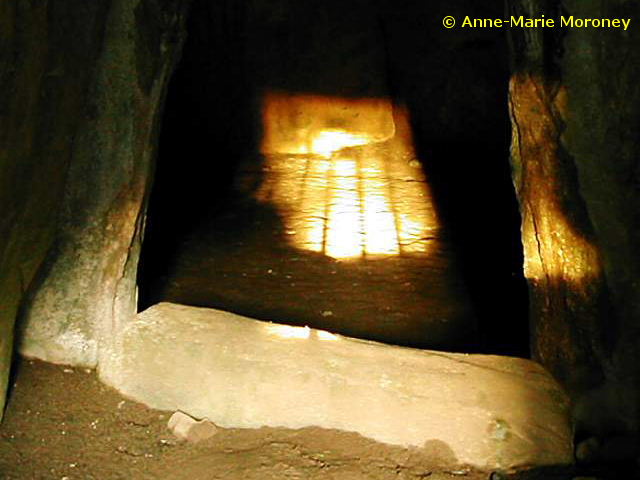 Sunset beam in the Dowth chamber photographed by Anne-Marie Moroney.
Winter Solstice Sunset at Dowth
While Newgrange is famous for the light of the rising sun entering its passage and chamber at the Winter Solstice, nearby Dowth has its own remarkable relationship with the midwinter sun. Here it is the setting sun that illuminates the interior of the great Neolithic passage tomb.
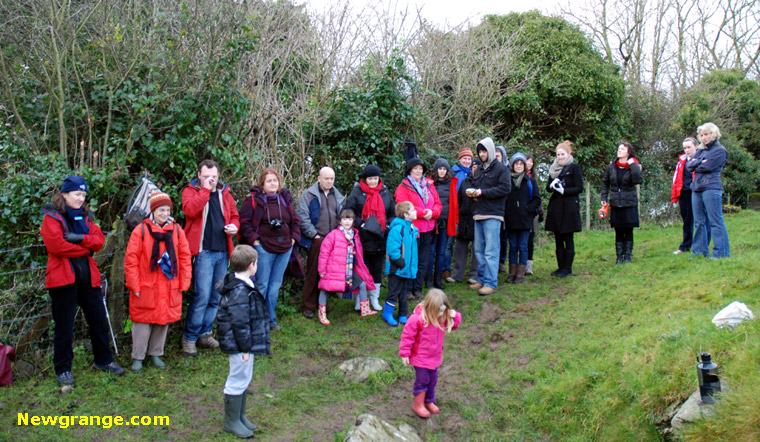 People gathered at Dowth for the Winter Solstice Sunset.
Dowth is one of the three great passage tombs of Brú na Bóinne, together with Newgrange and Knowth. The massive mound contains two known passages on its south-western side. The southern passage, known as Dowth South, is aligned towards the setting sun during the winter months.
As the sun moves southwards along the horizon during autumn and early winter, the rays of the late afternoon sun begin to penetrate the passage at Dowth South. Around the Winter Solstice in December, the low setting sun shines along the passage and enters the circular chamber. At the time of the solstice, sunlight reaches an orthostat at the rear of the chamber.
The alignment was brought to wider attention by researcher Martin Brennan during his investigations of Irish passage tombs in the 1970s and early 1980s. Later observations and photography have documented the changing path of winter sunlight through the passage and chamber at Dowth South.
Newgrange at Sunrise, Dowth at Sunset
The relationship between Newgrange and Dowth is particularly striking. On the shortest days of the year, Newgrange receives the rising sun from the south-east. Several hours later, the setting sun enters Dowth South from the south-west.
The solar illumination at Dowth is not confined to a single day. Sunlight can enter Dowth South over a period during the winter months, with the position of the beam changing as the sun approaches and moves away from its most southerly setting point.
More than 5,000 years after these monuments were built, the winter sun continues to enter their ancient passages. At Newgrange, the rising sun illuminates the chamber at the beginning of the shortest days of the year. At Dowth the setting sun sends its final rays deep into the monument.