Brú na Bóinne Research Framework: the 2008 Consultation Draft
The December 2008 consultation draft reviewed what was known about the World Heritage Site, identified gaps in understanding and proposed priorities for future research.
This page summarises the Brú na Bóinne World Heritage Site Research Framework: Consultation Draft, dated December 2008.
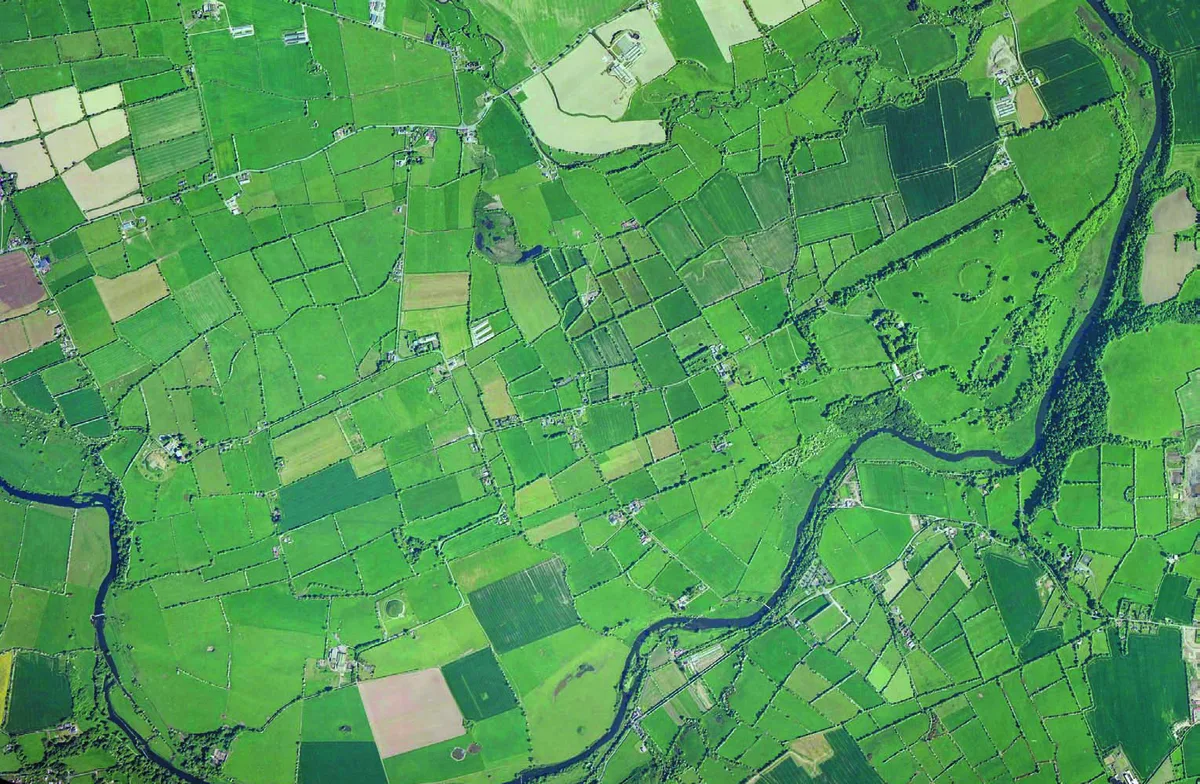 The Bend of the Boyne, from the cover of the December 2008 consultation draft.
What was the research framework?
The framework brought together existing knowledge about Brú na Bóinne and identified priorities for further investigation. Compiled and edited by Jessica Smyth, it was prepared by the Heritage Council and commissioned and funded by the Department of the Environment, Heritage and Local Government.
It combined a review of the archaeological evidence, a research agenda and a proposed research strategy. Specialists, heritage organisations and members of the public contributed to the process. Public seminars took place at the Conyngham Arms in Slane in March, June and October 2008.
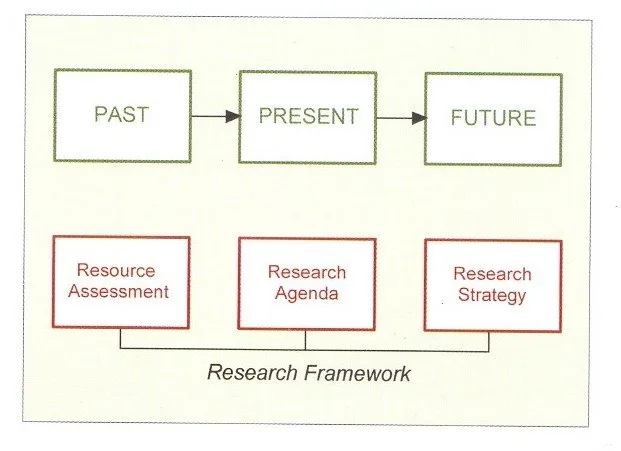 A research framework brings together a review of existing knowledge, questions for further
study and a strategy for addressing them. After Darvill (2005).
A landscape with a long history
Newgrange, Knowth and Dowth are the best known monuments of Brú na Bóinne. The draft emphasised the exceptional scale of its Neolithic passage tombs and the richness of their carved stone art, particularly at Knowth. It also argued for greater attention to the surrounding landscape and the many communities who lived there over thousands of years.
The review traced evidence from Mesolithic hunter-gatherers and the first farming communities through later prehistoric burial and settlement, early medieval kingship, monastic estates and Anglo-Norman influence. It also examined the Battle of the Boyne, country estates, mills, the Boyne Navigation and more recent rural buildings.
This broader view connected the famous tombs with the surrounding fields, homes, waterways and places of work. The draft also recognised Brú na Bóinne as a living landscape, with residents and farmers playing an essential role in its future.
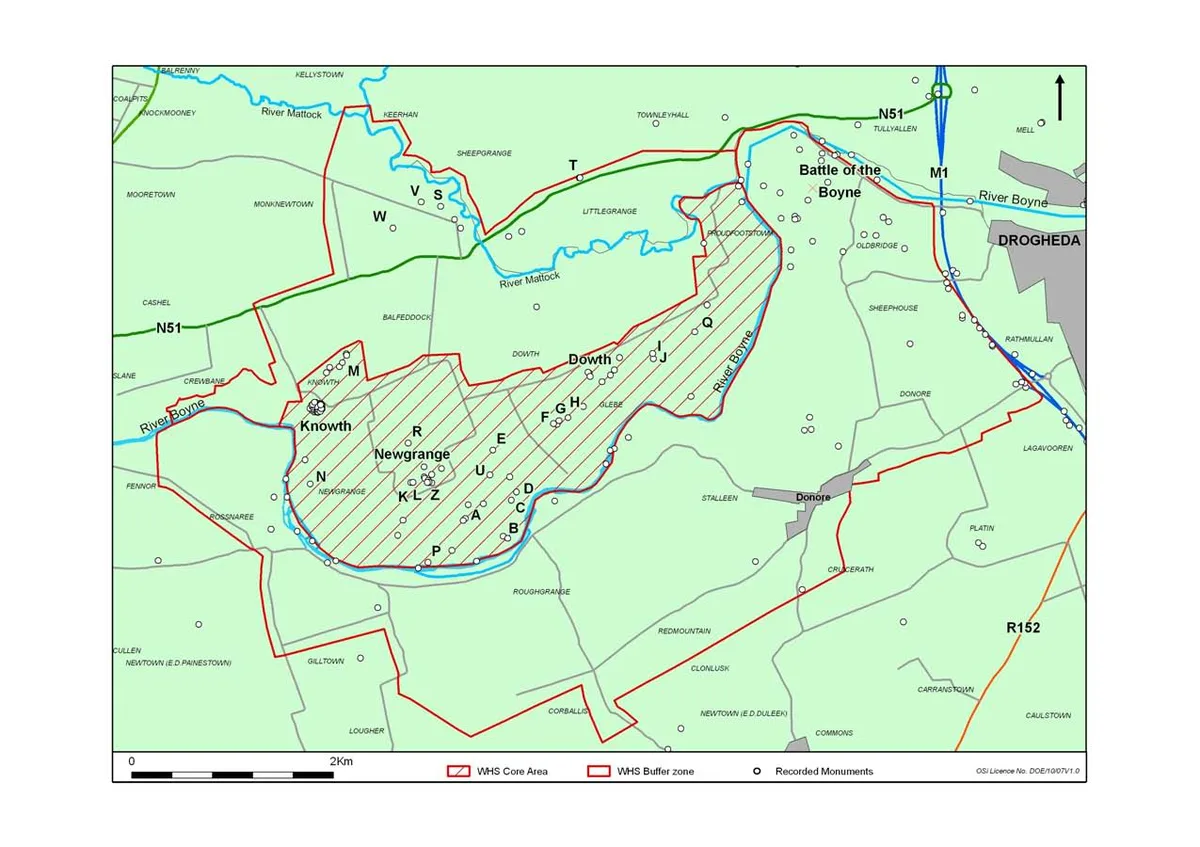 The World Heritage Site core area and buffer zone, showing recorded monuments along the Boyne. The scale bar is 2 km (1.2 miles).
What did the draft identify as the main gaps?
- Excavations had revealed settlement evidence, especially at Knowth, but where and how the wider population of tomb builders lived remained poorly understood.
- More precise dating was needed to establish the sequence of tomb construction and the relationships between passage tombs, timber circles, earthworks and later activity. The date and original extent of Newgrange's Great Stone Circle remained unresolved.
- Bronze Age and Iron Age settlement required further investigation. A shortage of visible remains did not necessarily mean that the area had been abandoned or lost its importance.
- Evidence for changing woodland, farming and land use was incomplete. Better environmental sampling could help reconstruct the landscape experienced by earlier communities.
- Despite its importance for movement, resources and cultural life, the River Boyne itself had received comparatively little archaeological investigation.
- Historic buildings, folklore and older excavation archives offered considerable research potential. Information needed to be brought together and made easier to use.
Five themes for future research
The draft grouped 42 research questions under five themes: People; Politics and Power; Landscape and Environment; Legacy; and The Living World Heritage Site. These covered daily life, belief, social organisation, connections with other regions, the reuse of ancient monuments and the experience of living in or visiting the site.
Its 18 proposed objectives included landscape-wide surveys, improved dating, reassessment of excavated material and further study of the passage tombs and their surroundings. They also included investigation of the river and the Battle of the Boyne landscape.
Practical proposals included shared inventories, an accessible online mapping database and a research centre with an education network. It also proposed a steering group to coordinate progress. These proposals reflect the December 2008 draft; this summary does not establish whether they were subsequently carried out.
Research, conservation and community
The framework called for research that would support the long-term protection of the site. It encouraged the use of existing collections and survey methods that could reveal buried features without excavation, alongside carefully targeted excavation where needed.
It also highlighted the need to understand visitor experiences, involve local communities, record vulnerable buildings and study how farming and development affected the landscape. Making research accessible was a central part of the proposed approach.
Read the December 2008 draft
Download the Brú na Bóinne World Heritage Site Research Framework: Consultation Draft, December 2008 (PDF, 99 pages).
This is a summary of the consultation draft, not the final published framework. The original consultation deadline was 12th January 2009 and has passed. Appendices on the consultation process, investigations and a selected site bibliography were left for completion in the final document.