George Coffey (1857 to 1916)
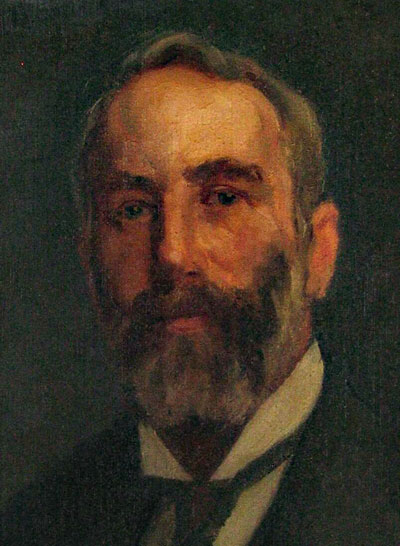 Prtrait of George Coffey by Count Casimir Markievicz.
George Coffey was the first Keeper of Irish Antiquities at the National Museum of Ireland. From that post he set Newgrange, Dowth and Knowth within the wider European context of prehistoric passage tombs.
He was born in Dublin on 2nd July 1857, the youngest son of James Charles Coffey, county court judge for Londonderry. Trinity College Dublin gave him a BA in 1878 and an engineering degree in 1881. Called to the Irish bar in 1883, he never practised in any serious way. A friendship with Robert Day, the Cork collector, drew him towards ancient remains.
Excavation and the museum
With Thomas Plunkett he opened the cairn on Topped Mountain, near Enniskillen, and he worked at Craigywarren crannog in Co. Antrim, a tumulus near Loughrea in Co. Galway and the caves at Kesh in Co. Sligo. A paper on each site went into the Transactions of the Royal Irish Academy. One of the Kesh caves was named after him following his work there in 1901.
Elected a member of the Academy in 1886, he was appointed curator of Irish antiquities at the National Museum in 1896 and became the first keeper of that department. He held the post until 1914, when he retired with a Civil List pension. A stroke in 1904 had already limited his public work. The late books were finished with difficulty and with help from E. C. R. Armstrong, who succeeded him at the museum.
He joined the Royal Society of Antiquaries of Ireland in 1891 and was a fellow from 1894. He sat on the councils of the Society and the Academy. In 1899 the Royal Hibernian Academy appointed him professor of antiquities. He was also an officer of the Académie Française.
Newgrange, Dowth and Knowth
Between 1892 and 1896 the Academy published his paper on the tumuli and inscribed stones at New Grange, Dowth and Knowth. The 1912 book, New Grange (Brugh na Boinne) and other incised tumuli in Ireland, carries that research further. The subtitle traces the influence of Crete and the Aegean on the art of the extreme west of Europe. On the map in the book, the unexcavated mound on the north bank of the Boyne is Tumulus B, the mound now called Site B.
The Bronze Age in Ireland followed in 1913, from Hodges Figgis in Dublin. Coffey wrote there about gold, weapons and tools. He traced contacts to the Aegean, Iberia and Scandinavia, and he kept the great Boyne tumuli apart from the smaller tombs at Carrowkeel. Frank Mitchell later called him one of the makers of modern European archaeology.
Coffey's research placed Newgrange, Knowth and Dowth within a wider European archaeological context. He believed that their architecture and carved decoration reflected influences from the Mediterranean, particularly Crete and the Aegean. He dated Newgrange to the Bronze Age, suggesting it could have been constructed around 1000 BC. Modern archaeological evidence has since established that Newgrange was built around 3200 BC, during the Neolithic period.
Other interests
In the late 1880s he was secretary of the Irish National League and wrote pamphlets on home rule. He married Jane Sophia Frances L'Estrange in September 1885, and they had a son, Diarmid. The house at 5 Harcourt Terrace was a meeting place for the Celtic revival. Douglas Hyde, a friend from Trinity, belonged to that company, and so did the wider circle of the Gaelic League. Away from the museum Coffey bound books and painted, and he took a hand in the Irish Arts and Crafts exhibitions. The Royal Hibernian Academy made him an honorary member.
After a long illness he died at Harcourt Terrace on 28 August 1916 and was buried at Deansgrange.
Principal archaeological works
- On the tumuli and inscribed stones at New Grange, Dowth and Knowth, Transactions of the Royal Irish Academy, 1892 to 1896.
- The origins of prehistoric ornament in Ireland, Journal of the Royal Society of Antiquaries of Ireland, 1894.
- Guide to the Celtic antiquities of the Christian period preserved in the National Museum, Dublin, 1909.
- New Grange (Brugh na Boinne) and other incised tumuli in Ireland, 1912.
- The Bronze Age in Ireland, 1913.