Dowth: Where Darkness, Stone and Memory Meet
By Harry Warren, published in Ireland’s Own, February 2026
Harry Warren visits Dowth, a 5,000-year-old burial tomb in the Boyne Valley, part of the UNESCO World Heritage Site, Brú na Bóinne.
It was on a still January afternoon that I turned from the narrow road in the Boyne Valley and made my way toward the great Neolithic mound of Dowth. The air carried the sharp bite of winter, cold enough that each breath drifted before me like a faint white cloud. The quiet of the landscape felt intentional, as though the land itself wished to lower its voice out of respect for what lay upon its gentle slopes.
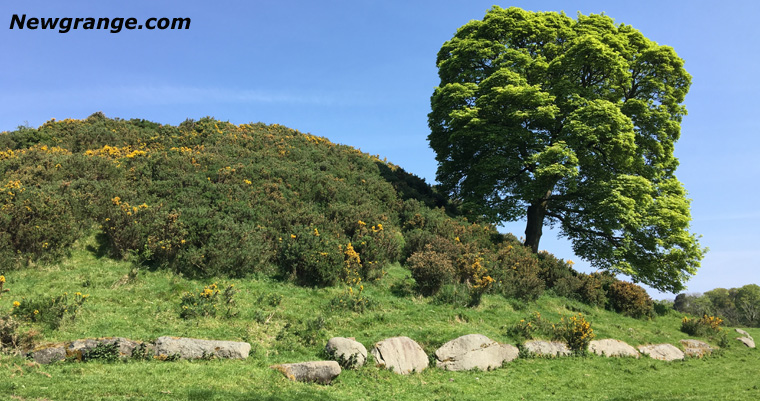 Dowth Megalithic Passage Tomb in the Boyne Valley, Ireland.
I had visited Newgrange and Knowth during brighter months, when visitors filled the paths and guides spoke with practised confidence, yet Dowth had always waited in the background like an older relative who preferred shadow and silence. Winter felt the proper time to approach a place whose very name has long been bound with darkness.
Dowth is a passage tomb, a prehistoric burial monument built of stone and earth, where a narrow passage leads into an inner chamber. Such tombs were raised during the Neolithic period around 3200 BC, long before the pyramids of Egypt, by early farming communities who shaped the land with patient skill.
Dowth rises from the earth with an understated dignity. At a distance it might be mistaken for a natural hill, softened by grass and weathered by centuries of wind and rain, yet the great kerbstones around its base declare unmistakably that it was shaped by human hands.
The rooks circling overhead called out in hoarse voices, offering their own greeting to the few visitors who arrived during the coldest months. Beyond them the River Boyne ran in a silver curve through the valley, steady and unhurried, as if it had all the time in the world. I felt as though I were stepping not only into an ancient landscape but into an ancient story still unfolding after thousands of years.
Unlike Newgrange, which has been carefully restored and shines with brightness, Dowth wears its age openly. Grass creeps over its stones and bramble hides the lower edges, but the engraved slabs still carry mysterious symbols.
A faint breeze moved across the mound, stirring the grass and whispering softly around the stones, as though echoing otherworld voices long since faded. Each step invited respect. This is not a monument polished for display but a survivor that has endured history with quiet strength. It felt less like a museum piece and more like a living part of the land itself.
As I walked around the mound the old legend of Dubhadh came to mind, a story told for centuries to explain Dowth’s name. According to tradition King Bresal wished to build a tower high enough to reach the heavens, and his sister, gifted with druidic power, cast a spell to keep the sun from setting so workers could build without pause.
When the king betrayed her trust the spell broke, the sun dropped, and darkness fell upon the land. In that sudden gloom the workers abandoned the building. The mound was said to be named for that fall into darkness. Standing there in muted winter light the legend seemed almost possible, as though the valley retained memory of ancient disappointment.
I traced a gloved hand lightly along one of the kerbstones and felt the shallow grooves carved long ago.
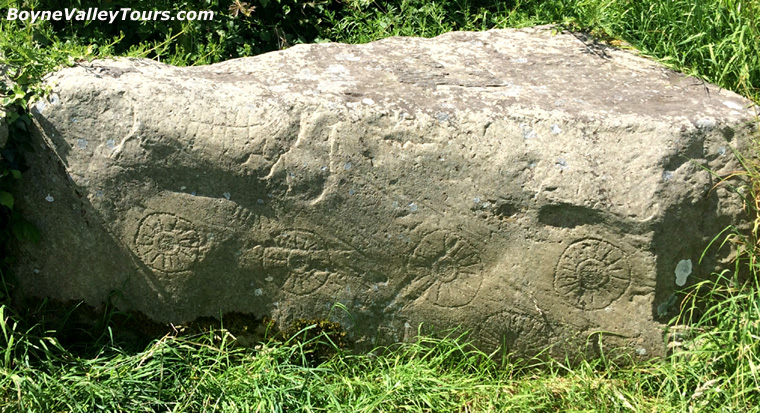 Dowth Kerbstone 51 - Stone of the Seven Suns.
The Stone of the Seven Suns, with its circles and radiating lines, lay partly hidden beneath a thin skin of frost, yet the artwork was clear enough to stir wonder. Other stones bore spirals and looping designs that hinted at meanings lost to time.
These carvings were the work of people whose imaginations shaped symbols that still speak across centuries. They remind us that the builders of Dowth were artists and thinkers as well as farmers and labourers, viewing the world with insight we are only beginning to grasp.
The mound contains two known passages called Dowth North and Dowth South. Neither is accessible today, yet archaeologists have studied them through surveys and historical records. The northern passage once led to a cruciform chamber that echoed with ceremonial movement. The southern passage was shorter and rested beneath a part of the mound that later collapsed.
Much damage to Dowth dates to the nineteenth century when treasure seekers used crude methods. Their blasting created the crater still visible on the summit. In spite of harm, the mound continues to reveal evidence of its ancient purpose as a burial and ritual site.
Excavations uncovered cremated human bone, fragments of pottery, decorated stones and a later souterrain from early medieval times, proving that generations continued to honour the place.
Research carried out at Dowth Hall in recent years transformed the understanding of this part of the valley. Archaeologists uncovered a ceremonial complex older than many known features at Brú na Bóinne.
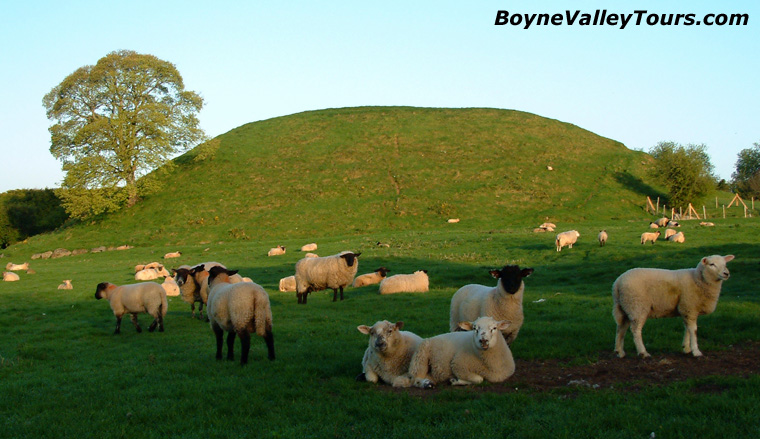 Dowth Mound viewed from the east.
Traces of timber structures, enclosures and decorated stones suggest Dowth was part of a vast ritual landscape drawing gatherings from across the region. This valley was not a lonely outpost but a vibrant centre where communities met to honour seasons, ancestors and gods.
The ambition of their building speaks of a proud heritage and sophisticated culture belonging to the earliest people of Ireland. The stones themselves are thought to have been gathered locally, hauled from riverbanks and nearby ridges with rope, timber and human strength.
As afternoon light faded the western sky turned pale gold. Dowth is associated with the winter solstice in a quieter way than Newgrange. While Newgrange greets the rising sun, Dowth is thought to honour the setting one. Near the solstice the sun’s final beam enters the southern passage. Even though the chamber is no longer intact the idea of that last ray slipping across carved stone remains deeply moving.
Watching the sun sink beyond fields I imagined ancient families gathered in stillness, waiting for light to touch the inner chamber and mark the turning year. It reminded me that endings and beginnings are often the same moment seen differently.
When true darkness arrived, it did so gently. The first stars appeared above the valley, bright points of light unmarred by city glow. The constellation of Orion lifted his familiar shape above the eastern horizon and the Pleiades shimmered like scattered dust.
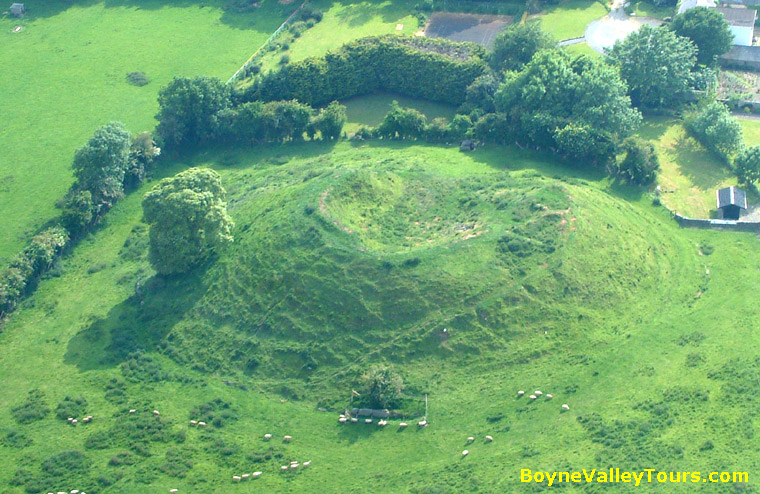 An Aerial View of Dowth Megalithic Passage Tomb.
Standing in the chill air I thought about the people who built Dowth and how they must have looked to the same stars for meaning and reassurance. Beneath the winter sky it was easy to imagine a connection stretching across time.
In moments like that faith and folklore seem to overlap. Whether one believes the mound was raised for gods, for ancestors, or for both, there is no denying a sense of the sacred. Even today many people speak quietly at Dowth, as if entering a natural cathedral shaped by human hands. The mound encourages reflection rather than explanation, inviting visitors to feel rather than analyse.
I began to make my way back along the quiet path. Grass crackled under my boots and the faint murmur of the Boyne drifted through darkness. Behind me the mound settled into shadow, yet its presence remained strong, like a companion choosing silence over speech.
I paused at the gate and looked back once more. A thin mist had begun to form around the base of the mound, softening its outline and giving it an almost floating appearance.
Dowth had shared something with me that day. It offered stories carved in stone, legends born of shadow, history marked by perseverance, and spirit shaped by hopes of countless generations. I felt grateful such places endure. They give a sense of belonging reaching beyond our own lifetime.
As I stepped onto the frost-touched road, I carried renewed appreciation for the deep ancient heritage of this valley where sky, earth and memory meet in quiet harmony. The silence felt companionable, and I left knowing the mound would remain, waiting patiently for future winters and thoughtful visitors alike.