Newgrange Kerbstone K52
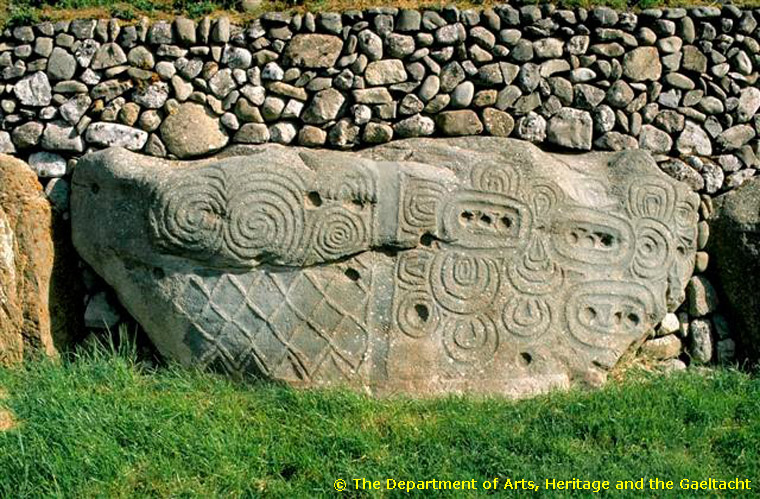
Kerbstone K52 stands on the north-western (rear side) of the kerb at Newgrange in the Boyne Valley, opposite the entrance passage. It is one of the 97 kerbstones numbered in Professor Michael J. O'Kelly's record of the monument.
 Newgrange Kerbstone K52 | Brú na Bóinne.
With the entrance stone (K1) and Kerbstone 67, Kerbstone K52 is one of three fully panelled kerbstones at Newgrange. Megalithic art on the stone is illustrated in Claire O'Kelly's corpus in Michael J. O'Kelly's Newgrange: Archaeology, Art and Legend.
Newgrange Kerbstone 52 stands out as a remarkable example of Stone Age artistic achievement. Similar to Kerbstone 1, a centrally placed vertical line divides the artwork into two main panels. The left panel is further subdivided into two sections. The motifs on the upper part are curvilinear, featuring spirals, while the lower panel exhibits angular art with lozenges. On the primary right-hand panel, the art is more integrated, predominantly showcasing a series of oval-shaped motifs and arcs composed of multiple elements.
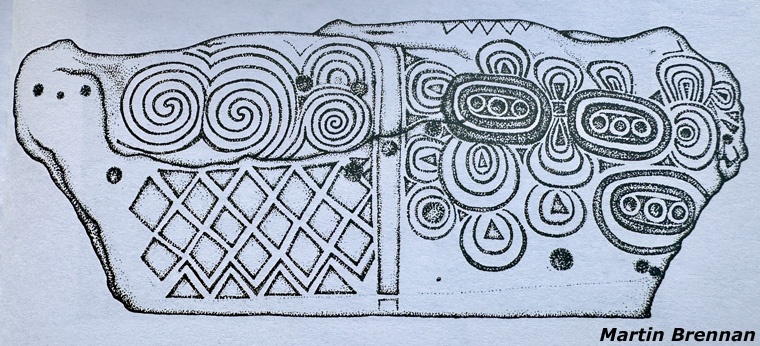 Newgrange Kerbstone 52 drawn by Martin Brennan.
Martin Brennan’s work played an important role in bringing the art of the Boyne Valley to a wider audience. Through detailed drawings and careful observation, he highlighted patterns and relationships within the carvings that are not always immediately visible on the stones themselves.
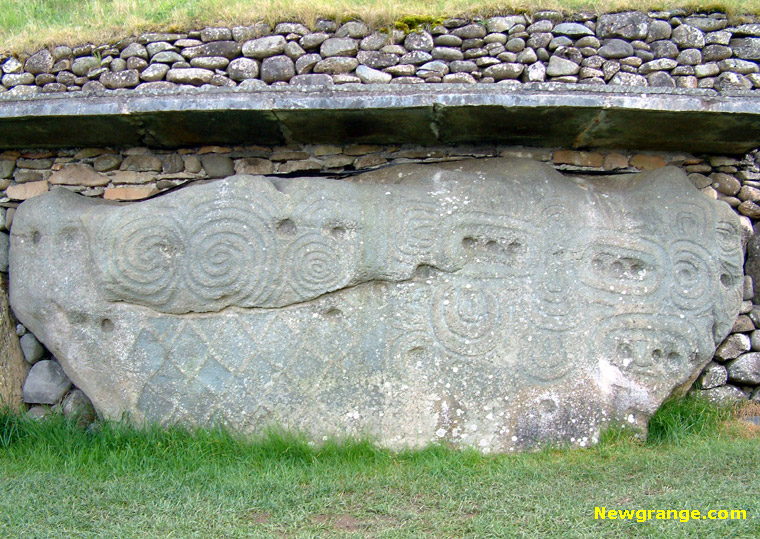 Newgrange Kerbstone 52 is a remarkable example of Stone Age artistic achievement.
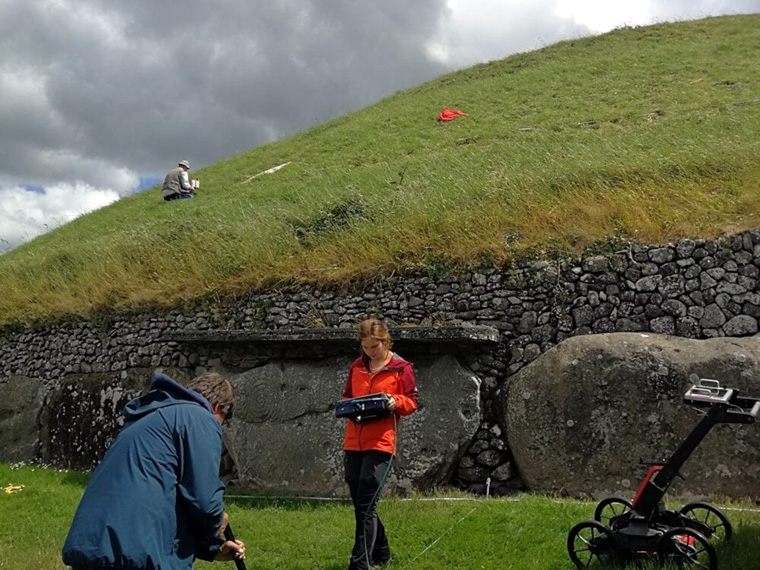 Researchers taking geophysical measurements at Newgrange in June 2022.
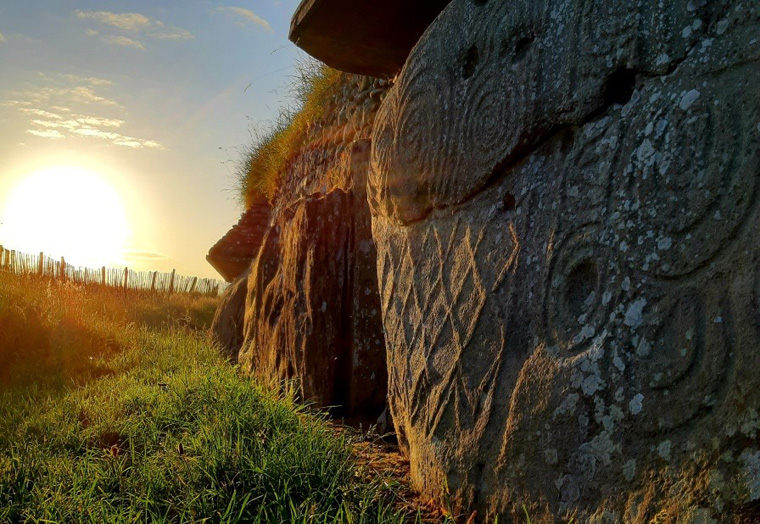 Newgrange K52 at sunrise in midsummer, photo by Clare, OPW.
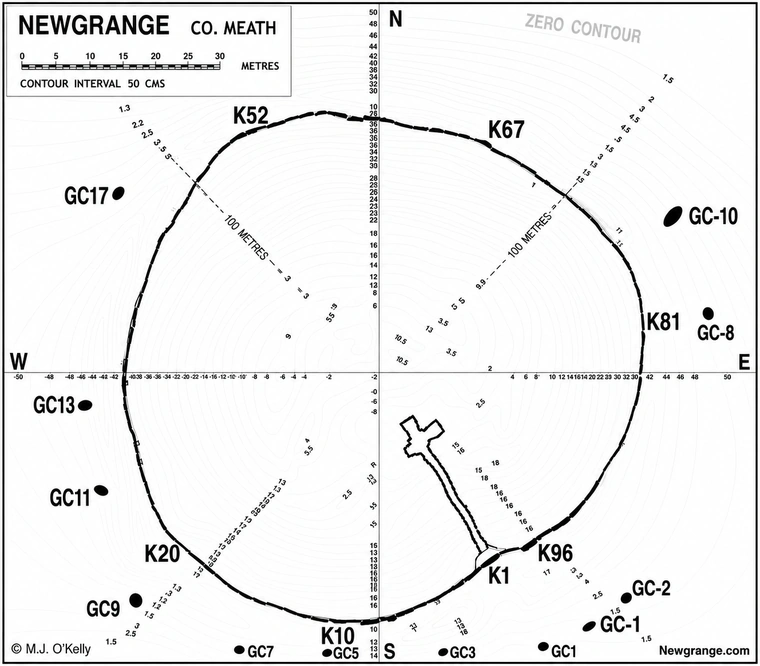 Plan of Newgrange Mound adapted from Newgrange - Archaeology, Art and Legend.
Newgrange | Brú na Bóinne
Newgrange is a prehistoric monument located in the Boyne Valley within Ireland's Ancient East, and is part of the Brú na Bóinne archaeological complex. Constructed around 3200 BCE, it is a large circular mound with a passageway leading to a central chamber. Newgrange is renowned for its winter solstice phenomenon, where sunlight penetrates the passage and illuminates the inner chamber, demonstrating an ancient understanding of astronomy.
Brú na Bóinne encompasses several prehistoric monuments, with Newgrange and Knowth being the most prominent. Brú na Bóinne is recognised as a UNESCO World Heritage Site, reflecting its importance in understanding the Neolithic period and the development of ancient Ireland.
Kerbstones are large stones that form a ring around the base of passage tombs in Ireland, and they are a distinctive feature of sites like Newgrange and Knowth. Many of the kerbstones, particularly at Knowth, are adorned with intricate megalithic art, featuring geometric patterns, spirals and symbols.