Newgrange Orthostat L19
Orthostat L19 carries one of the most distinctive spiral compositions in the Newgrange passage. The L series identifies the upright stones on the left-hand side of the passage when viewed from the entrance. Michael J. O'Kelly numbered those stones from the entrance, so L19 stands well along the passage toward the chamber. The panel was carved, and later pick-dressing cut into part of the design.
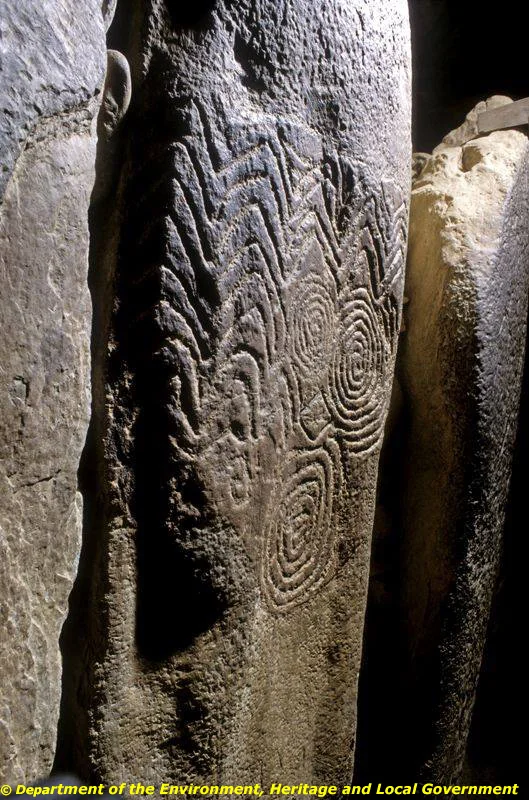 Orthostat L19, on the left-hand side of the passage at Newgrange.
Spirals, chevrons and a lozenge
The decoration features three prominent spirals, a lozenge motif and bands of chevrons. Zigzag patterns are among the most common motifs at Newgrange. The spirals are what make L19 stand out in the passage.
Some visitors see a face in the three spirals, and the stone is sometimes called a guardian. In Megalithic Art in Ireland (1993), Muiris O'Sullivan wrote that if the carving is read as a picture, the later pick-dressing leaves that face-like group standing, and he suggested it might have been thought of as an anthropomorphic guardian. The spirals, chevrons and lozenges belong to the ordinary geometric range of the Boyne tombs. What the carvers meant by them is not known.
Older spirals under the pick-dressing
Around the panel the surface is pick-dressed. A pointed tool was struck into the stone until the surround was lowered and pitted, and the carved panel stands a little proud of it. Pick-dressing could be used to finish a stone's surface, but it could also partially remove earlier carvings.
Claire O'Kelly's 1971 record of L19 shows the picking running across an older design. Two spirals were cut down until only traces remained. The dressing stops near the present ground line. Andrew Cochrane, citing that record, takes the stop as the reason rows of chevrons lower on the stone are still there. O'Kelly took pick-dressing at Newgrange to have been done after the stones were set, on faces that could still be reached. The stop near the floor on L19 fits that reading. Why one design was reduced and another kept is not known.
More than one stage of work
Orthostat L19 preserves evidence of changes to its carved surface. Earlier spirals were partly removed by pick-dressing, while the prominent three-spiral composition and lower chevrons survived.
The reasons for these alterations remain uncertain, as does the date when they were carried out.
The Discovery Programme
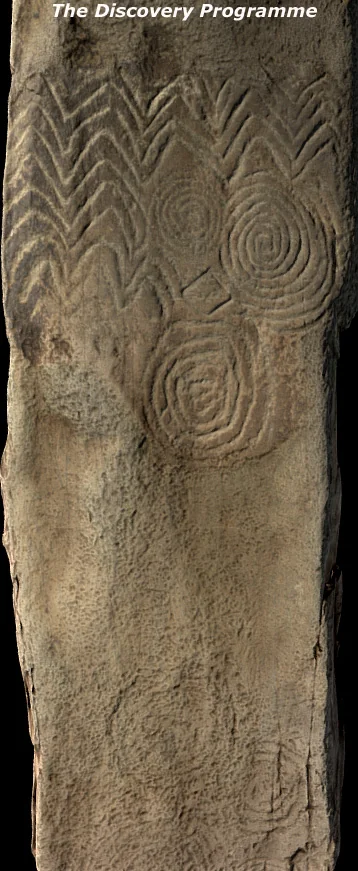
The Discovery Programme created a detailed 3D model of Orthostat L19 using scans recorded in 2014 and reprocessed in 2024 as part of the European 5Dculture project.
Description of Newgrange L19
Orthostat L19 is a stone dating from the Neolithic, located in the passage grave at Newgrange, Brú na Bóinne, Co. Meath, Ireland. It is situated on the west side of the tomb’s passage. Orthostat L19 is one of the best-known orthostats in the passage, and one of many decorated stones from Newgrange. The decorations were made by “pecking” the stone with a sharp implement, possibly flint or quartz.
The surface above and below the panel of designs has been dressed to it stands slightly proud of the remainder. The decoration on Orthostat L19 include spirals and chevrons - motifs seen across the corpus of decorated stones from Newgrange. Some of the decoration lies below the present ground surface and cannot be seen. There is also a modern supportive strut towards the top of the stone.
Newgrange: Archaeology, Art and Legend (London, Thames and Hudson, 1982)