Newgrange Orthostat R21
Orthostat R21 stands on the right-hand side of the inner section of the Newgrange passage, close to where the passage opens into the cruciform chamber. It is one of the few decorated stones that clearly displays two distinct approaches to Neolithic stone working: the earlier sculptural or plastic style and the later technique of pick dressing.
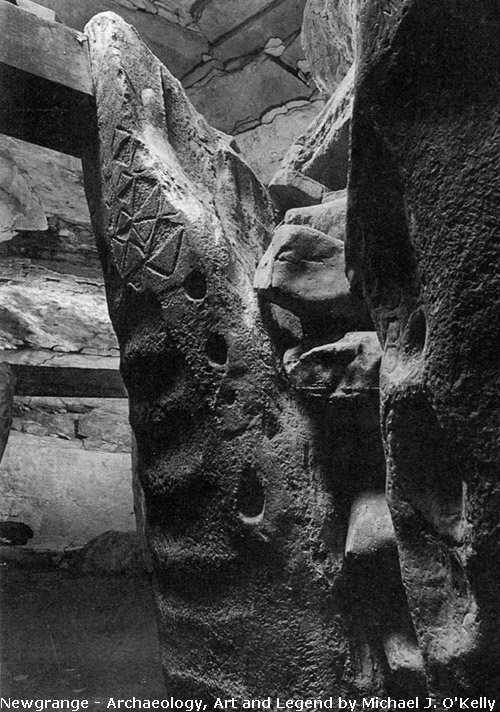 Newgrange Orthostat R21 from Newgrange - Archaeology, Art and Legend.
The Carved Surface of R21
The shallow grooves on R21 are not simply lines cut into the stone. They create a low relief design, leaving broad, rounded ridges between the picked channels. The result is a sculptural surface that makes use of the natural contours of the orthostat rather than treating it as a flat slab.
The later pick dressing altered the appearance of the stone by covering its surface with thousands of small hammer marks. This technique softened the original finish and produced a more even, dimpled texture. Pick dressing occurs throughout the passage and chamber at Newgrange, making R21 part of a wider programme of deliberate surface treatment within the monument.
Description by M. J. O'Kelly
Six shallow grooves were picked across the surface with well rounded ridges in between and the surface then pick dressed. There are two main types of megalithic art at Newgrange, the earliest of which is abstract and geometric design, known as the plastic style, and the later is pick dressing. Both can be seen on this orthostat.
Two Styles of Carving
Orthostat R21 is unusual because it preserves two different styles of Neolithic stone working on the same surface.
The plastic style is the earlier form of decoration. Instead of carving a pattern onto a flat surface, the artist shaped the stone with broad, shallow grooves that leave smooth, rounded ridges between them. The design follows the natural contours of the stone, giving it a sculptural appearance.
Pick dressing is the later technique. The surface was worked with countless small blows from a stone pick, creating a more even, textured finish. At Newgrange, this treatment can be seen on many passage and chamber stones.
Because both styles are visible on R21, archaeologists believe the stone was worked in more than one phase. It provides valuable evidence that the decoration of Newgrange developed over time rather than being completed all at once.
R21 in the Newgrange Chamber
Newgrange was excavated and restored under the direction of Professor Michael J. O'Kelly between 1962 and 1975. His work produced the definitive record of the passage tomb, documenting its decorated orthostats, kerbstones, roof-box, cruciform chamber and the famous winter solstice alignment.
R21 demonstrates that the decoration of Newgrange was not necessarily completed in a single phase. The combination of relief carving and later pick dressing suggests that some orthostats were reworked over time. As a result, R21 provides important evidence for the changing treatment of the passage and chamber during the life of the monument.
Understanding Newgrange Craftsmanship
R21 illustrates how the builders of Newgrange combined architecture, stone selection, surface treatment and artistic expression. Its carefully worked grooves, rounded ridges and pick-dressed finish demonstrate a sophisticated understanding of texture, relief and the effects of changing light within the passage tomb.
Although it is less well known than the entrance stone K1 or the richly decorated kerbstone K52, R21 is one of the most informative decorated orthostats inside Newgrange. By preserving both the earlier plastic style and the later pick dressing on a single stone, it provides valuable insight into the development of Neolithic art and the evolving history of the monument itself.