
Acoustical resonances at Newgrange and Loughcrew
In July 1994 Robert G. Jahn, Paul Devereux and Michael Ibison put a pure tone into six old stone chambers and listened for the note each one preferred. At Newgrange, and at Cairn L and Cairn I on Carnbane West at Loughcrew, that note sat at 110 or 112 Hz, inside the range of an adult male voice. Their survey is technical report PEAR 95002, March 1995.
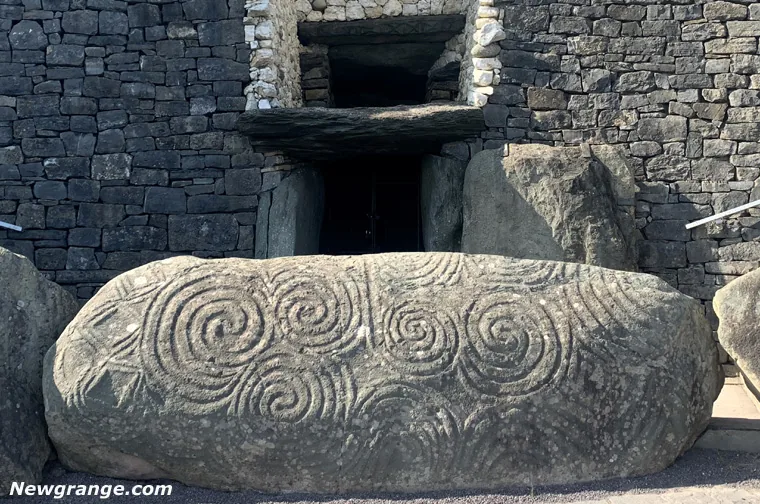 The entrance at Newgrange. The survey followed a standing wave from the chamber out to this doorway.
A note the chamber would hold
They worked with a small loudspeaker driven by a sine wave oscillator, and a portable meter for sound level. The speaker stood on a short tripod at the centre of the chamber. The frequency was swept through the lower audible range until the space rang, and the level was then mapped along lines that could be walked. Time on site was short, other visitors were coming through, and the chambers were awkward, so the maps stay rough. The note itself was steady. After a little practice they could find it again to within 1 or 2 Hz.
In every chamber they visited, the preferred frequency lay between 95 and 120 Hz. At about 110 Hz the wavelength is near 3 m (10 feet). The loud points, the antinodes, stood at the outer walls. Quieter nodes lay between those walls and the speaker.
Newgrange
Newgrange was the largest chamber in the survey. They describe a passage 19 m (62 feet) long, opening southeast, and a cruciform chamber 6.5 by 6.5 m (21 by 21 feet), a central space with three recesses. Each recess holds a stone basin. With the speaker at the centre the complex resonated at 110 Hz.
The two shorter recesses each carried two nodes and two antinodes, one antinode at the outer wall and one near the opening. The deepest recess held a third pair. In plan, a closed node stood in the central space and a closed antinode near the openings of the recesses and the passage.
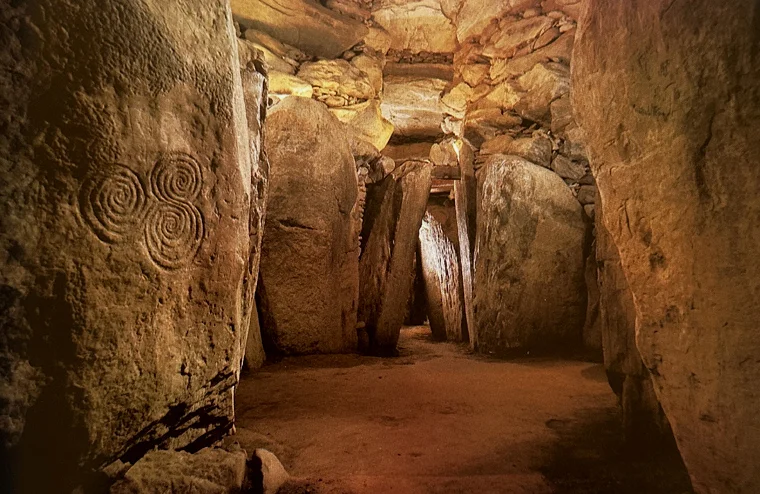 The passage at Newgrange. About twelve loud and quiet points were mapped along this length.
The passage was the surprise. It is only about 1 m (3 feet) wide and 2 m (7 feet) high, and the stones of the walls and roof are uneven, yet about twelve pairs of antinodes and nodes ran its full length, from the chamber to the outside entrance. The spacing was about half a wavelength, 1.5 m (5 feet), the pattern of a long wind instrument. The level fell as the wave travelled out, then recovered a little under the entrance capstone. At this frequency the passage is too narrow for any wave but the one running along its length.
Treating the central space as an ellipse 6.4 m (21 feet) by 4.0 m (13 feet) gives a calculated resonance of 103 Hz, close to the 110 Hz they measured. They give the west recess a depth of 2.2 m (7 feet), which yields 117 Hz, and the north and east recesses a depth of 0.8 m (2.6 feet), which yields 108 Hz. Five of the inner wall stones sit between the recess openings, where they would strengthen the loud ring of that central pattern.
Cairn L at Loughcrew
Cairn L stands on Carnbane West, on the ridge they call the Hill of the Witch. They give the cairn a circumference of 135 m (443 feet). The chamber inside is irregular, about 6 by 5 m (20 by 16 feet) and 3 m (10 feet) high, divided into seven cells by standing stones. One cell holds a basin and a carved backstone. The passage is about 5 m (16 feet) long and opens southeast, so that sunrise reaches a freestanding limestone pillar.
 Cairn L on Carnbane West at Loughcrew.
At 110 Hz the shorter cells each had a single antinode at the wall and a node just inside the opening. The deeper cell opposite the passage had two antinodes and two nodes. They did not follow the pattern far along the passage. Lines taken up the back walls of the large cell and the basin cell showed little change.
An ellipse with a semi-major axis of 2.4 m (8 feet) and a semi-minor axis of 1.7 m (6 feet) calculates at 112 Hz, close to the measured 110 Hz. They treat that agreement as partly luck. The north cell has a second node and antinode, and the southeast cell is irregular. Matching the central ellipse to a simple wave in each cell works for the northwest cell (99 Hz), the southwest (119 Hz) and the southeast (120 Hz). It fails for the northeast (67 Hz) and the north (58 Hz). The northeast cell is trapezoidal and seems to pull the node back inside the opening, which would raise its frequency. A standing stone jutting from the west wall of the north cell may be what adds the extra antinode there.
Cairn I
Cairn I lies a few hundred metres (a few hundred yards) southwest of Cairn L. It is smaller, and it is now roofless. The mound is about 55 m (180 feet) across, and the chamber about 4 m (13 feet) on its long axis. Again there are seven cells, and the walls are well carved. Eight lines mapped outward from the speaker gave a pattern like Cairn L, this time at 112 Hz. Every cell had one antinode at the outer wall and one node. In the three shorter cells farthest from the entrance, that node stood in the central space rather than inside the cell.
They treat the open chamber as an elliptical cylinder, 2.5 m (8 feet) by 1.8 m (6 feet), and allow a roof height of 2.0 m (7 feet) for the closed tomb. The simplest radial mode then falls at 106 Hz, near the 112 Hz they heard, with the node 0.8 to 0.9 m (3 feet) in from the wall. The sector stones, they suggest, may have been set to damp waves that run around the chamber, leaving a cleaner single note. The missing roof changes the vertical pattern from whatever the closed chamber once had. The chamber is low enough that a strong vertical wave was unlikely even then.
Carvings and the standing wave
Circles, ellipses and spirals in the rock art reminded the authors of a resonance seen in plan, and zig-zag lines reminded them of the rise and fall along a measured traverse. On a corbel at the left side of the west recess at Newgrange, two zig-zag trains have the same number of peaks and troughs as the standing wave mapped from the centre of the chamber out along the passage. One kerbstone carries three zig-zags above a dot and two concentric circles, a count and a spacing they match to the waves running from the centre into the recesses. The triple spiral on the entrance stone, and on other stones, they take as a looser sign of the three recesses answering together.
The paper
The authors call the work a pilot study. All six chambers they visited, these three among them, held a clear resonance near 110 Hz. The dominant pattern was the simple wave running out from the source, or along a passage, with little change around the circle or up the wall. In a few places the interior stones look as if they were set to favour that pattern. Whether the builders intended any of it, and what a chant on that note might have been for, they leave open.
Robert G. Jahn, Paul Devereux and Michael Ibison, "Acoustical Resonances of Assorted Ancient Structures", Princeton Engineering Anomalies Research, technical report PEAR 95002, March 1995.
Read the paper Acoustical Resonances of Assorted Ancient Structures.