Pigs, pannage and the winter solstice at Newgrange
Newgrange is famous for the shaft of sunlight that enters the chamber at winter solstice sunrise. Less is known about what people did here after the passage tomb was closed. A 2025 paper by Eric Guiry and colleagues looks at pig bones from the ground outside the mound and asks whether midwinter gatherings continued. The short answer is that they did, for centuries after the interior went out of use.
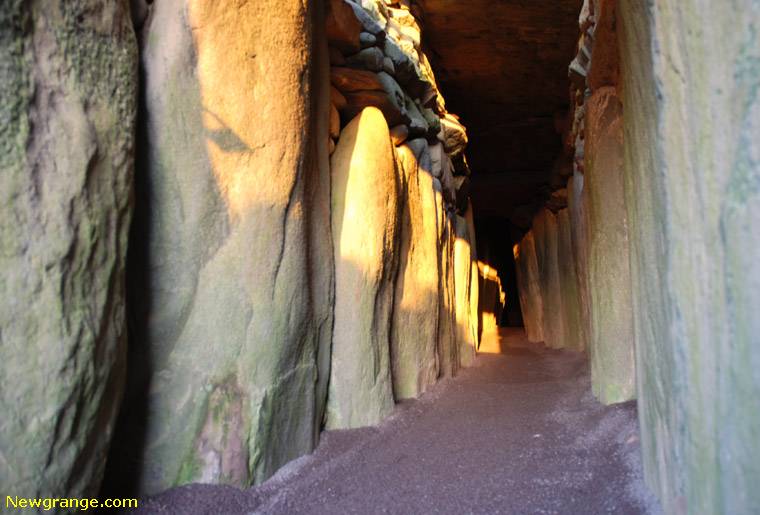 Winter solstice light in the passage at Newgrange.
After the tomb was closed
The great passage tomb was built around 3300 to 3000 BC. Deposition inside it continued until about 2700 BC, when the interior seems to have been sealed. People did not leave the site. Excavation around the front of the mound found pits, post-holes, stone-lined hearths and a huge quantity of animal bone, mixed with later pottery and other material that had accumulated over a long period.
Michael O'Kelly treated much of that bone as food waste from a Beaker settlement. Later work has shown that the so-called Beaker layers are mixed, and that Grooved Ware activity around the entrance belongs to the earlier third millennium BC. Guiry's team set out to date the pig remains themselves, and to see whether the animals were killed at a particular time of year.
What the bones show
Louise van Wijngaarden-Bakker's earlier study of the assemblage counted more than 12,000 animal bones, with pig and cattle dominant. At least 200 pigs are represented. Whole joints were still together in places, especially in front of the entrance, which points to slaughter and butchery on the spot rather than a scatter of kitchen scraps from everyday living.
New radiocarbon dates on seven pigs, with three cattle dates published earlier, place the pig deposits around 2600 to 2450 BC. That is late in the Neolithic, after the tomb was sealed and before Beaker pottery came into use in Ireland. Modelled together, the pig dates form a short pulse, perhaps a few years or a few decades rather than centuries of slow accumulation.
 Standing stones of the Great Circle in front of the entrance at winter solstice, where most of the animal bone was found.
Fattened on woodland nuts
Pannage is the old practice of turning pigs into woodland in autumn to fatten on mast, the crop of acorns, beech nuts and similar food. Chemical analysis of collagen from 67 pig bones shows a diet rich in those woodland nuts. The pigs sit apart from cattle killed at the same site, which browsed foliage rather than mast, and apart from pigs of later periods in Ireland, which often had more mixed diets including leftover food.
The animals were mostly killed in their third year, after a burst of weight gain. Tooth wear and bone fusion, read together with the isotope results, point to slaughter in late autumn and early winter, once the nut harvest had done its work. Cooler weather would have helped keep the meat, but the scale and tightness of the deposits make a purely practical cull a poor fit.
Still gathering at midwinter
If the pigs were fattened on autumn mast and killed soon afterwards, the feasts fall in the weeks around the winter solstice. The bones are concentrated outside the entrance, the same side of the monument that was built to catch the midwinter sunrise. By then the chamber was sealed, so nobody inside could watch the light travel up the passage. The gathering outside still kept to that time of year.
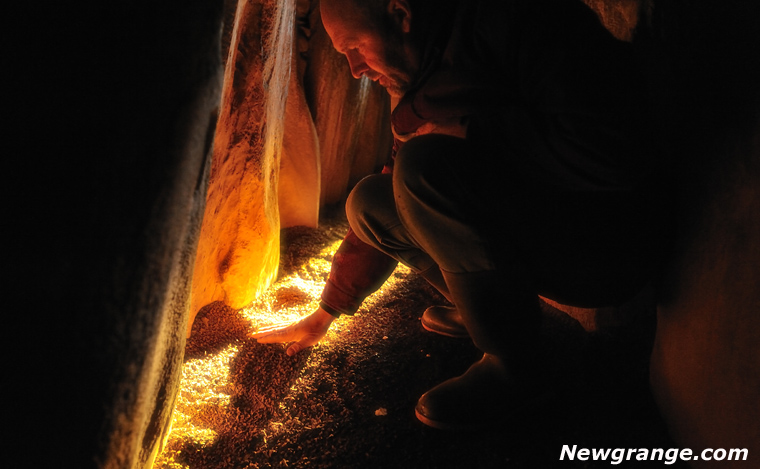 Winter solstice sunbeam on the chamber floor at Newgrange.
The authors treat this as ceremonial feasting rather than a farmyard dump. They do not claim that every pig was killed on a single solstice morning. They do argue that people were present at Newgrange for midwinter events in the 26th and 25th centuries BC, two centuries or more after the last generation to see the light from inside the tomb.
A wider world of winter feasts
Similar short bursts of midwinter pig feasting are known from timber and earthen monuments in southern Britain, including Durrington Walls. Those gatherings also belong to the 26th and 25th centuries BC and are tied to Grooved Ware pottery. Newgrange was not in decline after the tomb closed. Timber enclosures, hearths and earthworks around the mound belong to the same energetic later Neolithic landscape described in Beyond Newgrange.
A yellow clay bank later covered some of the deposits beside the kerb. Dates from pigs found beneath it suggest that the bank was built after about 2560 to 2450 BC. Cattle bones from the same area spread over a longer span than the pigs, so not every animal at the site belongs to that tight midwinter pulse.
Read the paper
Eric Guiry, Fiona Beglane, Neil Carlin, David Orton, Mathew A. Teeter and Paul Szpak, 2025. Pigs, pannage, and the solstice: isotopic insights from prehistoric feasting at Newgrange. Proceedings of the Prehistoric Society 91, 195-215. The article is open access.