Newgrange Great Circle Standing Stones
The Great Circle is the outer ring of standing stones around the Newgrange mound. It is the first feature many visitors notice when approaching the monument. Twelve stones survive today. If the circle was ever complete, it may have contained between thirty-five and thirty-eight stones; whether a full ring was erected remains uncertain.
 Standing stones of the Great Circle before the Newgrange facade.
The circle stands from 7 to 17 metres (23 to 56 feet) outside the kerb. Its average diameter is 103.6 metres (340 feet), enclosing roughly two acres. That makes it a little larger than the outer bank at Stonehenge, and the same diameter as the two inner circles at Avebury, though there is no known connection with either monument. The stones look plain beside the decorated kerbstones, but some of them carry traces of megalithic art.
The four tallest stones opposite the entrance, GC3, GC1, GC-1 and GC-2, rise between 2 and 2.5 metres (6½ to 8 feet) above the original ground surface. Many of the other survivors were broken in antiquity and now stand only a short distance above ground level. Select a thumbnail below for a larger photograph.
 GC1
GC1 GC3
GC3 GC5
GC5 GC7
GC7 GC9
GC9 GC11
GC11 GC13
GC13 GC17
GC17 GC-1
GC-1 GC-2
GC-2 GC-8
GC-8 GC-10
GC-10How the stones are numbered
The surviving stones are numbered from the entrance. West of the passage they run clockwise from GC1 to GC17. East of it they run anticlockwise from GC-1 to GC-10. The gaps in the sequence, such as the jump from GC3 to GC5, leave room for stones that may once have stood in the wider spaces.
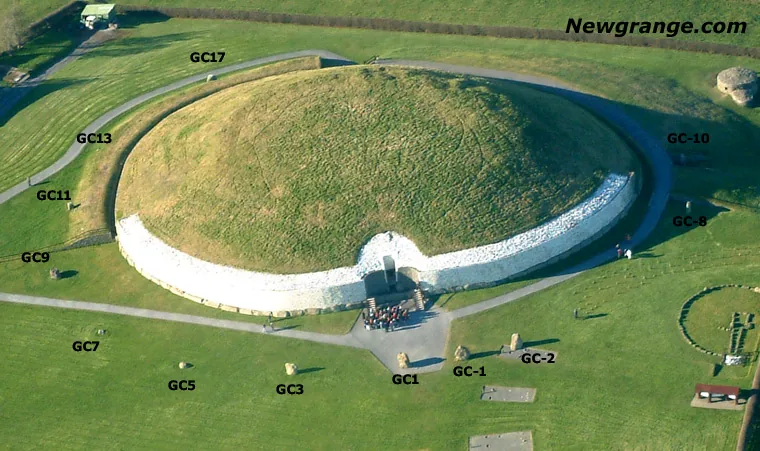 Great Circle stones: clockwise from GC1 to GC17 west of the entrance, anticlockwise from GC-1 to GC-10 east of it.
Those four tall stones form a flattened arc opposite the passage mouth. They sit farther from the kerb than the stones at the sides and back, so the ring and the mound share the same loosely ovoid outline, with the greatest space left in front of the entrance. That open ground reads as a forecourt: a defined place to stand before reaching the entrance stone.
What the stones are made of
Five of the standing stones are greywacke, the same sandstone used for the kerb and passage of the tomb. They were brought from the coast around Clogherhead, about 20 kilometres (12 miles) to the east, rather than gathered as glacial erratics from the fields nearby. Those five are GC3, GC13, GC17, GC-8 and GC-10. GC11 is grey sandstone. The other stones are a mixed set of distinctive rocks arranged mainly around the front of the mound: dolerite, basalt, limestone, volcanic breccia, spilite and conglomerate. GC9, on the western arc, is the striking reddish stone with quartz pebbles that many visitors notice first.
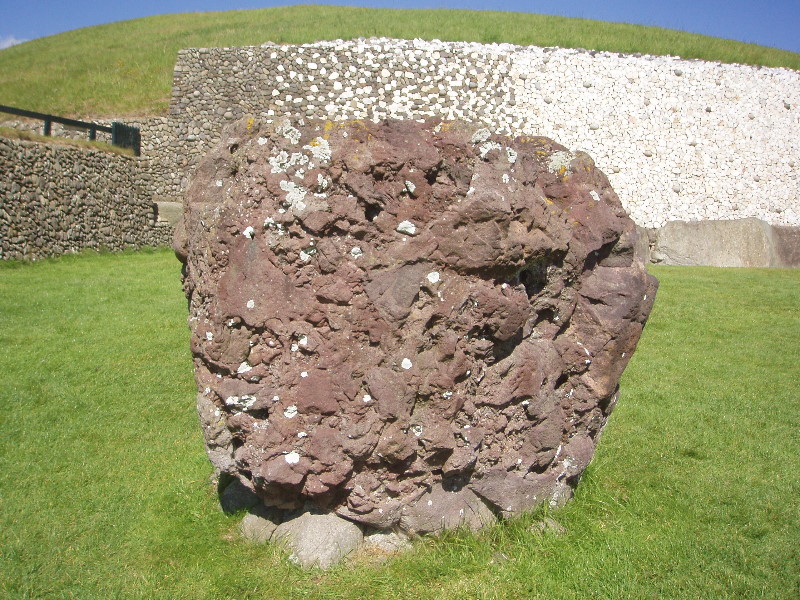 GC9, a volcanic breccia standing stone on the western arc of the Great Circle.
The mix of colour and texture at the front echoes the white quartz and granite cobbles of the reconstructed facade. These are not leftover slabs from the tomb. Several of the circle stones are too bulky for passage or kerb work, and none of the main tomb's structural stones are missing. GC17 is a large rounded boulder that would have been an awkward fit inside a chamber.
Was the ring ever complete?
That question is still open. A reconstructed complete ring would have had stones spaced approximately 9m (30 ft) apart. The gaps between the surviving stones are irregular, and excavation in front of the tomb found only a few possible sockets. Those positions were left unmarked, so that visitors would not treat uncertain pits as proven standing stones.
Early accounts after the passage was opened in 1699 already record those twelve stones, though the first drawing of the mound shows only nine. GC-10 had already fallen in prehistory, GC7 is broken near the base, and GC13 barely shows above the old cairn slip. GC-10 was raised again in 1973 once its original socket had been found. A nineteenth-century note of fifteen stones has not been confirmed and may have counted debris from later clearance.
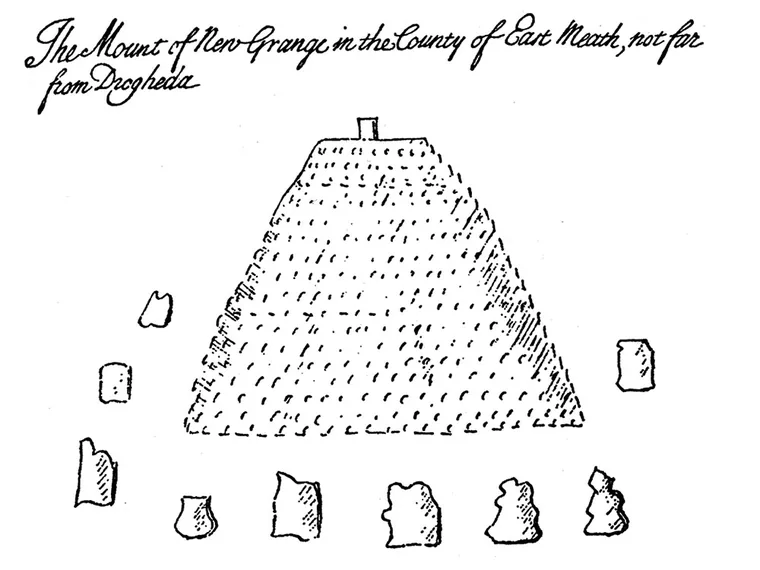 The first drawing of Newgrange, by Edward Lhwyd in 1699.
Lhwyd drew the cairn as a steep pile of loose stone, not the grass-covered mound seen today, and he marked a smaller pillar on the top. That summit stone is gone. The nine circle stones in the sketch sit around the base, with the largest grouped in front of the entrance, much as they still stand.
Shadows on the kerbstones
On the mornings around the winter solstice, the tall standing stones opposite the entrance throw long shadows across the forecourt onto the kerb. The sun is low enough then for those lines to reach the mound. GC1 casts a long shadow toward Kerbstone 2, immediately east of the entrance. GC-1 points toward Kerbstone 96, and GC-2 toward Kerbstone 93. The same low light can enter the chamber through the roof-box.
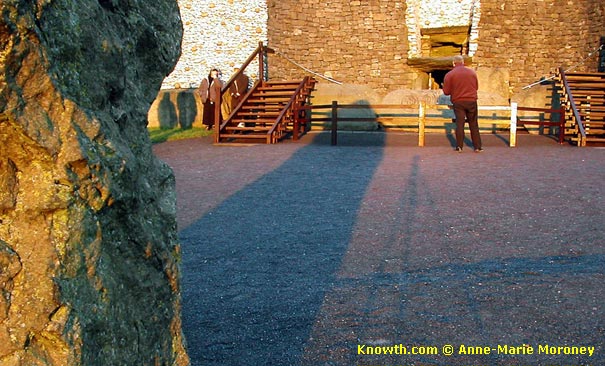
At sunrise on those mornings the shadow of GC1 also tracks across the face of Kerbstone 1, skimming beneath the triple-spiral motif on the west side of the entrance stone. GC-1 throws a shadow onto the same carving in mid-February and late October, and GC-2 around the equinoxes. Frank Prendergast's 1991 study models those sunrise tracks across K1 in detail.
Winter solstice sunset
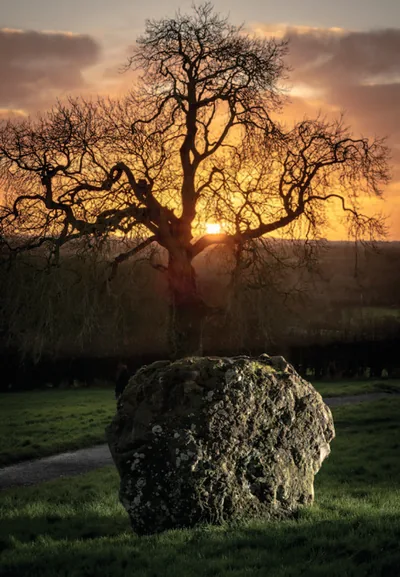
Ken Williams's 2023 paper records his own observations at sunset on the shortest days. Viewed from Kerbstone 18, the sun goes down behind GC9, so that stone's shadow falls on K18. The carving on K18 is on the hidden inner face, and was completely out of sight once the cairn was finished. K18 is one of two kerbstones with the richest decoration on those reverse faces, as recorded in O'Kelly's 1982 corpus.
If the possible socket for a missing GC8 is accepted, a stone there, depending on its height, could have thrown a shadow toward Kerbstone 13, the other of that pair. Williams does not treat this as a precise calendar. Construction of the cairn concealed the carvings on the inner faces; later collapse covered the exposed kerb and would have blocked or distorted the shadows. The shadow alignments therefore make most sense while the outer faces of the kerbstones were still visible.
Megalithic art on the standing stones
Ken Williams's 2023 study records megalithic art on four Great Circle stones: GC3, GC17, GC-8 and GC-10. The art consists mainly of picking: small marks struck into the stone surface, either scattered or closely grouped. Williams compares this work with picking on the kerbstones and structural stones of the passage tomb. An illustrated discussion of the carvings is on Megalithic art on the Great Circle at Newgrange.
- GC3: dispersed picking on the left side of the outer face, partly hidden by lichen.
- GC17: picking near the base on the eastern side, which Williams argues was applied before the stone was erected.
- GC-8: dispersed picking on both faces, including two roughly arranged arcs on the inner face. A very faint possible penannular ring, or incomplete circle, appears near ground level on the outer face.
- GC-10: close area-picking on the outer face, including near the base and along the right-hand edge.
When was the Great Circle erected?
The date remains debated. Where the stones sit in sockets, those sockets were cut into the old ground surface, not through the cairn slip that later buried the kerb. Occupation layers from the centuries after the tomb was built overlie the fill of several sockets, and cairn collapse piled against stones that were already standing. GC-10 is a clear case: charcoal and occupation debris surrounded its socket, but none was found in the fill, and the fallen stone had cairn material banked against its exposed end.
O'Kelly's excavations in the 1960s and 1970s therefore treated the circle as no later than the Late Neolithic and Beaker settlement around the mound, and possibly contemporary with the tomb itself. Work around GC-2 in the 1980s led David Sweetman to place the stones after a large pit circle to the south-east, then read as a Beaker monument. That sequence has never been settled. The pit circle is about 90 metres (295 feet) across. A smaller timber structure was found on the western side of the mound, and later hearths inside the Great Circle show that people were still gathering in the enclosed space long after the passage tomb was built.
Guiry and colleagues' 2025 study of pig bones from around the mound dates a concentrated phase of feasting to about 2600 to 2450 BC, still clustered around the winter solstice, centuries after the tomb itself had been sealed.
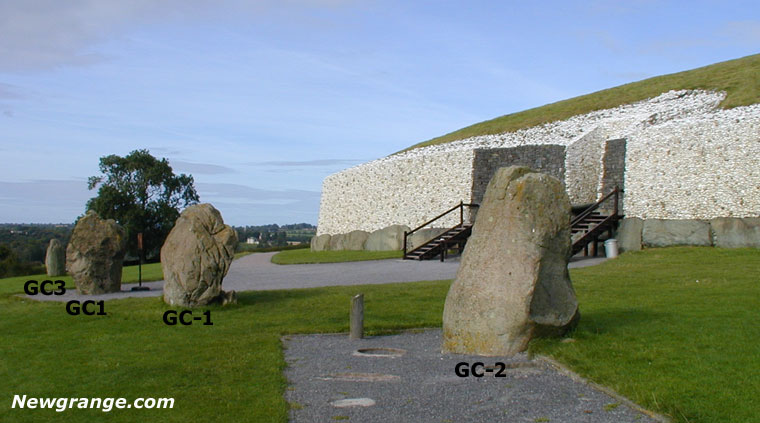 Standing stones of the Great Circle set back from the entrance to Newgrange.
Williams's 2023 review of the excavation records and comparable monuments argues that the stones were erected during the construction or use of the Neolithic passage tomb, rather than as a Bronze Age afterthought. A bank of yellow clay in the lower cairn slip appears to follow the gap between kerb and standing stones, which is hard to explain if the ring were a late insertion. None of this gives a year for every stone, or proves that the whole circle went up in one campaign.
Typical Bronze Age stone circles in Ireland are far smaller. The largest in the Cork and Kerry group is about 17 metres (56 feet) across, and the northern circles average well under 15 metres (49 feet). Even Grange in County Limerick, one of the big outliers, is less than half the diameter of the Newgrange ring. Settings of standing stones outside passage tombs are known at Knowth, where stones stand in line with the eastern and western entrance kerbstones, and similar arcs survive at other Irish passage tombs. Williams argues that the evidence supports an association between the Great Circle and this Neolithic passage-tomb tradition, rather than the later stone circles of the south-west and north. This interpretation does not settle every aspect of the circle's chronology.
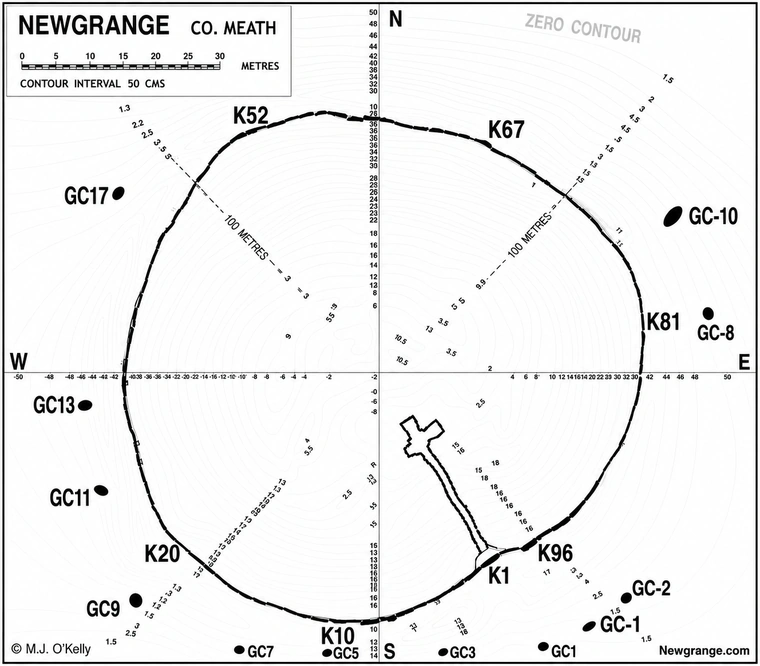 Plan of Newgrange Mound adapted from
Newgrange - Archaeology, Art and Legend.
Plan of Newgrange Mound adapted from
Newgrange - Archaeology, Art and Legend.