Newgrange Great Circle Stone GC3
Great Circle stone GC3 is one of the surviving standing stones in the Great Circle at Newgrange. It stands to the west of the entrance to the mound. It is one of the four tall standing stones opposite the entrance to the Newgrange mound.
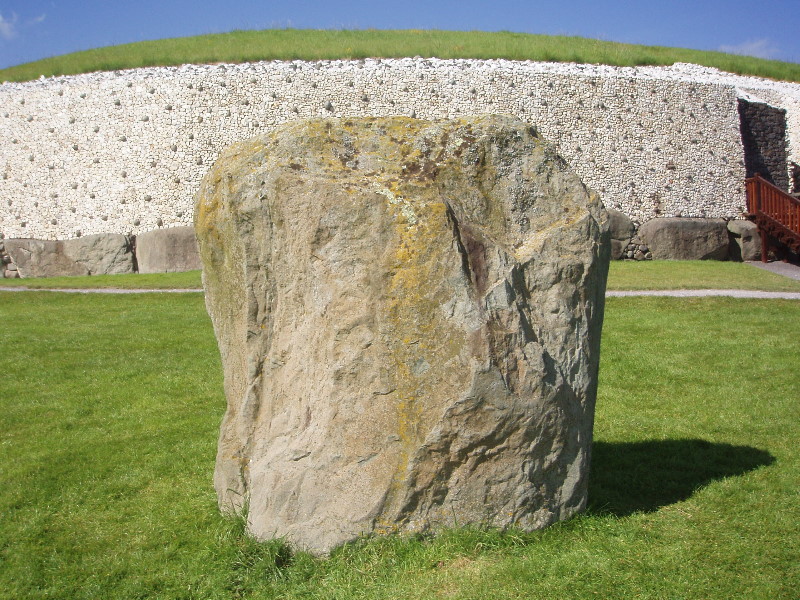 Newgrange Great Circle stone GC3.
The standing stones
Twelve Great Circle stones survive today. If the ring was ever complete, it may have contained between 35 and 38 stones; whether a full circle was erected remains uncertain. The four tall standing stones opposite the entrance to the Newgrange mound rise between 2 and 2.5 metres above the original ground surface. They are GC3, GC1, GC-1 and GC-2. Many of the other surviving stones were broken in antiquity and now stand only a short distance above ground level.
Megalithic art on GC3
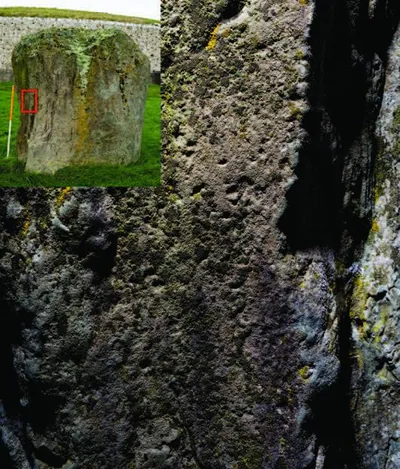
GC3 is one of the four tall stones opposite the entrance. Dispersed picking is visible on the left side of its outer face, partly concealed by lichen. The area immediately to the right of the picking appears to have been broken away.
Like GC-8, GC3 is greywacke, the stone preferred for the kerb and orthostats of the tomb. Williams notes that both stones may have been shaped so that the upper edge is regular and curved.
Source: Ken Williams (2023), Megalithic art on the Great Circle at Newgrange and the implications for chronology, The Journal of Irish Archaeology 32, 1-22.
Dating the Great Circle
The date of the Great Circle remains debated. Williams argues from the carvings, excavation records and comparisons with other monuments that it was erected during the construction or use of the Neolithic passage tomb. Its precise construction date remains uncertain.
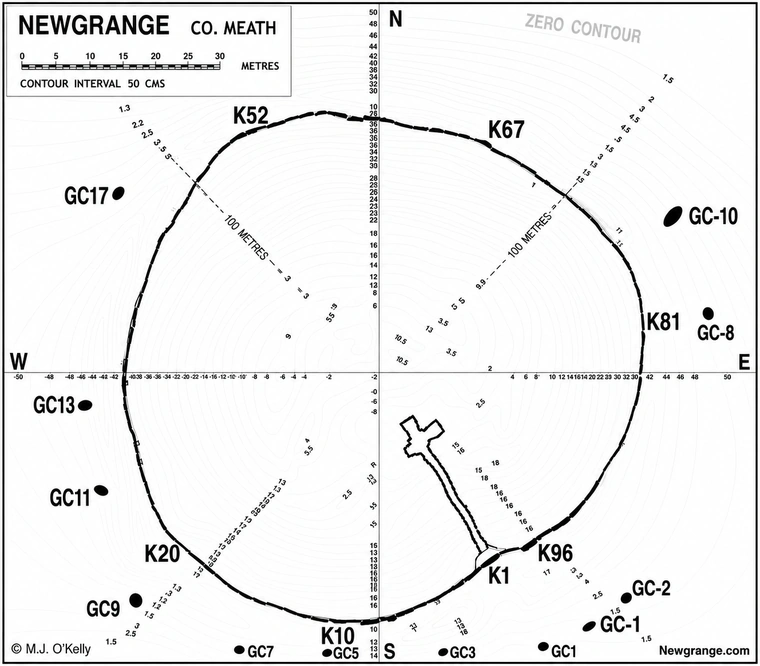 Plan of Newgrange Mound adapted from Newgrange - Archaeology, Art and Legend.
Newgrange – Archaeology, Art and Legend
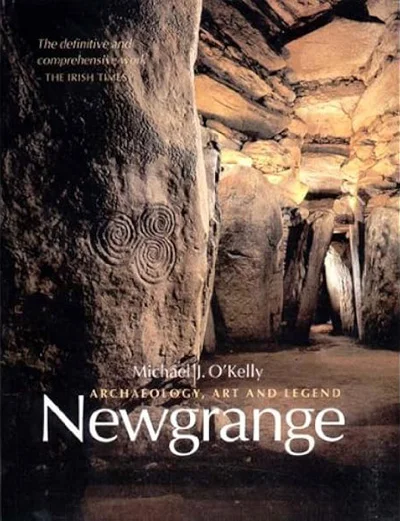
Newgrange – Archaeology, Art and Legend by Professor Michael J. O'Kelly and Claire O'Kelly is the definitive archaeological study of Newgrange and one of the most important books ever published on an Irish prehistoric monument.
Based on Professor Michael J. O'Kelly's excavations between 1962 and 1975, the book explains the construction, chronology, megalithic art and winter solstice alignment of Newgrange. O'Kelly also describes the excavation, interpretation and restoration of the great passage tomb using detailed archaeological records and architectural analysis.
Richly illustrated throughout, the volume includes the important contribution of Claire O'Kelly, who collaborated closely in the excavation and recording of the site from its earliest seasons.
First published in 1982, with a paperback edition in 1988, the book remains an essential reference for anyone interested in the archaeology, megalithic art and wider significance of Newgrange and the Boyne Valley.
Purchase at Amazon.com or Amazon.co.uk
Newgrange | Brú na Bóinne
GC3 is one of the four tall standing stones that face the passage entrance, rising between 2 and 2.5 metres above the original ground surface. Together with GC1, GC-1 and GC-2, it framed the approach to the tomb across the open ground enclosed by the Great Circle. The circle averaged 103.6 metres in diameter, larger than the kerb ring, and its centre does not coincide with that of the mound, so the builders planned an outer enclosure distinct from the tomb itself.
Excavation showed that Newgrange was constructed around 3200 BC, centuries before Stonehenge or the Egyptian pyramids. The Great Circle may belong to the construction or use of the Neolithic tomb, but it has not been securely dated to the same building phase. The monument lies at the heart of Brú na Bóinne, a UNESCO World Heritage landscape that includes Knowth, Dowth and many smaller sites. Passage access is by guided tour from the visitor centre; the tall entrance-side stones are among the most photographed features on the outer walk.