Newgrange Great Circle Stone GC7
Great Circle stone GC7 is one of the surviving standing stones in the Great Circle at Newgrange. It stands to the west of the entrance to the mound.
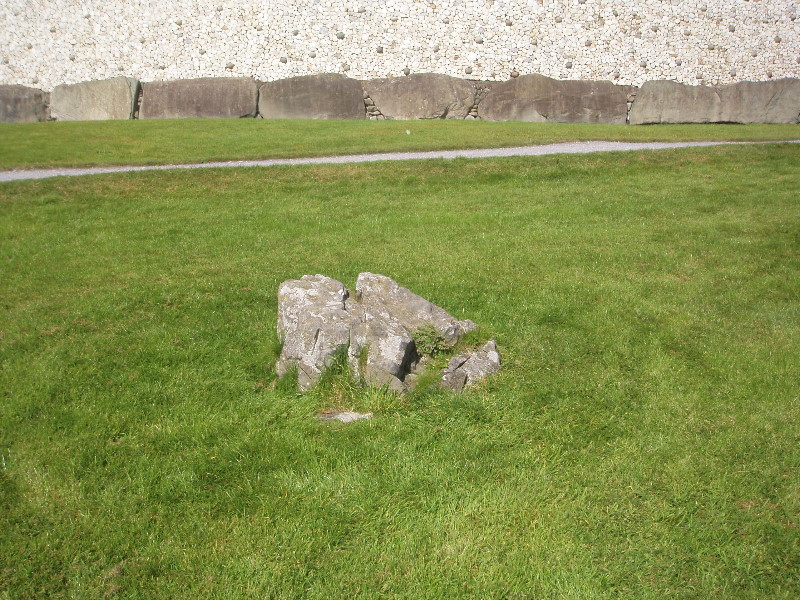 Newgrange Great Circle stone GC7.
The standing stones
The Great Circle originally consisted of approximately 35 standing stones surrounding the mound, although only 12 survive today. The four tall standing stones opposite the entrance to the Newgrange mound rise between 2 and 2.5 metres above the original ground surface. They are GC3, GC1, GC-1 and GC-2. Many of the other surviving stones were broken in antiquity and now stand only a short distance above ground level.
Megalithic art
Megalithic art has been recorded on four Great Circle stones: GC3, GC17, GC-8 and GC-10. The markings are mainly scattered or closely grouped picking on the stone surfaces. GC7 is not among the four decorated stones identified in Ken Williams's 2023 study. The circle has an average diameter of 103.6 metres (340 feet) and encloses an area of approximately two acres.
Dating the Great Circle
The date of the Great Circle remains debated. It has often been assigned to a later Beaker-period or Bronze Age phase, but Ken Williams's 2023 study argues, from the carvings and a reassessment of excavation records, that the stones were erected during the construction or use of the Neolithic passage tomb. The circle's precise construction date remains uncertain.
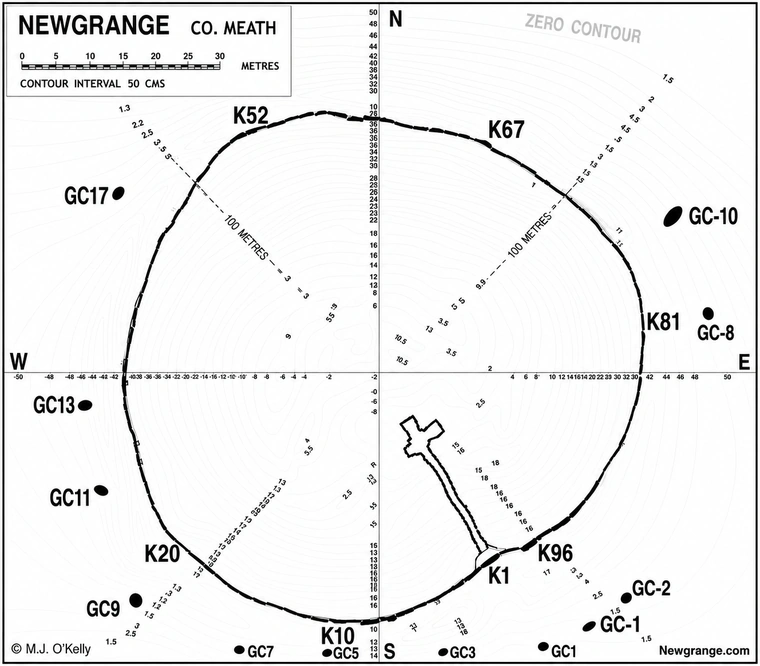 Plan of Newgrange Mound adapted from Newgrange - Archaeology, Art and Legend.
Newgrange – Archaeology, Art and Legend
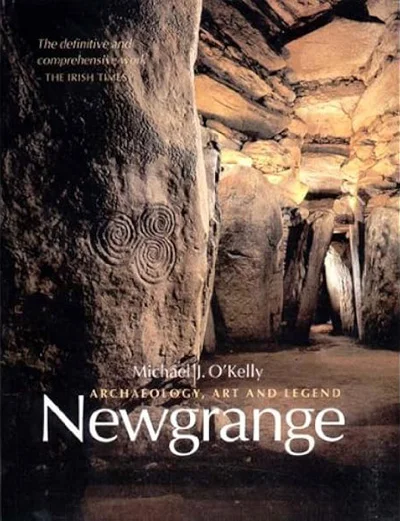
Newgrange – Archaeology, Art and Legend by Professor Michael J. O'Kelly and Claire O'Kelly is the definitive archaeological study of Newgrange and one of the most important books ever published on an Irish prehistoric monument.
Based on Professor Michael J. O'Kelly's excavations between 1962 and 1975, the book explains the construction, chronology, megalithic art and winter solstice alignment of Newgrange. O'Kelly also describes the excavation, interpretation and restoration of the great passage tomb using detailed archaeological records and architectural analysis.
Richly illustrated throughout, the volume includes the important contribution of Claire O'Kelly, who collaborated closely in the excavation and recording of the site from its earliest seasons.
First published in 1982, with a paperback edition in 1988, the book remains an essential reference for anyone interested in the archaeology, megalithic art and wider significance of Newgrange and the Boyne Valley.
Purchase at Amazon.com or Amazon.co.uk
Newgrange | Brú na Bóinne
GC7 occupies a position on the western side of the Great Circle, part of the wide stone ring that Claire O'Kelly noted as the first feature seen when approaching Newgrange from the visitor path. The circle originally contained about thirty-five standing stones; only twelve remain, and many of those, including GC7, were snapped off near ground level in antiquity. Even as stumps, they trace an enclosure roughly 103 metres across that was not concentric with the kerb of the passage tomb at its centre.
Professor Michael J. O'Kelly's excavations between 1962 and 1975 recorded each surviving circle stone as part of the wider Newgrange site plan published in Newgrange: Archaeology, Art and Legend. That work established a date of about 3200 BC for the tomb and documented how kerb, circle and mound were built as related elements within Brú na Bóinne. Today the Office of Public Works manages the monument; passage entry is by timed tour from the visitor centre, while the circle stones remain visible from the outer walk.