Newgrange Great Circle Stone GC-8
Great Circle stone GC-8 is one of the surviving standing stones in the Great Circle at Newgrange. It stands to the east of the entrance to the mound.
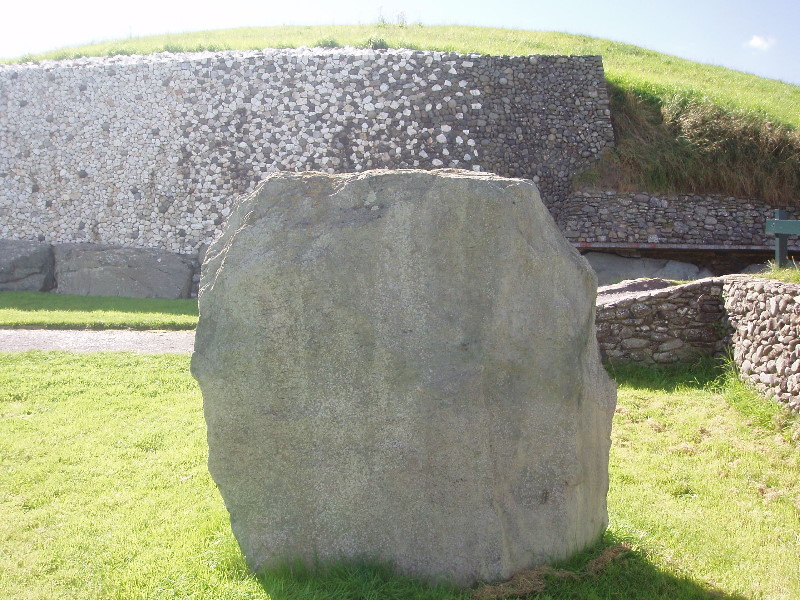 Newgrange Great Circle stone GC-8.
The standing stones
Twelve Great Circle stones survive today. If the ring was ever complete, it may have contained between 35 and 38 stones; whether a full circle was erected remains uncertain. The four tall standing stones opposite the entrance to the Newgrange mound rise between 2 and 2.5 metres above the original ground surface. They are GC3, GC1, GC-1 and GC-2. Many of the other surviving stones were broken in antiquity and now stand only a short distance above ground level.
Megalithic art on GC-8
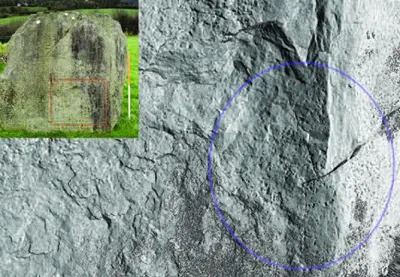
Dispersed picking is visible on both faces of GC-8, especially on the lower right of the inner face, towards the tomb, and more centrally on the outer face. On the inner face the marks appear to cluster into two roughly laid-out arcs.
A very lightly picked penannular ring, or incomplete circle, also appears near ground level on the outer face. Picking occurs on angled surfaces close to the base, where it would have been difficult to apply after the stone was erected.
Source: Ken Williams (2023), Megalithic art on the Great Circle at Newgrange and the implications for chronology, The Journal of Irish Archaeology 32, 1-22.
Dating the Great Circle
The date of the Great Circle remains debated. Williams argues from the carvings, excavation records and comparisons with other monuments that it was erected during the construction or use of the Neolithic passage tomb. Its precise construction date remains uncertain.
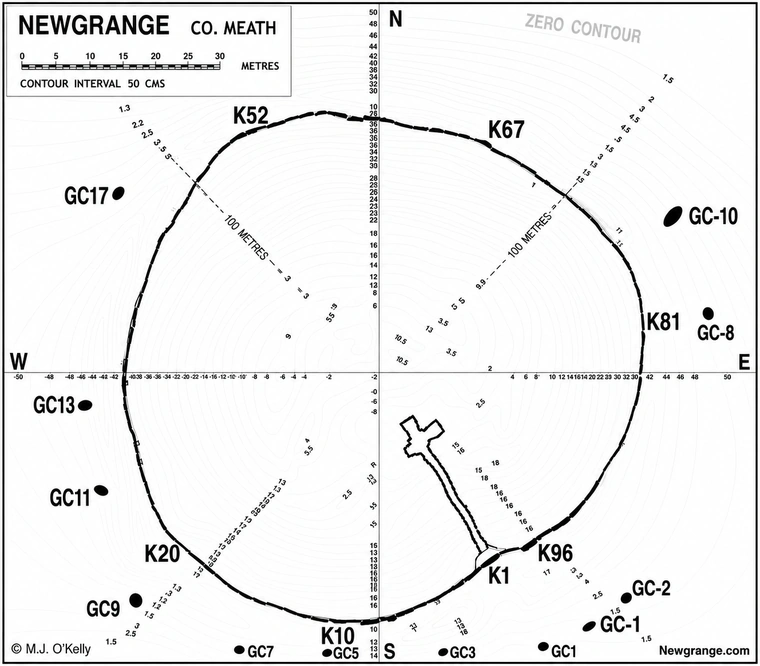 Plan of Newgrange Mound adapted from Newgrange - Archaeology, Art and Legend.
Newgrange – Archaeology, Art and Legend
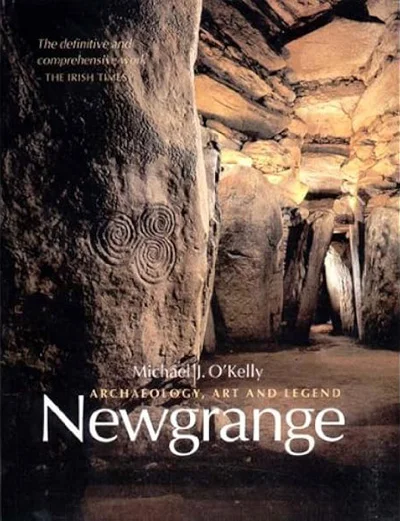
Newgrange – Archaeology, Art and Legend by Professor Michael J. O'Kelly and Claire O'Kelly is the definitive archaeological study of Newgrange and one of the most important books ever published on an Irish prehistoric monument.
Based on Professor Michael J. O'Kelly's excavations between 1962 and 1975, the book explains the construction, chronology, megalithic art and winter solstice alignment of Newgrange. O'Kelly also describes the excavation, interpretation and restoration of the great passage tomb using detailed archaeological records and architectural analysis.
Richly illustrated throughout, the volume includes the important contribution of Claire O'Kelly, who collaborated closely in the excavation and recording of the site from its earliest seasons.
First published in 1982, with a paperback edition in 1988, the book remains an essential reference for anyone interested in the archaeology, megalithic art and wider significance of Newgrange and the Boyne Valley.
Purchase at Amazon.com or Amazon.co.uk
Newgrange | Brú na Bóinne
GC-8 stands on the eastern arc of the Great Circle. It is one of the greywacke stones used in the ring, and its picked surfaces provide a connection with the megalithic art of the passage tomb. The circle has an average diameter of 103.6 metres and encloses roughly two acres.
The Boyne Valley passage tombs at Newgrange, Knowth and Dowth were inscribed as a UNESCO World Heritage Site in 1993. Newgrange is best known for the midwinter sunrise alignment, when light passes through the roof-box and travels the length of the passage to the chamber. The Office of Public Works manages the site; access to the interior is by guided tour from Brú na Bóinne Visitor Centre, while GC-8 and the other circle stones can be viewed from the path around the mound.