Megalithic art on the Great Circle at Newgrange
Ken Williams's 2023 paper in the Journal of Irish Archaeology records megalithic art on several of the large standing stones that form the Great Circle outside Newgrange. The carvings were missed for decades because they are faint, often partly hidden by lichen, and show up best under oblique lighting and photogrammetry.
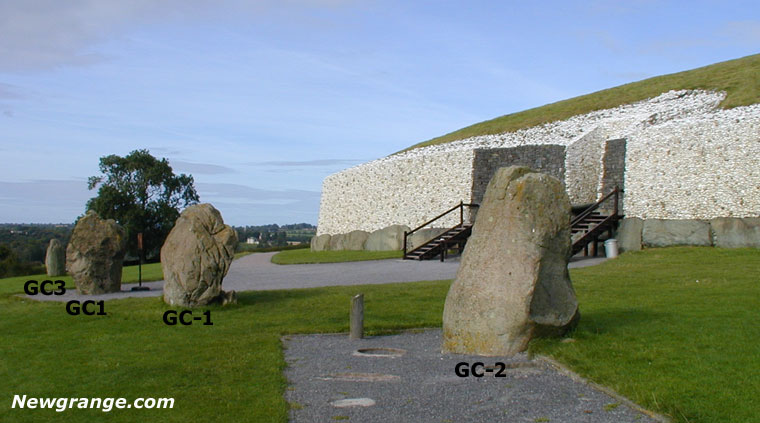 Standing stones of the Great Circle set back from the entrance to Newgrange.
The full article, with plans, excavation photographs and comparative sites, is available as a PDF.
The Great Circle
Twelve standing stones survive around the mound. If the ring was ever complete, it may have contained between 35 and 38 stones. Whether a full circle was erected remains uncertain. Stones west of the entrance are numbered clockwise from GC1 to GC17. Those east of the entrance are numbered anticlockwise from GC-1 to GC-10.
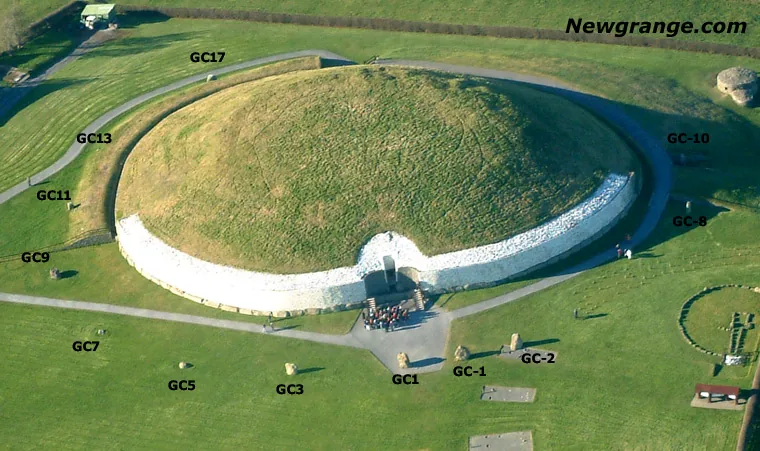 Numbering of the surviving Great Circle stones: clockwise from GC1 to GC17 west of the entrance, anticlockwise from GC-1 to GC-10 east of it.
The circle stands from 7 to 17 metres (23 to 56 feet) outside the kerb. Its average diameter is 103.6 metres (340 feet). The four tallest stones opposite the entrance, GC3, GC1, GC-1 and GC-2, rise between 2 and 2.5 metres (6½ to 8 feet) above the original ground surface.
The carvings
Williams records picking, small marks struck into the stone, on four Great Circle stones: GC-10, GC-8, GC3 and GC17. Some of the marks are scattered (dispersed picking). Others are grouped tightly together (close area-picking). Both techniques are familiar from the kerbstones and structural stones of the passage tomb.
GC-8
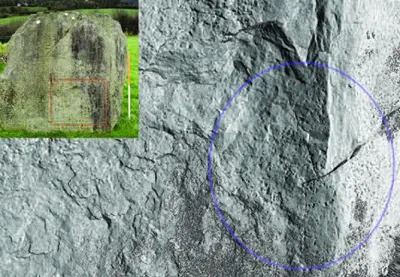
Dispersed picking is visible on both faces of GC-8, especially on the lower right of the inner face, towards the tomb, and more centrally on the outer face. On the inner face the marks appear to cluster into two roughly laid-out arcs.
A very lightly picked penannular ring, or incomplete circle, also appears near ground level on the outer face. Picking occurs on angled surfaces close to the base, where it would have been difficult to apply after the stone was erected.
GC3
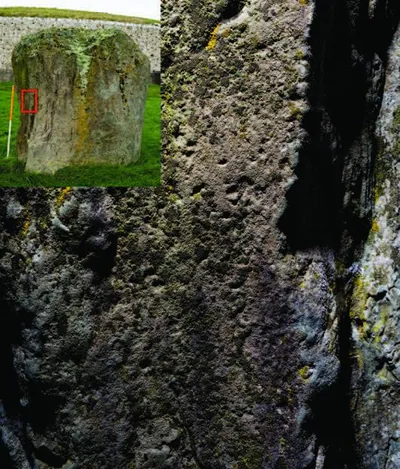
GC3 is one of the four tall stones opposite the entrance. Dispersed picking is visible on the left side of its outer face, partly concealed by lichen. The area immediately to the right of the picking appears to have been broken away.
Like GC-8, GC3 is greywacke, the stone preferred for the kerb and orthostats of the tomb. Williams notes that both stones may have been shaped so that the upper edge is regular and curved.
GC-10
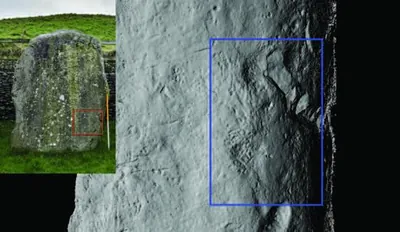
GC-10 has close area-picking on the outer face, mainly on the right-hand side and close to the edge. Other picking sits near the base, within natural depressions in the stone and on the surrounding surface. Williams first noticed this work in 2020, which led to the wider recording of the circle.
The stone fell onto its outer face early in the monument's history, which helped to preserve the picking. It is one of the taller survivors east of the entrance, standing about 2 metres (6½ feet) high.
GC17
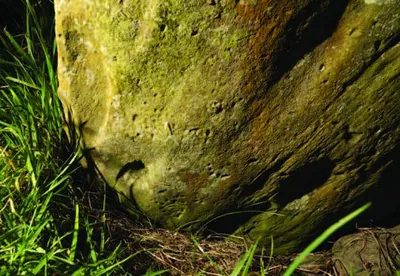
On GC17 the picking sits close to the base, on the eastern side and at an angle that would have made it almost impossible to carry out after the stone was in position. Williams argues that this work was done before the stone was erected.
GC17 stands on the western arc of the circle. It is a large rounded greywacke boulder, one of five Great Circle stones of that rock type, sourced in the same way as the slabs of the passage tomb.
When was the Great Circle built?
Williams writes that disagreement has persisted over whether the Great Circle was later than the tomb, contemporary with it, or earlier. Michael O'Kelly's excavations suggested that the standing stones were in place before the later occupation around the tomb, and that they could be earlier than or contemporary with its construction. After further work around GC-2 in the 1980s, David Sweetman proposed a later date, after the neighbouring pit circle.
Williams's review of the carvings, the excavation records and comparable monuments argues that the circle was erected during the construction or use of the Neolithic passage tomb, rather than in the Bronze Age. The picking matches tomb art. Some of it was applied before stones were set up. Five greywacke slabs were brought from a distance, as they were for the tomb itself. The circle and the kerb also share a loosely flattened ovoid shape, with larger stones concentrated near the entrance.
Similar settings of standing stones outside passage tombs are known at Knowth, Loughcrew, Carrowkeel and sites in Britain. That does not give a precise year for every Newgrange circle stone, but it places the Great Circle in the same Neolithic world as the tomb rather than among the much smaller Bronze Age stone circles of Cork, Kerry and the north.
Read the paper
Ken Williams, 2023. Megalithic art on the Great Circle at Newgrange and the implications for chronology. The Journal of Irish Archaeology 32, 1-22. Photographs on this page are by Ken Williams.