Shadow casting phenomena at Newgrange
Frank Prendergast's 1991 paper asks whether the tall standing stones in front of Newgrange were placed so that their sunrise shadows would fall on the entrance kerbstone at particular times of year. He modelled those shadows from a measured survey, then checked the results with photographs taken on site between 1986 and 1989.
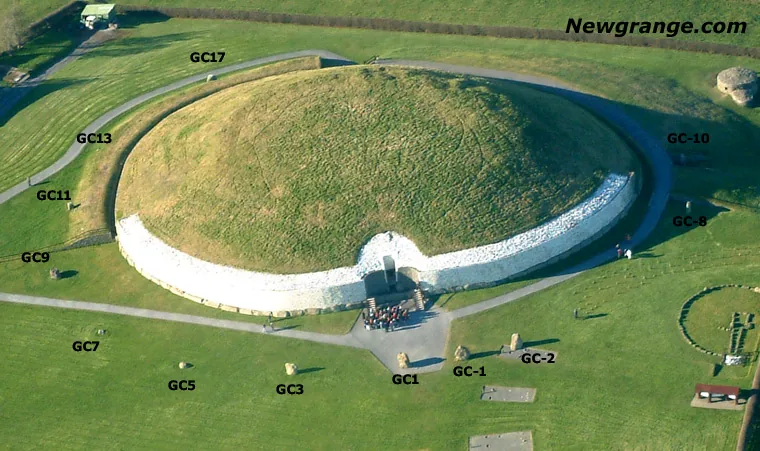 Great Circle stones: clockwise from GC1 to GC17 west of the entrance, anticlockwise from GC-1 to GC-10 east of it.
How the study began
On 20 December 1986 Frank Prendergast was at Newgrange to watch winter solstice sunrise in the chamber. Clare Tuffy, then manager of the monument, pointed out a second event outside: shortly after sunrise, the tip of the shadow from GC1 moved diagonally down the face of Kerbstone 1, passing beneath the triple spiral. The artist Martin Brennan had already described that play of light. Prendergast set out to measure it.
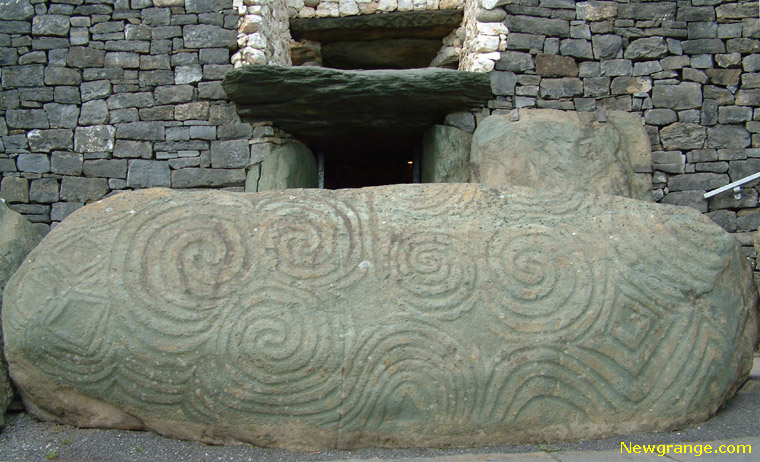 Kerbstone 1, the entrance stone. Prendergast's study tracks sunrise shadows across the triple spiral on the left-hand side.
He surveyed the Great Circle and the entrance facade in 1988, using a gyroscopic theodolite for true north and photogrammetry for the carved face of K1. Each standing stone was recorded as a wire-frame from measured points on its surface. The facade and the art on K1 were mapped from overlapping photographs, because the carving is too intricate to take by tape. Computer simulations then predicted when the shadows of GC1, GC-1 and GC-2 would cross the same motif. Site photographs from later winters and springs confirmed those dates. The paper was read in Dublin in 1991 and published in Survey Ireland. A revised author copy appeared online in 2020.
Shadows on the entrance stone
The model is about the vertical face of K1, not the long ground shadows that stretch across the forecourt. Three of the largest stones opposite the entrance, GC1, GC-1 and GC-2, take turns throwing a sunrise shadow onto the triple spiral. Each stone does so at a different season. The cycle, as Prendergast reads it, begins and ends at winter solstice.
- GC1 to K1 at winter solstice. On 20 December 1986 the shadow tracked beneath the spiral for about twenty minutes. A few days before or after the solstice, that same track falls on Kerbstone 2, immediately east of the entrance, instead of on the spiral itself.
- GC-1 to K1 in mid-February and late October, about 15 to 24 February and 18 to 27 October, when the Sun's declination is around minus 12 degrees. The shadow then crosses the width of the motif.
- GC-2 to K1 around the equinoxes, about 17 to 24 March and 19 to 26 September.
On those February and October mornings the shadow of GC-1 runs diagonally down the face of K1, across the triple spiral, and reaches the ground at the right-hand side of the central groove. The same twenty-minute window appears around the equinoxes with GC-2. GC1 is the exception. Its shadow can only reach the spiral at winter solstice, when sunrise sits at its furthest south-east. A few days either side of that, the track falls on Kerbstone 2 instead.
In the Bronze Age, Prendergast's model has the winter-solstice shadow of GC1 passing through the left side of the spiral, about 0.3 metres east of the path seen today. He ran the same simulation for about 3200 BC, when the tomb was built, and for the present day, so that the computer tracks could be compared with photographs. The Earth's tilt has changed a little since then, so a modern photograph shows the shadow skimming beneath the carving rather than through it. After the spring equinox, shadows stop hitting K1 until the Sun returns in September. The next event in his sequence is not on the kerb at all.
GC3 and GC5
GC3 casts a dawn shadow onto the base of GC5 in late April and mid-August, about 19 to 24 April and 18 to 23 August. GC5 stands only about half a metre (20 inches) above the ground, and that is taken as its original height. The alignment lasts about six mornings. Prendergast treats those dates as the northern mid-declination pair in the same rough seasonal scheme, not as a precise calendar.
Two other stone-to-stone lines look like solstice alignments on paper, GC-2 to GC1 at summer and GC11 to GC7 at winter. He set those aside because the stones are not neighbours in the ring, and he judged the matches fortuitous.
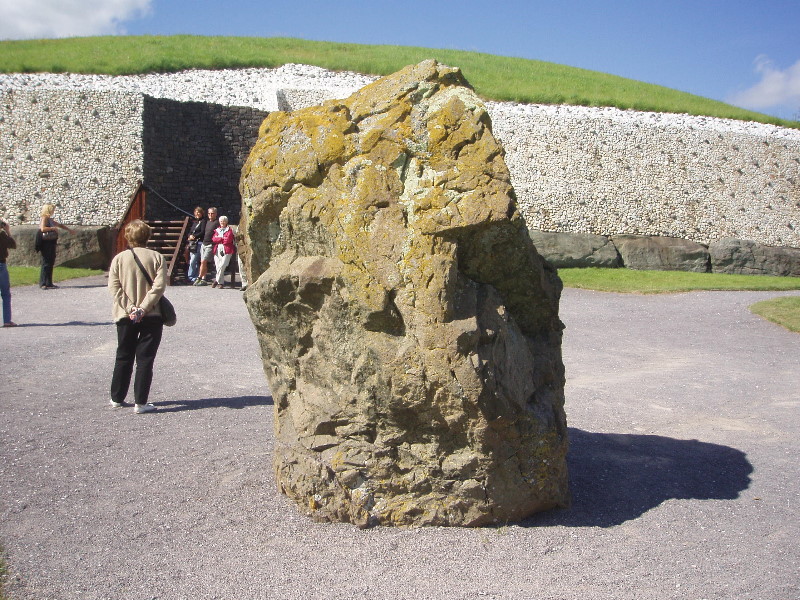
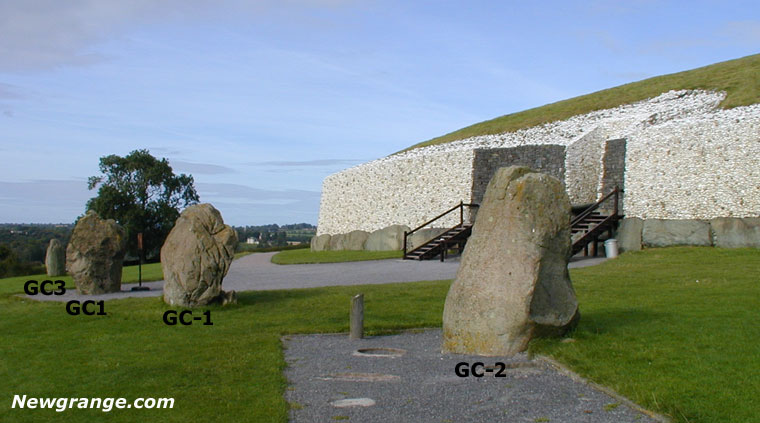 Standing stones of the Great Circle in front of the Newgrange entrance.
Was the ring meant to be a circle?
O'Kelly numbered the stones with gaps so that sockets for missing members could be added later. He also warned that the numbering was a convenience for excavation, not proof that a full ring had ever stood. Prendergast found no extra sockets, and he tested the twelve survivors as they stand. Fitting a circle, and then an ellipse, through their centres left residuals of several metres. The spacing of the stones is statistically irregular, closer to a random scatter than to an even ring. The average gap from each stone in to the kerb is about 11.8 metres (39 feet), with a range of roughly 9.6 to 14.1 metres. The centre of the ring and the centre of the cairn sit about 4.3 metres (14 feet) apart.
He also compared the spacing with Scottish tombs that really are ringed by more evenly placed stones, such as Balnuaran of Clava. At Newgrange the stones bunch toward the entrance and thin out elsewhere. For Prendergast that argued against a carefully set circular enclosure, and left room for another explanation: that some of the stones were placed for the shadows they throw.
Moving the stones
He tested that idea in the computer model by shifting GC1, GC-1 and GC-2 along the line of the ring, or in and out from the kerb, by about half to one diameter of each stone's base. In almost every case the sunrise shadow then missed the triple spiral. Move GC3 or GC5 by more than one basal diameter and the April and August alignment fails as well. The stones, as they stand, sit close to the positions that make the effect work.
When was the circle built?
The shadows only work if the standing stones can see the face of K1. O'Kelly described a two-phase collapse of the mound, the later one a sudden slide of stones that reached the Great Circle in front of the entrance and ran well beyond it to east and west. That slip would have buried the front of the kerb, including K1, and blocked any view from the standing stones. If the shadows on the spiral were intended, the circle had to be standing before the cairn came down.
He follows David Sweetman's 1985 excavation around GC-2. O'Kelly had found trenches of a pit and post enclosure running up to the west and east sides of that stone, but not under it. Sweetman reopened the ground at the west and south faces and showed the same trenches continuing beneath the monolith. The base of GC-2 sat above nearby burial pits that held flint, cremated bone and charcoal dated to 2015 ± 65 bc. Sweetman concluded that the standing stones were later than the Beaker-period pits, and could not be earlier than about 2015 bc, some five centuries after the passage tomb. Prendergast reads the shadows as a possible seasonal marker from that later use of the site.
That chronology is not settled. Ken Williams's 2023 paper argues that the circle belongs with the Neolithic tomb rather than with later stone circles. Prendergast's measurements of the present-day shadows do not depend on that debate. His interpretation of why the stones were placed where they are does.
A low-precision seasonal marker
Prendergast does not claim one-day accuracy. Each shadow event lasts several mornings, and he treats the equinox as a broad horizon event rather than a single civil date. The carved art on K1 stops at ground level, so the stone was decorated after it sat in the kerb. What struck him is that the same motif is hit again and again: at winter solstice, at the mid-season dates in February and October, and around the equinoxes. The slope of each shadow on the face of the stone also follows the climb of the rising Sun.
Those dates do not match the later Irish quarter-day festivals of Imbolc, Bealtaine, Lughnasa and Samhain. They sit instead at winter solstice, at the mid-point of the Sun's travel between solstice and equinox, and at the equinoxes themselves. He suggests that GC1, GC-1 and GC-2 may have been set so that people could mark those periods for ceremony or gathering. The April and August pairing of GC3 and GC5 falls at the matching northern mid-declination, and he notes a similar April and August sunset line at Balnuaran of Clava in Scotland.
He also warns that the sample of stones is small. A chance test of the four alignments does not, on its own, prove intention, and similar shadow events need to be found at other sites before the idea can be pressed hard.
Read the paper
Frank Prendergast, 1991, revised 2020. Shadow Casting Phenomena at Newgrange.