Ken Williams
Ken Williams is an Irish photographer and researcher specialising in prehistoric monuments and megalithic art in Ireland and western Europe. Originally from Drogheda in the Boyne Valley, he is best known for his long running photographic project, Shadows and Stone.
 Kerbstone 67 at Newgrange | Shadows and Stone.
His work focuses particularly on the passage tombs of Newgrange and Knowth, where his specialist lighting techniques have revealed remarkable details of ancient stone carvings. In July 2018, he accompanied Anthony Murphy during the discovery of a previously unrecorded Neolithic enclosure near Newgrange, officially referred to as the Geometric Henge but popularly known as Dronehenge.
Now living in County Wicklow, Williams maintains close connections with the Boyne Valley. He has described how rarely a week passes without returning to Newgrange or Knowth, the monuments that first inspired his work.
Early Interest in Photography
Williams developed an interest in photography as a teenager in the early 1990s, learning to use an Olympus film SLR camera borrowed from his school's art department. He also learned traditional darkroom techniques, developing and printing his own black and white photographs.
His earliest subjects included the medieval ruins of Mellifont Abbey and Monasterboice, both near Drogheda. These early photographs helped establish an approach that continues to influence his work, using light, shadow and composition to capture the character and atmosphere of ancient monuments.
Shadows and Stone
Shadows and Stone is a long-term photographic study of prehistoric monuments and rock art, developed over two decades. Williams has photographed archaeological sites throughout Ireland and western Europe, including the Orkney Islands, Brittany, Galicia, Portugal and southern Spain.
In 2018, the museum at the Côa Valley Archaeological Park in Portugal selected photographs from Shadows and Stone to represent the World Heritage Site at an international symposium commemorating the centenary of the discovery of Peking Man.
A defining feature of Williams' photography is his use of carefully controlled lighting to reveal the details of prehistoric carvings. He sometimes employs as many as five remotely operated flash units, positioning them at different angles to highlight faint spirals, lozenges, circles and other motifs on weathered stone surfaces.
Williams avoids constructing composite images from unrelated photographs or replacing skies digitally. Instead, he works with natural conditions and carefully positioned artificial lighting to capture the monuments and their surroundings. What began as a practical response to the limited daylight of an Irish winter developed into a valuable technique for recording prehistoric art that can be difficult to distinguish under ordinary lighting.
His approach has attracted attention beyond archaeology. The Irish Times described how his use of key, back and fill lighting transforms ancient stone monuments into striking three-dimensional subjects.
Williams describes his work in the Boyne Valley as the most extensive photographic study undertaken of the monuments within the Brú na Bóinne World Heritage property. He has also incorporated techniques such as laser scanning and three dimensional recording, while continuing to use specialist lighting as a central part of his photographic research.
Photographing the Megalithic Art at Knowth
Knowth contains the largest concentration of Neolithic megalithic art at any single site in Europe. Much of this decoration is found on the kerbstones surrounding the great mound. Many carvings are shallow or weathered, making them difficult to distinguish in ordinary daylight.
Williams has spent many years systematically photographing these decorated stones, using directional lighting to reveal the depth, texture and intricate patterns of the carvings. By illuminating the surfaces from carefully selected angles, he has produced detailed photographs that help archaeologists examine features that might otherwise remain difficult to see.
 Kerbstone K15, the sundial stone at Knowth.
This work has been undertaken with the cooperation of the Office of Public Works, the National Monuments Service and the guides and management at the Brú na Bóinne Visitor Centre.
For more than a decade, Williams collaborated with archaeologist Elizabeth Shee Twohig, a leading specialist in prehistoric megalithic art. His photographs feature in the Royal Irish Academy's Excavations at Knowth series, including Volume 6, The Passage Tomb Archaeology of the Great Mound at Knowth, and Volume 7, The Megalithic Art of the Passage Tombs at Knowth, County Meath.
Volume 7, edited by George Eogan and Elizabeth Shee Twohig and published in 2023, provides a comprehensive record of the decorated stones at Knowth. Williams is credited as a contributor, with his photographs complementing the archaeological descriptions, measured drawings and detailed catalogue of carvings.
In 2024, the Royal Irish Academy published Knowth, a 128-page illustrated guide to the monument, with photography by Williams. His images play an important role in presenting the archaeology and megalithic art of Knowth to a wider readership.
The Knowth Exhibition
The exhibition at Knowth, which opened in 2019, explores the remarkable collection of prehistoric carvings found at the site, the techniques used to create them and their possible significance.
Photographs from Williams' extensive study of Knowth have contributed to the exhibition and associated publications. His carefully illuminated images reveal details of the carved stones that can be difficult to appreciate on the monuments themselves, particularly where the decoration has become faint through weathering.
Newgrange and Other Prehistoric Monuments
Beyond Knowth, Williams has extensively photographed the passage tombs at Newgrange and Dowth, documenting their decorated orthostats, chambers, kerbstones and surrounding landscapes.
Heavy snowfall prior to the 22nd December 2010 made travelling to Newgrange difficult, preventing some of those selected in the solstice lottery from reaching the chamber for sunrise. Local enthusiasts who had managed to make the journey were allowed to take their places, including Anthony Murphy, Ken Williams and tour guide Michael Fox. During the winter solstice illumination, Williams captured a memorable photograph of Fox holding his hand in the golden beam of sunlight entering the chamber. The event is described in more detail on the Newgrange Winter Solstice 2010 page.
 Michael Fox touching the winter solstice sunbeam in the Newgrange passage, 22 December 2010.
In 2023, the Journal of Irish Archaeology published Williams' research into previously unrecognised megalithic art on four stones of the Great Circle at Newgrange: GC-8, GC3, GC-10 and GC17.
Using oblique lighting and photogrammetry, he identified faint carvings that had escaped recognition for decades. Drawing on the newly recorded decoration and a re-examination of the excavation evidence, Williams suggested that the Great Circle stones may have been erected during the construction or use of the passage tomb, rather than representing a substantially later addition.
His findings are discussed in greater detail on the Megalithic Art on the Great Circle at Newgrange page.
At Dowth Hall, east of the great mound of Dowth, Williams documented the remains of passage tombs discovered beneath the gardens of the historic house. His photography recorded the chambers, decorated stones and archaeological finds, both at ground level and from the air.
He has also photographed megalithic art at the Hellfire Club passage tomb on Montpelier Hill in Dublin, along with numerous other prehistoric monuments throughout Ireland.
Open air rock art forms another important part of his research. Through experimental lighting, Williams has identified previously unrecorded carvings on stone surfaces that had already been examined and published. In the summer of 2020, he discovered previously unrecorded rock art at Derreeny in County Kerry, photographing the carvings shortly after recognising them.
At Loughcrew, Williams has documented the equinox sunrise illumination of Cairn T, including the morning of 22 September 2006, when sunlight entered the chamber and moved across the decorated backstone.
The Discovery of Dronehenge, July 2018
On the evening of Tuesday, 10 July 2018, Williams accompanied Anthony Murphy on a drone photography expedition over farmland south of Newgrange.
Ireland was experiencing an exceptionally dry summer, and the prolonged drought had created ideal conditions for identifying buried archaeological features. Ancient pits and ditches retained moisture, allowing the wheat above them to remain greener than the surrounding crop. These differences produced distinctive patterns visible from the air.
At approximately 8:47 pm, the drone camera revealed the outline of a large prehistoric enclosure in a wheat field near Newgrange Farm, also known as Redhouse Farm. The previously unrecorded monument was subsequently named the Geometric Henge, although it became more widely known as Dronehenge.
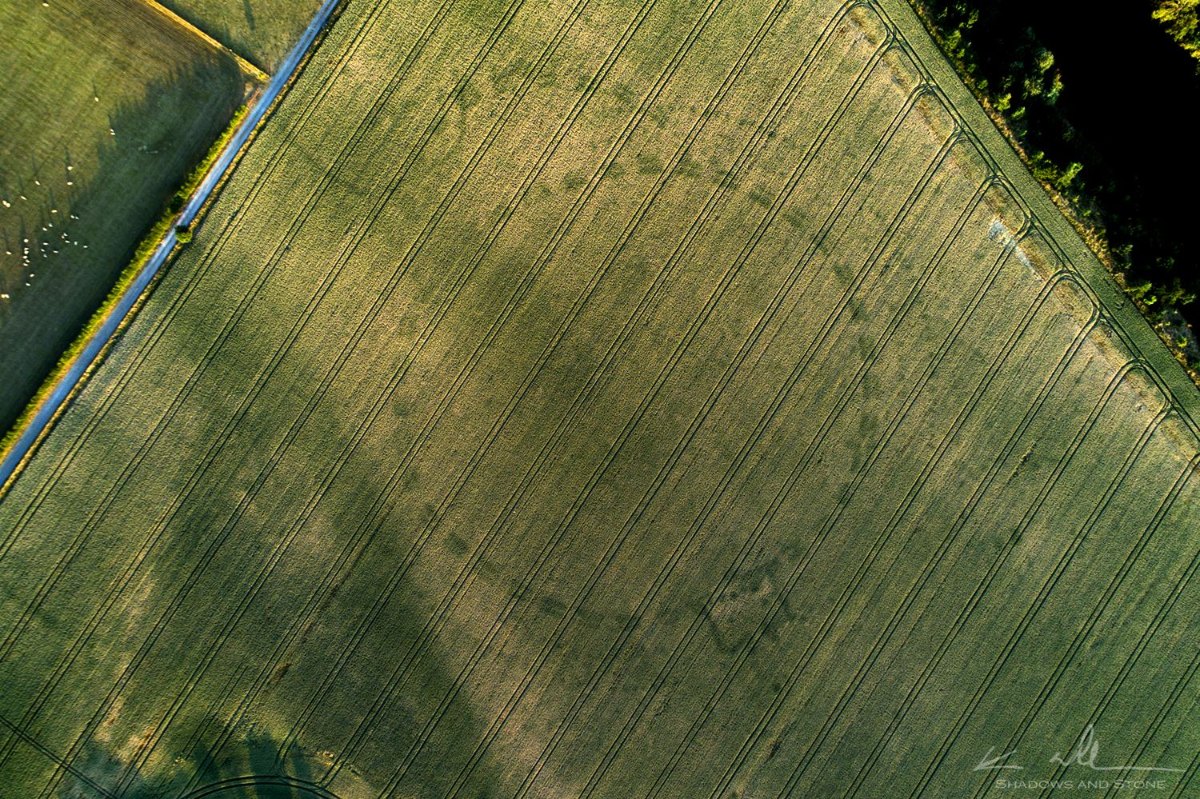 The enclosure in the wheat at Newgrange Farm, 10 July 2018. Ken Williams, Shadows and Stone.
The discovery attracted international attention and was followed by extensive aerial surveys undertaken by the National Monuments Service and the Irish Air Corps during July and August 2018.
John Lalor carried out the oblique aerial photography, while Tom Condit and Mark Keegan documented the findings in their December 2018 interim report. The surveys revealed numerous additional prehistoric features, including large enclosures, palisades and other monuments across the Boyne floodplain.
These discoveries significantly expanded understanding of the prehistoric ceremonial landscape surrounding Newgrange, Knowth and Dowth. Williams' involvement demonstrated how aerial photography and modern technology can reveal archaeological features that have remained hidden for thousands of years.
Publications, Exhibitions and Recognition
In April 2006, Williams held a solo exhibition of Shadows and Stone photography at the Brú na Bóinne Visitor Centre. His work was subsequently selected for display at the Sixth World Archaeological Congress, held in Dublin in 2008.
During the handover to the organising committee of the seventh congress in Jordan, the Dublin organisers presented a framed photograph from his collection.
Shadows and Stone has been featured in The Irish Times Magazine and Irish Arts Review. Williams' photographs have also appeared in publications including National Geographic, Science, Archaeology Ireland, The New York Times, The Irish Times and the Irish Independent.
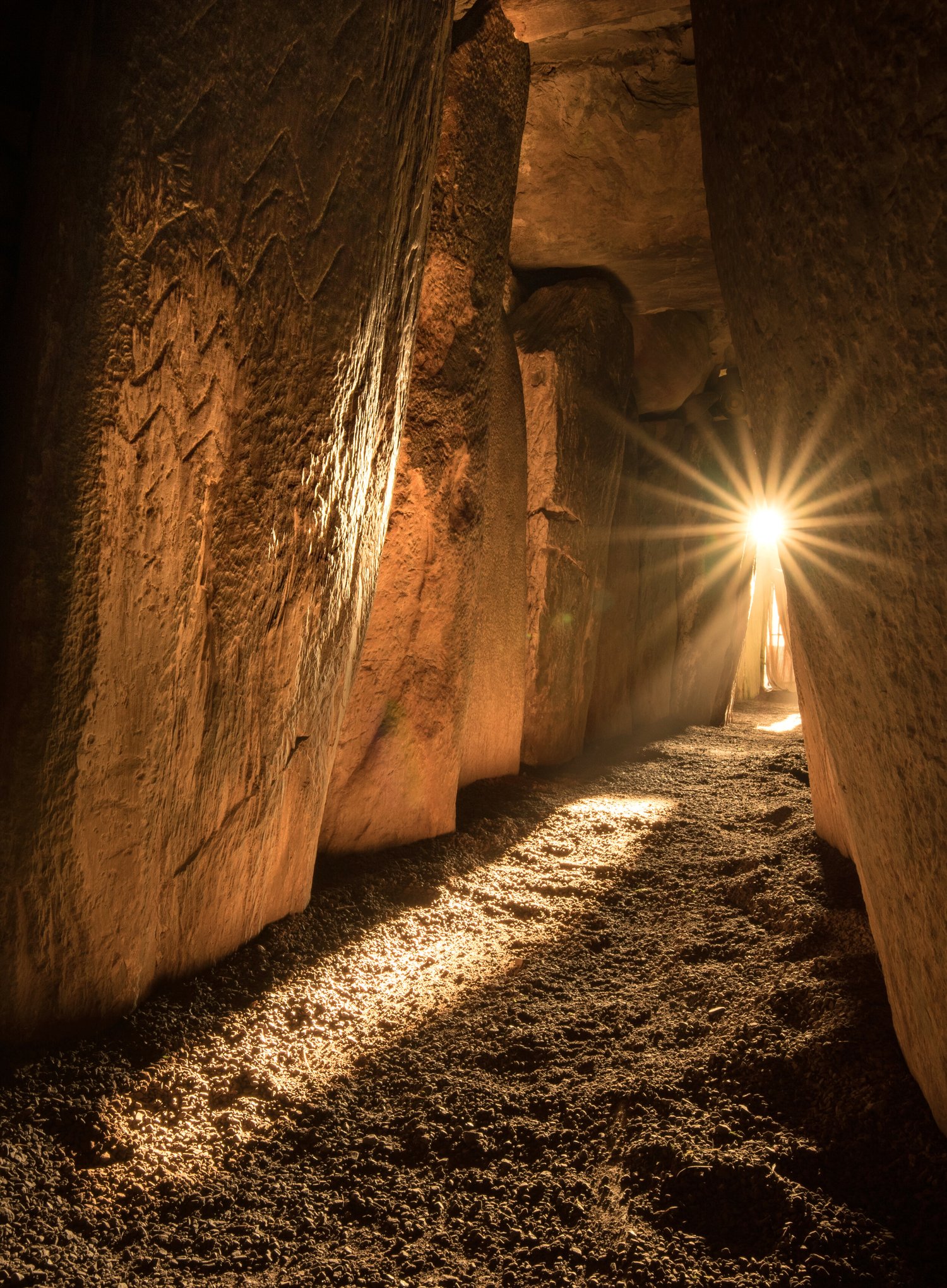 The winter solstice sunbeam in Newgrange, photo by Ken Williams used on the cover of Nature, June 2020.
His photography was featured on the cover of the 2017 An Post Irish Stamps Yearbook. In 2020, the scientific journal Nature selected one of his winter solstice photographs from Newgrange for the cover of an issue featuring research into ancient DNA from Neolithic Ireland.