Anthony Murphy
Anthony Murphy is a writer and photographer from Drogheda and the founder of Mythical Ireland. Since March 2000 the site has been his record of the Boyne monuments, the myths told about them, and the way those monuments sit under the sun, moon and stars.
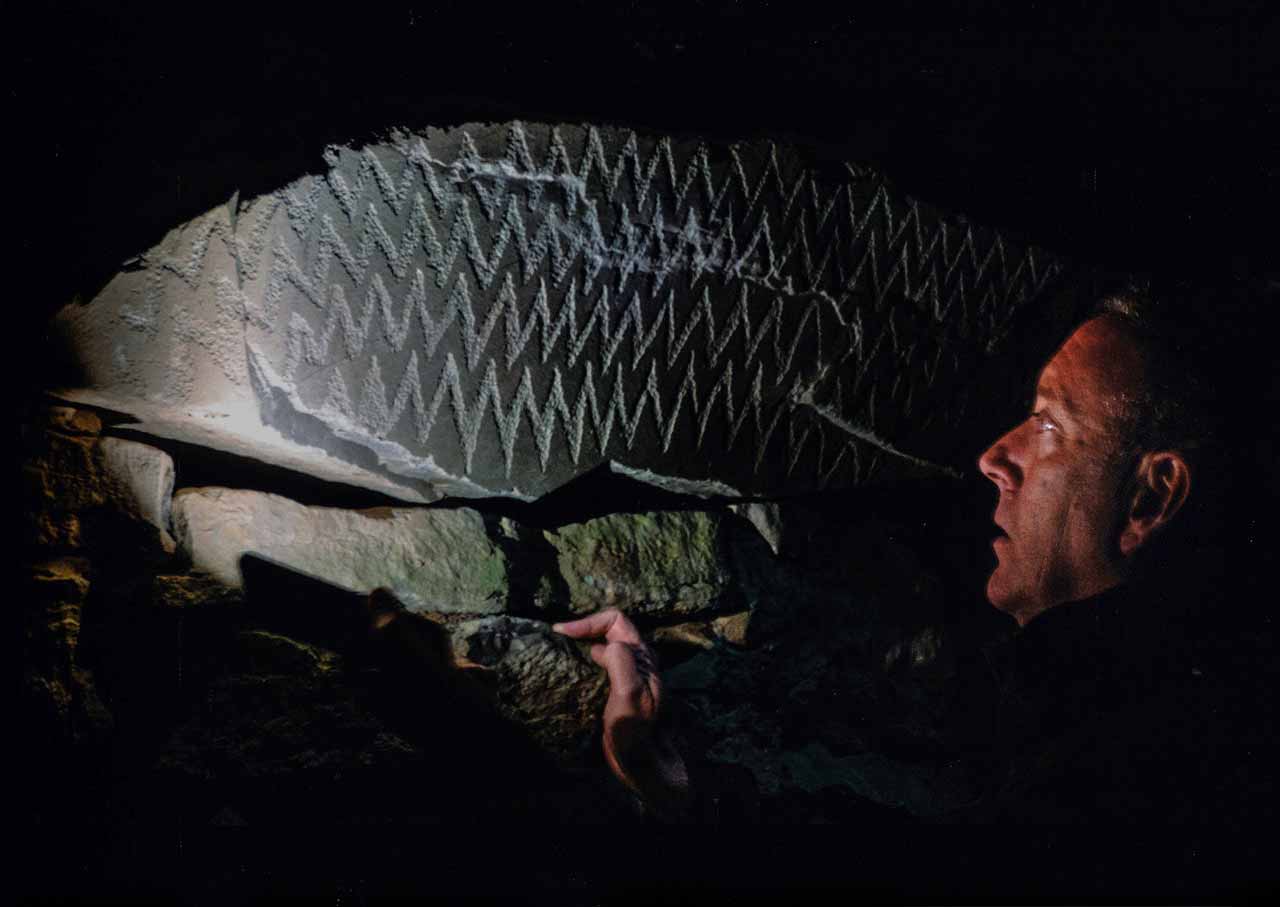 Anthony Murphy in the chamber at Fourknocks | Mythical Ireland.
His work combines independent research, photography, public lectures and guided visits to ancient sites, with more detailed accounts of his findings and interpretations presented in his books.
An Early Interest in Astronomy
Anthony Murphy grew up in Drogheda, close to the River Boyne, and developed an interest in astronomy from an early age. By the age of twelve, he was writing a monthly astronomy column for the Drogheda Independent. A primary school visit to Newgrange and Dowth introduced him to the prehistoric monuments of the Boyne Valley, while regular reports of the archaeological excavations at Knowth further encouraged his interest in Ireland's ancient past.
In January 1999, Murphy began collaborating with Drogheda artist Richard Moore, combining their interests in astronomy and archaeology. Together with Michael Byrne, they investigated a winter solstice sunrise alignment at the standing stones of Baltray, near the mouth of the River Boyne. This early research developed into Island of the Setting Sun, a book exploring possible astronomical connections with Ireland's prehistoric monuments, published by Murphy and Moore in 2006.
A Career in Journalism
Murphy's early astronomy column marked the beginning of a 31-year career in journalism. He spent ten years with the Drogheda Independent, initially as a reporter and later as design editor. In 2003, he became editor of the Drogheda Leader and subsequently held the position of editor at the Dundalk Democrat. From 2012, he worked as a sub-editor and graphic designer with the Irish Farmers Journal. In 2023, he left newspaper journalism to concentrate on Mythical Ireland full-time.
Mythical Ireland
Murphy established Mythical Ireland in March 2000, initially hosting the website on the free Geocities platform before moving to its own domain approximately a year later. The website has since developed into an extensive independent resource exploring Irish archaeology, mythology and ancient astronomy, with particular emphasis on Newgrange, Knowth, Dowth and the wider Boyne Valley landscape.
Mythical Ireland operates independently, without state funding, and is supported through book sales, photographic prints and contributions from readers. Alongside his writing and research, Murphy gives public lectures, leads guided visits and documents ancient monuments through photography. In March 2020, he began a weekly livestream series, Live Irish Myths, exploring Irish mythology, archaeology and related subjects. He also produces a podcast covering similar themes.
Exploring Ancient Astronomy
Island of the Setting Sun: In Search of Ireland's Ancient Astronomers, co-authored with Richard Moore, was first published in late 2006 and sold out within a year. A revised and expanded edition followed in 2008, with a further reprint published by The Liffey Press in 2020. The 352-page book contains 170 colour photographs and maps, examining possible relationships between Ireland's prehistoric monuments, mythology and astronomical observations.
Murphy and Moore explore the relationship between the ancient monuments of Newgrange, Knowth and Dowth and the movements of the sun, moon and stars. Their book examines astronomical alignments within the Bend of the Boyne, along with possible connections between prehistoric monuments across Ireland. Drawing on mythology, archaeological surveys and astronomical observations, they suggest that the positioning of these monuments reflects a sophisticated understanding of the heavens.
Newgrange: Monument to Immortality, published by The Liffey Press in 2012 and reprinted in 2016, offers a more personal exploration of the monument. Murphy draws on his own experiences of Newgrange, combining archaeological evidence, astronomical observations and personal reflections to examine its significance and the lasting impression it makes on visitors.
Mythology and Ancient Traditions
Much of Murphy's research explores the mythology associated with the Bend of the Boyne. In medieval Irish literature, Newgrange, known as Síd in Broga, is closely associated with the Dagda, a prominent figure in Irish mythology who is said to have distributed the other burial mounds among the gods. Murphy contributed a chapter on the Dagda to Harp, Club and Cauldron. He has also suggested that Site B, a smaller mound near the River Boyne, may be the second dwelling of the Dagda referred to in an account recorded by James Fergusson.
The goddess Bóinn, from whom the River Boyne takes its name, is another recurring subject in Murphy's writing. In his monograph Bóinn, Goddess of the Boyne and the Milky Way, he explores possible connections between the river goddess and the Milky Way. Finn and the Salmon of Knowledge examines the traditional story of the young Fionn mac Cumhaill and the legendary salmon associated with the Boyne. Murphy revisits similar themes in Return to Segais, a handwritten work that blends elements of mythology and fiction.
His monograph Fourknocks: Archaeology, Astronomy and Mythology examines the prehistoric passage tomb at Fourknocks. In Mythical Ireland: New Light on the Ancient Past, published by The Liffey Press in 2017, Murphy brings together his research into Ireland's ancient monuments, mythological traditions and astronomical connections. The book was reprinted in 2019, revised and expanded in 2021, and published in a new edition in 2025.
Murphy has also explored these subjects through fiction. His novella Land of the Ever-Living Ones was published in 2013, followed by The Cry of the Sebac, a short novel released for Kindle in 2015 and in print in December 2018. Both works draw inspiration from the mythology and ancient traditions that feature throughout his research.
By the summer of 2018, Murphy had spent almost two decades researching and documenting the ancient landscape of the Boyne Valley. That July, an exceptional drought and the use of drone photography led to one of his most significant discoveries: a previously unrecorded Neolithic enclosure near Newgrange, subsequently known as Dronehenge.
The Discovery of Dronehenge, July 2018
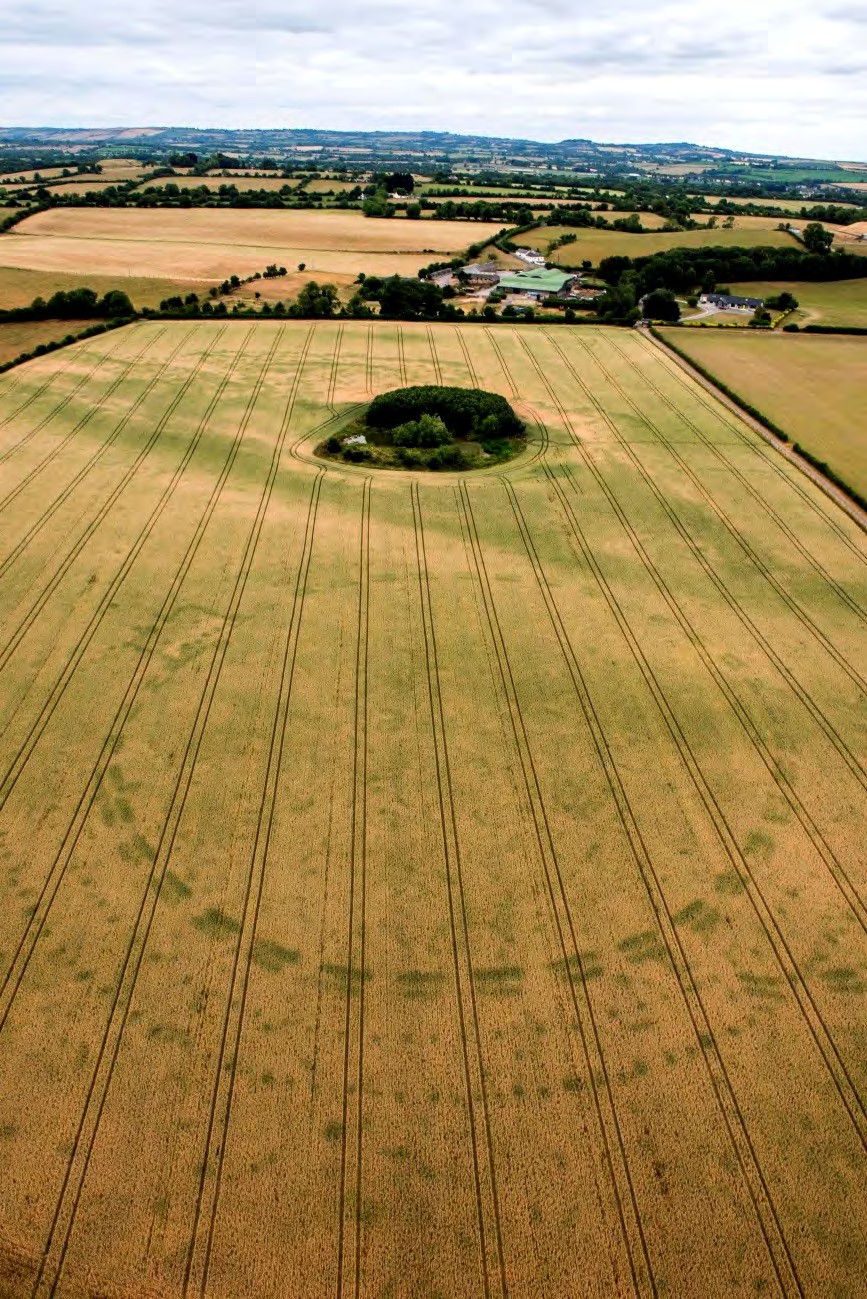 The Geometric Henge, also known as
Dronehenge, looking north towards Newgrange Farm.
National Monuments Service, 2018.
The exceptionally dry summer of 2018 revealed previously unknown archaeological features across Ireland. On the evening of Tuesday, 10 July, Anthony Murphy and photographer Ken Williams were using a drone to survey farmland south of Newgrange. At approximately 8:47 pm, the drone camera captured the outline of a large prehistoric enclosure in a wheat field near Newgrange Farm, also known as Redhouse Farm.
The prolonged drought had made buried archaeological features visible through differences in crop growth. Ancient pits and ditches retained moisture, allowing the wheat above them to remain greener than the surrounding crop. From the air, these variations revealed the distinctive pattern of a substantial prehistoric monument that was almost invisible at ground level.
Murphy estimated the enclosure to be approximately 750 m (2,461 feet) from Newgrange. In their December 2018 interim report, Tom Condit and Mark Keegan placed the entrance to the Newgrange passage tomb approximately 655 m (2,149 feet) northeast of the enclosure. The monument occupies the lowest river terrace, approximately 48 m (157 feet) from the River Boyne, and measures 154 m (505 feet) from north to south and 143 m (469 feet) from east to west.
The accompanying aerial photograph was taken by John Lalor during the Irish Air Corps surveys that followed the discovery. Looking north towards the farm buildings at Newgrange, it reveals a complex arrangement of cropmarks, including outer and middle circuits of substantial post-holes and an inner series of short, paired ditch segments. The western side is flattened and incorporates a rectangular enclosure, while a further series of ditch segments extends towards the southeast, possibly indicating an entrance.
Condit and Keegan referred to the monument as the Geometric Henge because of its distinctive arrangement of features. However, the name Dronehenge, reflecting the technology used in its discovery, became widely adopted.
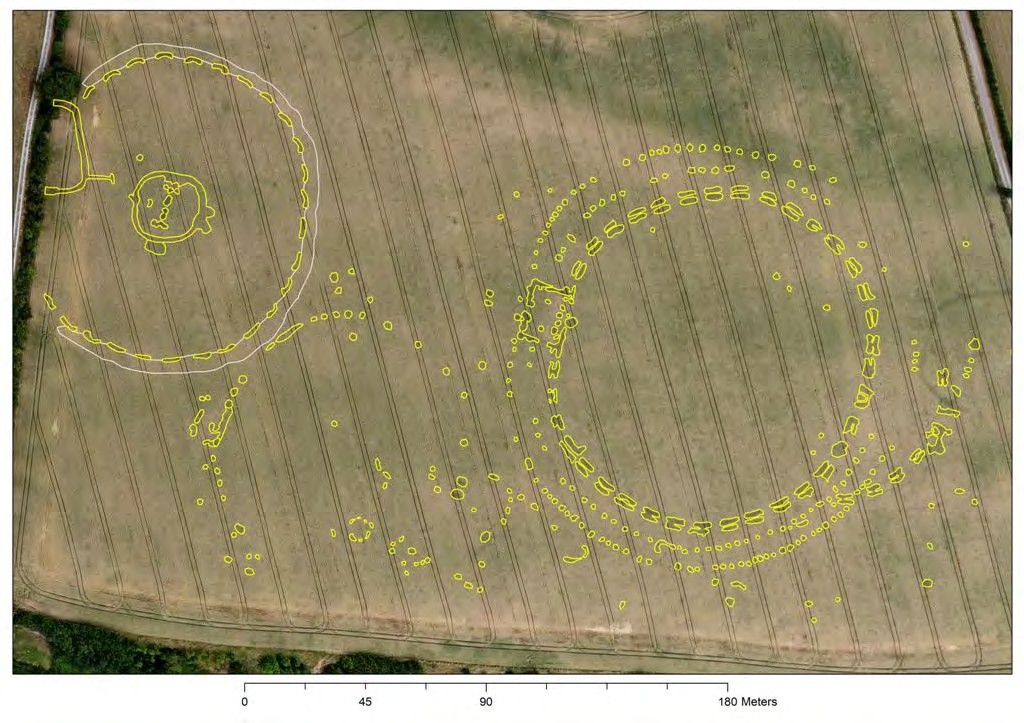 Aerial photograph showing Dronehenge outlined in yellow and
a second enclosure, the Univallate Henge, outlined in white.
National Monuments Service, 2018.
Condit and Keegan interpreted the concentric features as parts of a single complex monument, probably dating to the later Neolithic period. However, the sequence of construction and the relationship between its various elements remain uncertain. As the monument has not been excavated, its precise date and original function have yet to be established.
Dronehenge stands on privately owned farmland and is not open to the public. Access requires the landowner's permission, although the wider landscape can be viewed from Newgrange, looking south across the river terraces towards the Boyne.
Further Discoveries Across the Boyne Floodplain
The discovery by Murphy and Williams attracted considerable attention and was followed by a wider archaeological investigation of Brú na Bóinne. Within days, the National Monuments Service, working with the Irish Air Corps, began an extensive programme of aerial reconnaissance that continued through July and August 2018. John Lalor carried out the oblique aerial photography, while Mark Keegan mapped and interpreted the newly recorded features.
The findings were documented in a December 2018 interim report by Tom Condit and Mark Keegan, which revealed an exceptional concentration of previously unrecorded prehistoric monuments across the Boyne floodplain.
The field containing Dronehenge also revealed several other archaeological features, including a second large enclosure known as the Univallate Henge, a four-poster arrangement of substantial pits, a hook-shaped enclosure and an extensive palisaded structure. Further east, cropmarks in the pasture near Site B revealed additional large enclosures interpreted as possible henges.
Murphy and Williams made the initial discovery of Dronehenge, while the subsequent National Monuments Service surveys documented the wider complex of prehistoric monuments. Together, these discoveries greatly expanded understanding of the ceremonial landscape surrounding Newgrange, Knowth and Dowth. In 2021, archaeologists Stephen Davis and Knut Rassmann examined the evidence further in their study of the later Neolithic landscape at Brú na Bóinne.
News of Dronehenge attracted international media coverage. Murphy later recalled spending much of the following three weeks giving interviews to broadcasters and newspapers, including the BBC, the Washington Post and the New York Times. He also appeared alongside Tony Robinson in a Channel 4 production filmed in the Boyne Valley. Clare Tuffy of the Office of Public Works described the find as probably Ireland's most significant archaeological discovery of the century, a quotation later used by The Liffey Press to promote Murphy's book.
In October 2019, Murphy published Dronehenge: The Story Behind the Remarkable Discovery at Newgrange. The 288-page book, containing 120 colour plates, recounts the events surrounding the discovery and explores the monument's possible purpose and significance within the prehistoric landscape of Brú na Bóinne.
Research and Activities Since 2018
In January 2019, Murphy received a Mayoral Award from the Mayor of Drogheda, Councillor W. Frank Godfrey, in recognition of his work as a writer, journalist, photographer, public speaker, musician and researcher. Outside his archaeological interests, he is a euphonium player with Drogheda Brass Band and previously conducted the town's youth brass band for several years.
In November 2019, Murphy was invited by poet Paul Muldoon to lecture at Princeton University as part of its Fund for Irish Studies programme. He has also contributed to television and radio programmes exploring Irish archaeology, mythology and ancient astronomy, including productions for the History Channel, National Geographic, Discovery Science, Channel 4, RTÉ, the BBC and TG4.
Murphy has also been involved in local cultural events, writing and narrating scripts for Drogheda's Lú Festival of Light in 2022, 2023 and 2024. The festival uses large-scale illuminated projections to bring stories from Irish mythology and history to life.
His archaeological investigations continued beyond the discovery of Dronehenge. In April 2021, while flying a drone over the River Boyne at Drogheda, Murphy identified three possible historic logboats in the river. He subsequently returned at low tide to examine the remains, including one upstream of the Bridge of Peace measuring approximately 4.5 m (15 feet) in length.
Murphy has also examined satellite imagery for previously unrecorded archaeological features across Ireland, reporting the identification of approximately 230 potential monuments and earthworks. His work illustrates how aerial photography, satellite imagery and digital mapping can contribute to the discovery and documentation of archaeological sites.
Through Mythical Ireland, Murphy continues to research, photograph and document Ireland's ancient monuments. His activities include writing, public lectures, guided visits and aerial photography, with particular emphasis on the archaeology, mythology and astronomical traditions of the Boyne Valley.