Clare Tuffy
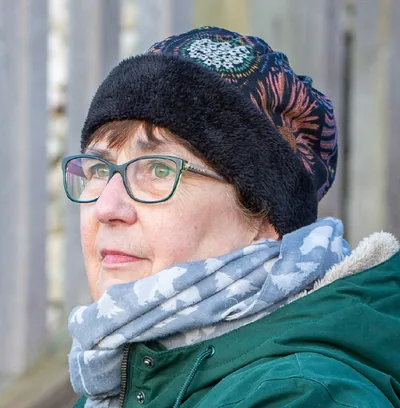 Clare Tuffy, Visitor Services Manager at Brú na Bóinne until 2022.
Clare Tuffy helped shape the way generations of visitors experience Brú na Bóinne. During more than forty years with the Office of Public Works (OPW), she helped develop visitor services at Newgrange, as facilities grew from a guide's hut beside the monument to a visitor centre for the wider World Heritage Site. She joined in 1981 and retired as Visitor Services Manager in October 2022.
Originally from Islandeady, near Castlebar in County Mayo, Clare drew on her teaching experience throughout her heritage career. She holds a Bachelor of Education and a master's degree in business administration. Her interest in archaeology led her from the classroom to the OPW, where she continued to help people learn about the past.
Clare's association with the Newgrange winter solstice began on 21st December 1981. By then, Michael J. O'Kelly's excavations and restoration had transformed understanding of Newgrange, while George Eogan's excavations at Knowth, begun in 1962, were continuing to reveal the neighbouring complex. Growing public interest in the monuments brought increasing demands on visitor services.
Visitors then drove directly to Newgrange along narrow local roads. As numbers increased, the need for a different approach became clear: access had to be organised in a way that protected the monument and improved the experience of those coming to see it.
A visitor centre for the valley and its communities
The visitor centre designed by Anthony O'Neill, with landscaping by Barbara O'Neill, opened at Donore in 1997. Visitors began their journey south of the Boyne and crossed the river to reach the monuments. This approach introduced them to the surrounding landscape as well as the passage tombs themselves.
Landscape design helped connect the centre with its setting. The choice of native plants drew on Frank Mitchell's pollen research, while later exhibitions featured photographs by Ken Williams. Together, the planting, exhibitions and imagery encouraged visitors to consider the valley as a whole.
The development was controversial, particularly over the location of the centre and the changes to access. Brú na Bóinne was inscribed on the UNESCO World Heritage List in 1993, bringing international recognition to the landscape. For Clare, building a working relationship with neighbouring communities became an essential part of managing the site.
The centre also became a venue for community activities, hosting activities such as school performances, exhibitions and local club events. Welcoming these activities helped make the centre part of local life.
Clare's responsibilities extended to visitor services at the Hill of Tara, Trim Castle, Old Mellifont Abbey and Loughcrew. Richard Hodges's profile in The Past, published in January 2023 following a visit the previous August, reflects on her career and the development of the visitor centre.
Newgrange and the winter solstice
Clare's talks draw on years of observing the sun's alignment with the tombs at Newgrange, Dowth and Loughcrew. At Newgrange, the rising midwinter sun enters through the roof-box above the doorway and, when the sky is clear, illuminates the chamber. The light can last about seventeen minutes. Cloud can obscure the sunrise, but the anticipation and the explanation of the alignment remain part of the experience.
Demand for places inside the chamber led the OPW to introduce a lottery in 2000. In Behind the Scenes at Newgrange at the Winter Solstice, her 2019 account for Heritage Ireland, Clare described local schoolchildren helping to draw names and staff contacting successful applicants around the world. Her account describes the arrangements in place at the time.
Her account captures the human side of the event: the excitement of receiving an invitation, the decision to travel a great distance and the knowledge that even a carefully planned journey cannot guarantee sunshine.
Preparing for the event required close coordination between OPW staff, the Gardaí, Meath County Council and media teams. Traffic, winter road conditions and access for broadcasting all required preparation well before the first visitors arrived in the dark.
Small acts of hospitality mattered too. Clare recalled offering tea and a biscuit before the early journey to the monument, helping visitors feel at ease before entering the chamber. When the sun appeared, cheers from the crowd outside reassured those in the chamber that light might soon reach them.
A livestream from the chamber
Public health restrictions in December 2020 prevented the usual chamber visits. The OPW and National Monuments Service instead streamed the sunrise, bringing views from inside the tomb to a worldwide audience. In her commentary with archaeoastronomer Dr Frank Prendergast, Clare drew on her years at Newgrange to explain the monument and its alignment with the sun. The OPW named them both as narrators for the December 2024 livestream, two years after her retirement. Writer Lucy Caldwell later wrote about watching the broadcast that morning.
Clare also shared her knowledge through podcast interviews. In September 2022, shortly before retiring, she discussed Brú na Bóinne on Tourism Ireland's Longing for Ireland podcast.
Mapping the light
The temporary absence of visitors in 2020 also created an opportunity for research. Clare suggested using this time to investigate research priorities set out in the Brú na Bóinne Research Framework, including a detailed study of how direct sunlight enters the chamber. The resulting paper credits her with proposing the research opportunity.
A multidisciplinary team led by Frank Prendergast developed a project to record sunlight on the chamber floor over a 41-day period centred on the 2020 winter solstice. An initial account, Mapping the light fantastic at Newgrange, appeared in the winter 2021 issue of Archaeology Ireland, volume 35, pages 30–35. Clare co-authored it with Prendergast, John Lalor, Claire Breen and Sinéad Gargan. Her contribution shows how daily experience of caring for the site could inform archaeological research.
Conferences, lectures and TEDxMarshallU
At Pathways to the Cosmos in Dublin Castle on 15th September 2018, Clare presented Waiting for the Light. She shared a session with photographer Ken Williams and artist Roisin Fitzpatrick in a session exploring ways of connecting with the people who built the passage tombs.
She also contributed to the Heritage Council's DIG conference in Kilkenny in November 2018, discussing World Heritage and the surrounding community at Brú na Bóinne. Her presentation explored a theme central to her work: how a heritage site can serve its local community as well as its visitors.
On 2nd October 2022, Clare chaired The Boyne Valley, the opening session of the National Monuments Service's Boyne & Beyond conference at Dublin Castle. The official programme lists presentations by Kerri Cleary on Knowth and Clíodhna Ní Lionáin on the Dowth Hall passage tomb excavation.
After retirement, she continued speaking about the monuments and their interpretation. Her Archaeology Online lecture, Newgrange, It's All About the Light, was advertised for 6th December 2022 and explored the monument and its winter solstice alignment.
On 7th December 2023, her online seminar for the Irish Institute of Hellenic Studies at Athens, Connecting with our Past, examined how people can form meaningful relationships with cultural heritage. She discussed community involvement, the solstice broadcasts and research into the chamber's illumination.
Clare was a speaker at TEDxMarshallU in Huntington, West Virginia, on 27th February 2024. Her talk, Weaving History Into Our Communities: The Value of Sharing Spaces, explored how sharing historic places can strengthen community life.
On 23rd October 2024, the Westmeath Archaeological and Historical Society's programme featured her lecture Waiting for the Light – Sunrise & Sunset at the Boyne Valley Tomb at the Greville Arms Hotel in Mullingar.
Honorary Doctor of Science from UCD
On 6th December 2024, University College Dublin awarded Clare an honorary Doctor of Science degree. Dr Claire Cave of the UCD School of Archaeology delivered the citation, recognising her work in heritage education, community engagement and her work explaining the significance of Brú na Bóinne to a wider public.
The citation also highlighted her support for school visits, archaeological projects and UCD's World Heritage master's students. Through regular meetings with students, she shared her experience of managing visitors and working with local communities. Some of those students later became World Heritage site managers themselves.
Continuing public engagement
Her later engagements included events organised by the Irish Institute of Hellenic Studies at Athens in May 2026. Its Layers of Ireland series listed The Archaeology of the Boyne Valley for 7th May, followed by a hands-on family workshop on Stone Age megalithic art on 10th May.
During Clare's career, the visitor experience at Brú na Bóinne changed considerably. Visitors who once drove along the lane to Newgrange now begin at a centre across the Boyne, while audiences around the world can watch the solstice online. Throughout these changes, her work has focused on helping people understand the monuments, supporting their care and strengthening their connection with local communities.