Winter Solstice at Newgrange
By Lucy Caldwell, author of Devotions, a collection of short stories.
It’s the winter solstice, and I’m about to watch the sun rise on the shortest day of 2024 at Newgrange through my smartphone in bed. As the countdown to the live broadcast enters its last minutes, the chat-box fizzes with greetings and blessings from all over the world. It’s a dizzying feeling, so many of us gathering, readying ourselves to go through the same thing together, thousands of miles and time zones apart.
At the Neolithic monument itself, people are already gathered. For a handful of days at this time of year you can stand at the heart of the burial chamber, which pre-dates the pyramids at Giza by four centuries, and Stonehenge by seven, and watch as a beam of light from the rising sun enters the passage and illuminates its deepest recesses. When Covid restrictions in 2020 meant the whole site of Brú na Bóinne had to remain closed, the Office of Public Works decided to livestream the event, and the commentary provided by Dr Clare Tuffy and Dr Frank Prendergast proved so popular they have done it each year since.
Such an atomised digital experience of the solstice, I think, would have been inconceivable to any previous generation. It would have made little sense to most of us even a decade earlier. As the final seconds tick away, someone offers the old Irish proverb, Ar scáth a chéile a mhaireann na daoine, we live in each other’s shadow. In the shelter of each other, people survive.
A Short Story Begins
I know then that this is the material of a short story. I can feel its life force stirring in a way that always feels to me like the switching on of a magnetic current, to which parts of your life, your thoughts, your experience, rise unbidden, charged. The occasion seems to speak uniquely to our times, to our need for connection, through and despite the limits and capacities of our technology, through and despite our era’s darknesses, a particularly 21st century metaphysics.
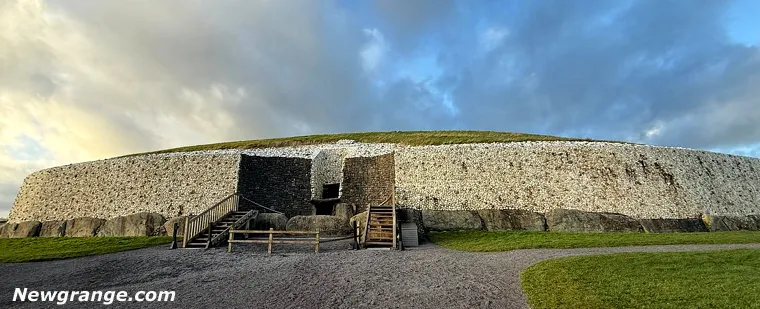 The gleaming white quartz façade of Newgrange.
I think of how, for years, it has been the summer, not the winter, solstice I’ve revered. Growing up in Belfast, I loved the way the sky at that time of year stayed light until late into the evening. After going across the water I marked the summer solstice in many different ways, sometimes with others, at Stonehenge, with dawn yoga, in the company of Swedish friends celebrating Midsommar, and sometimes as a private devotion.
Most recently I sat out in my courtyard garden in Folkestone with my cat, watching as the sky paled imperceptibly and the bats came out, until it was fully dark. I thought about how in Belfast, at that time, there would still be light in the sky, and I stayed until even that would be gone. Did this newfound melancholy, I wondered then, come from knowing that the days were already shorter from here on in, the year already tilting to winter? There seemed to be the sense of something steely, implacable, that was never there when I was younger, the feeling of a door closing.
The Winter Solstice, on the other hand, used to be something I endured, wished over, but lately I have felt its peculiar pull. I have asked myself what it might mean to see the darkness as a portal, and where it might take me.
A bodhrán starts up like a heartbeat. The livestream is under way. My cat pads into the room and jumps up onto the bed beside me. I take a breath and try to open myself up to whatever is coming.
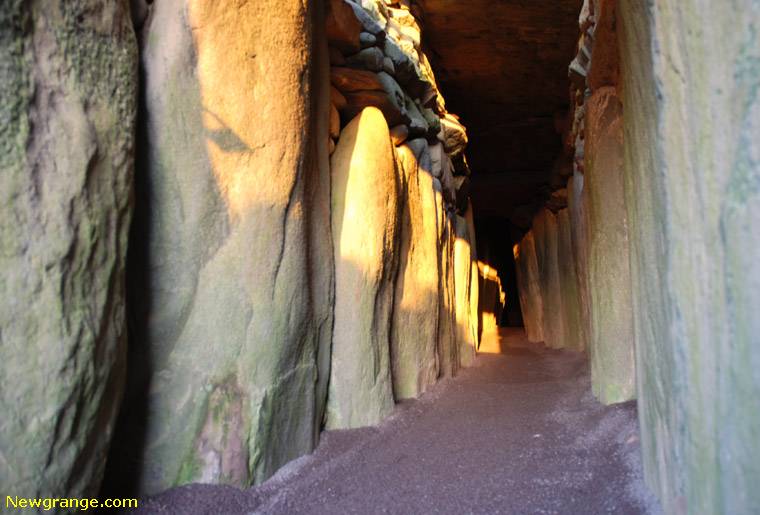 Winter Solstice Illumination at Newgrange.
Devotions
That’s where the title story of my new collection started, watching the online stream of the winter solstice at Newgrange. Devotions is the sort of story I think of as “freewheeling thought in motion”, barely a story at all in any traditional sense, of plot, say, or character. In literal terms, almost nothing “happens”. A nameless Irish woman in an English coastal town watches, for the most part, the beam of light not happening due to unfortunate cloud cover.
If you do away with plot and character, you need strong compensatory unifying factors. I pulled time very tight as a controlling principle, using a meticulous moment-by-moment chronology. The story also required a precise delineation of the character’s emotional contours, so that even a small shift could feel epic.
I learned this from Edna O’Brien’s readings of Chekhov. He knows how to make, she says, “even the desultory dramatic”. This might be the real test of a short story writer. If you can corral the symbolic or existential realm, then the actual physical stakes, objectively, can be small. A beam of light materialising, or not, on the stone floor of an ancient chamber, on one level, it doesn’t “mean” anything, it doesn’t matter. But from another perspective, it is a matter of psychic life and death. A successful story must hold these forces in balance.
This one also seemed to make a particular demand, that I use Tuffy and Prendergast by name.
It would have been easy to rechristen them, but Dante himself, I thought, could not have invented better names for two guides through the darkness and into the light, so I kept their real names and, following that decision’s logic, used only things they actually said during the 2024 livestream. Stories, when you’re writing them, have a wild amorality. It is part of their addictive pleasure, and the only thing that matters is that they work. It is afterwards you must come to terms with what you have done. In this case, sending the manuscript to them both and crossing my fingers. Both gave me their blessing, and Tuffy suggested I should come to Newgrange in person. And so, this last winter solstice, I went.
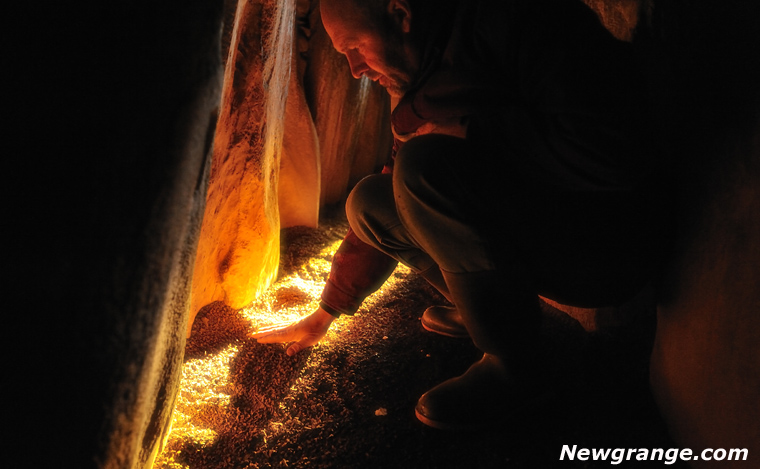
The Newgrange Solstice Lottery
Places inside the Newgrange chamber on the five mornings around the solstice are allocated by a free lottery. Each person drawn can bring a guest. Anyone anywhere in the world can apply online through the solstice lottery page, and about 30,000 people do each year. But even if you’re not lucky enough to be one of those who win a place, you can still go to Newgrange.
I drove down from Belfast with a friend, who picked me up at an unholy hour so we would get there in good time. Even so, the visitors’ car park was full, the overfill overflowing, and the lanes around Brú na Bóinne chock-a-block. The volunteers in hi-vis jackets and torches, directing folk to the visitors’ centre, were taken aback at the volume of people. Tuffy later ascribed it to a number of factors, the winter solstice falling on a Sunday, the weather being clear, the increasing awareness brought about by the livestream, but most importantly, she said, an exponential rise in people wanting to connect with the sense of an ancient calendar, with something deeper.
This makes sense. When you begin to look for it you see it everywhere, a rising general awareness that time is not linear, that we do not live in teleological, relentlessly progressive time. That vision of time is maybe best understood as a symptom of living in late, goal-oriented western capitalism, ultimately insufficient for our spiritual needs. As too are the increasingly frenetic feedback loops of social media and instantaneous digital communication we so often seem trapped in. We crave the consolations of more cyclical ways of understanding our lives, more sense of connectedness with the past, and of the future as well, because honouring our ancestors comes with an awareness that we too are ancestors-in-waiting.
Travelling to the Monument
My friend and I waited for nearly an hour in the queue of people for the shuttle bus to the monument. We had just given up and decided to walk the 40-odd minutes there, accepting we would miss the sunrise but deciding we would at least be en route, when a bus came along with miraculous spaces. The mood, despite the length of the queues, was one of anticipation and camaraderie.
I talked to a retired couple who had come from New York, a mother and her 10-year-old son, a Ukrainian television presenter. An older Irishwoman regaled my friend with the story of Diarmuid and Gráinne. After Diarmuid’s death, in the face of Gráinne’s despair, Aengus Óg takes his body to Newgrange and breathes life back into it. A story, she said, to contain and make sense of the moment of the returning sun.
At the monument, people thronged. Modern-day Druids with deerhounds, groups of singers ululating and several with bodhráns, but also punters in puffer coats and woolly hats, those who were regulars with Thermos flasks and, crucially, they told me, thermal underlayers. As the sky lightened, and the first rays of sun appeared in the east, a mist rose from the Boyne. It was breathtaking.
The Light Appears
But the rising sun was frustratingly shrouded by cloud and we all knew that the beam of light had only 17 minutes, at best, to penetrate the roof-box and flood the passage and reach the people in the chamber. Minute after precious minute passed and there was nothing, for all our technological advances, that we could do, except will it, hope it, pray it for them, and yield to whatever the day, and maybe the coming year too, had in store for us.
Clare Tuffy imagines that people went into the chamber 5,000 years ago too. The priests, or that year’s bereaved, or those selected, why not, by lottery, to stand in for the rest of the community. Descending into the darkness with their hopes and their fears, their griefs and their longings. That day’s chosen were there on behalf of us all, and we desperately wanted it to happen for them, though as Tuffy says in my story, it’s already an act of great faith to travel to Ireland in late December and hope for sunshine.
In the very final minute that morning, as if it too were a story, the last ragged clouds parted and we knew the light would be faintly visible underground, and we cheered with triumph, defiance, abandon.
Moments of Light
Afterwards we stood against the glistening damp quartz of the monument’s outer wall, basking in the risen sun, knowing we had been through something sacred, and knowing it had, in a curious sense, somehow depended on us. That was the ineffable tension to hold, to know that you were nothing, in the face of the solstice’s implacable forces, completely inconsequential, and yet that any consequence at all, any meaning, resided in you.
It was what you made of it, or was in your openness to it. I thought of seeing Toni Morrison speak, in my very early 20s, and how she said something which has always stayed with me: that as a writer it is your aesthetic and also your moral duty to engineer moments of light.
It confirmed everything I’d been trying to do in my story, and, indeed, all that is an abiding preoccupation in the collection as a whole, about finding the numinous in the quotidian. How we get to choose, each and every one of us, what is sacred in life, and how we must honour that. For my character in the title story, yearning for deeper connection to the mysteries, this is something of the realisation that crystallises.
That light exists not just in spite, but because of the darkness, that the darkness is also part of the light. So many of our oldest stories, from the Sumerian myth of the descent of Inanna to the Persephone cycle, to that day’s bespoke version of Diarmuid and Gráinne, are to do with rebirth in the dark, reminding us that there must be moments when we let go, let go of all that we do, all that we are, in order once again to be renewed.
Lucy Caldwell’s Devotions is a collection of eight beautifully written short stories exploring memory, longing, relationships and the search for meaning in modern life. The title story, “Devotions”, is inspired by the Winter Solstice at Newgrange in the Boyne Valley, where sunlight enters the ancient passage tomb at sunrise on the shortest days of the year.
Blending mythology, personal reflection and the atmosphere of the solstice gathering, Caldwell uses Newgrange as a powerful symbol of rebirth, hope and human connection. The story captures both the timeless mystery of the 5,000 year old monument and the emotional experience of people gathering in darkness, waiting for the returning light.
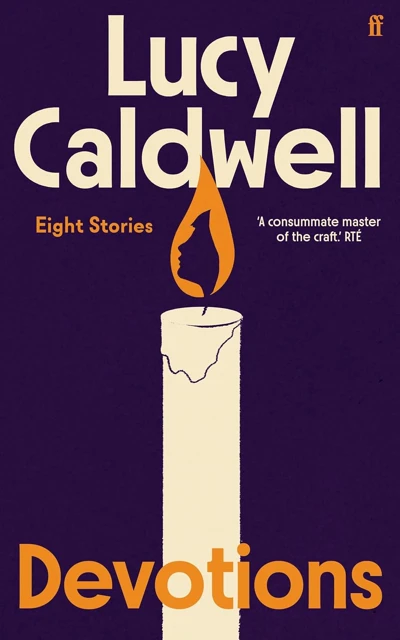 Devotions - Eight Stories by Lucy Caldwell.
The highly-anticipated new collection from the BBC National Short Story Award-winning author of Multitudes, Intimacies and Openings.
'There must be moments when we let go - let go of all that we do, all that we are.'
A young Belfast theatre troupe brings its experimental production of Hamlet to New York.
On a night-flight, travelling with a violin older than the United States, a professional musician slips through time.
A man who loses all he thought he had, and finds himself haunted by all he never will, comes to a painful new understanding of what it might mean to love.
Transporting and profound, these are stories of love, grief, longing, of new beginnings, and the ways we find shelter in each other.
Purchase at Amazon.com or Amazon.co.uk
Newgrange Winter Solstice Archive
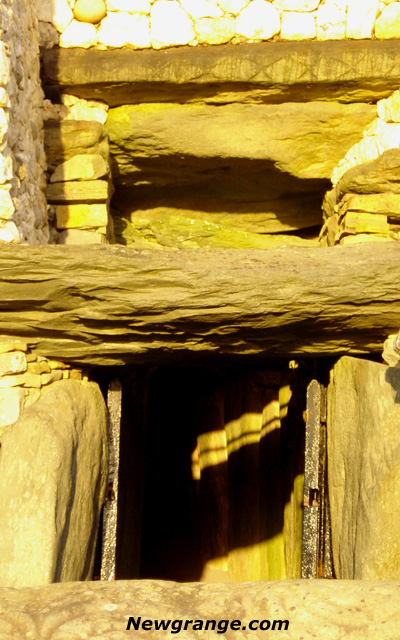 Newgrange roofbox above the entrance lintel.
- 21st December 2025 Winter Solstice.
- 19th December 2024 Winter Solstice.
- 19th December 2023 Winter Solstice.
- 20th December 2022 Winter Solstice.
- 20th December 2020 Winter Solstice.
- 18th December 2016 Winter Solstice.
- 20th December 2015 Winter Solstice.
- 19th December 2014 Winter Solstice.
- 21st December 2013 Winter Solstice.
- 18th December 2011 Winter Solstice.
- 22nd December 2010 Winter Solstice.
- 19th December 2010 Winter Solstice.
- 18th December 2010 Winter Solstice.
- 22nd December 2009 Winter Solstice.
- 21st December 2009 Winter Solstice.
- 21st December 2008 Winter Solstice.
- 21st December 2007 Winter Solstice.
- 22nd December 2006 Winter Solstice.
- 21st December 2006 Winter Solstice.
- 21st December 2005 Winter Solstice.
- 20th December 2005 Winter Solstice.
- 21st December 2004 Winter Solstice.
- 19th December 2004 Winter Solstice.
- 21st December 2003 Winter Solstice.
- 22nd December 2002 Winter Solstice.
- 21st December 2001 Winter Solstice.