
Facing the Cairn at Newgrange
Robert Hensey and Elizabeth Shee Twohig examine the evidence for a Neolithic quartz and granite facing above the kerbstones at Newgrange. Their 2017 paper compares excavation records, correspondence about the reconstruction and stone facings at other Neolithic cairns. They conclude that a quartz facing is the most convincing interpretation of the evidence, while recognising that the original wall’s dimensions and appearance cannot be recovered exactly.
Robert Hensey and Elizabeth Shee Twohig, Facing the cairn at Newgrange, Co. Meath, The Journal of Irish Archaeology, vol. 26 (2017), pp. 57–76.
Read the full paper (PDF, 12.1 MB).
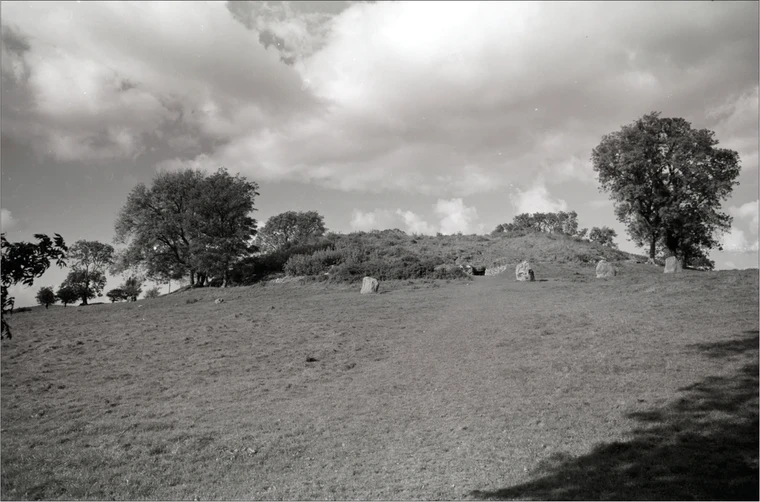 Newgrange before excavation and reconstruction in 1962. O’Kelly 1982, © National Monuments Service.
The excavated deposits
The authors compared sections through the material outside the kerbstones. They found a broadly similar sequence in several trenches, with a deposit that thinned as it extended away from the kerb. They argue that this wedge shape fits material slipping from the mound more closely than a deliberately laid platform, which they would expect to be flatter. Late Neolithic material partly overlay the slipped deposits in several sections, indicating that some of the collapse had already taken place by then.
The spread varied along the front. It extended about 7.5 metres (25 feet) beyond kerbstone 95, compared with about 5 metres (16 feet) beyond the Entrance Stone. Ann Lynch’s later excavations found abundant quartz outside kerbstone 79 on the east side. Farther around the mound the deposit thinned and disappeared by kerbstone 71. That distribution supports O’Kelly’s observation that the quartz was concentrated at the front.
At the entrance, Grooved Ware pottery in a layer over the quartz suggests that the quartz was already on the ground by the middle of the third millennium BC. A radiocarbon date from a cattle tooth beneath the deposit in Lynch’s eastern trench has been interpreted differently by researchers. The paper therefore considers the timing of the deposits in relation to the evidence from each part of the mound.
Michael J. O’Kelly and engineer John Fogarty also tested the collapse interpretation by building a short facing about 2 metres (7 feet) high with excavated quartz and granite. O’Kelly reported that the resulting lower layers closely resembled those recorded in the excavation. The authors note that the estimated height of the original facing, about 3 metres (10 feet), came from engineering analysis. A thicker layer of quartz would have covered a smaller area.
Alternative readings of the evidence
Palle Eriksen read the layers of turf inside the cairn as traces of successive mound surfaces. Hensey and Shee Twohig question that reading. They note that the layers resembled strips cut for construction and that environmental analysis identified comparable turves elsewhere at Newgrange as material cut from damp pasture.
Gabriel Cooney considered whether the quartz could have served as a platform, including the possibility that it had first stood above the kerb and was later moved or reused. Geraldine and Matthew Stout proposed a sloping quartz buttress. Hensey and Shee Twohig argue that the distance the stone spread in some trenches is difficult to explain if the material had simply slumped from a low slope.
Interpretation and reconstruction
Correspondence in the excavation archive shows that O’Kelly argued for returning the slipped material to the mound behind a retaining face. The Office of Public Works and its engineering advisers decided how to stabilise it. The present facing uses excavated quartz and granite in front of a reinforced concrete retaining structure. The authors assess O’Kelly’s interpretation of the Neolithic facing separately from the modern choice of materials and methods.
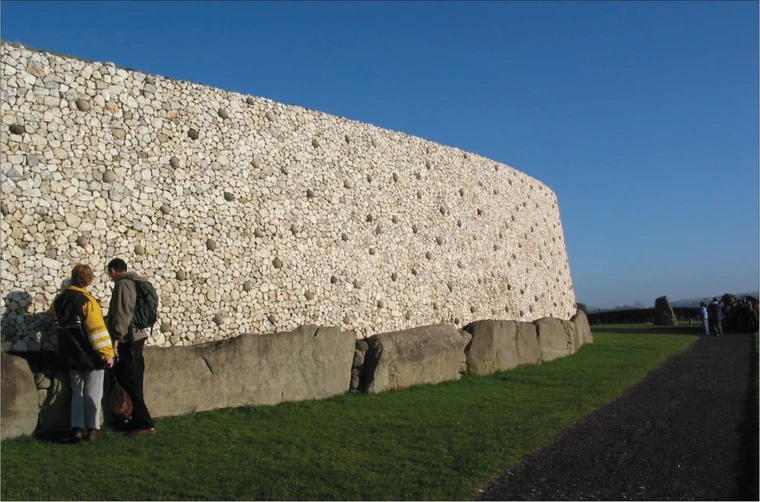 Detail of the reconstructed quartz and granite facing. Photograph by Elizabeth Shee Twohig.
The archive also records an early proposal to leave the mound’s profile as it stood and show a conjectural reconstruction in a model. O’Kelly favoured putting the slipped stone back on the mound, which in his view required a retaining face. The surviving correspondence documents that choice and distinguishes it from the engineering decisions behind the concrete structure.
Comparisons with other cairns
The paper compares Newgrange with dry stone facings at other sites, including the stepped cairn at Barnenez in Brittany and the passage tomb at Baltinglass in County Wicklow. These examples show that retaining faces were an established part of Neolithic cairn construction. Their relevance to Newgrange lies in the construction technique. The evidence for quartz above the kerbstones comes from the excavated deposits at Newgrange itself.
What the evidence supports
The authors favour a quartz facing above the kerbstones because it accounts for the shape and composition of the deposits and is consistent with construction at other cairns. They leave room for a facing of different height or extent and for more than one explanation of its collapse. Their study concerns the exterior facing. The roof box and winter solstice alignment are outside its scope.
See also the Newgrange quartz façade and the debate about its original form.