Newgrange: A View from the Platform
Gabriel Cooney’s 2006 paper reconsiders the quartz and granite deposit outside the kerbstones at Newgrange. He argues that the stones formed a platform around the entrance before much of the cairn slipped. He leaves open the possibility that some of the stone first stood on the mound.
Gabriel Cooney, Newgrange – a view from the platform, Antiquity, vol. 80, no. 309 (2006), pp. 697–708. Read the full paper (PDF, 247 KB).
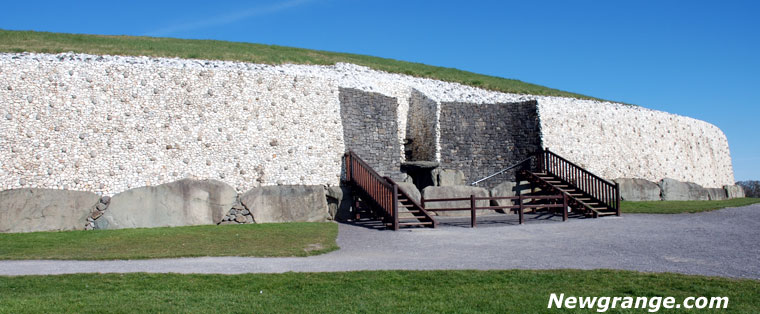 The reconstructed quartz facing at Newgrange.
The deposit outside the kerbstones
Michael J. O’Kelly interpreted the white quartz and rounded cobbles as the remains of a facing that had collapsed outwards from above the kerbstones. Cooney notes that the excavated deposit was thickest and most extensive near the entrance and diminished to either side. The reconstructed facing gives the front of the mound a more uniform appearance.
Cooney places the reconstruction in the context of experimental archaeology. Engineer John Fogarty helped estimate that a facing about 3 metres (10 feet) high would have leaned inward by about 30 centimetres (12 inches). To test how the stones might have fallen, the team built a section above the kerb using quartz and granite recovered in excavation. Cooney notes that a single collapse would have had to occur along the full stretch to produce such similar deposits in the different excavation trenches.
In several excavated sections the spread was about 4 to 5 metres (13 to 16 feet) wide. Quartz also lay against the foot of kerbstone K81 beneath a slight overhang. Cooney treats these details as evidence that at least some of the stones may have been placed deliberately at ground level. He compares the deposit with finds at Knowth and Knockroe, where spreads near tomb entrances could include both deliberately placed stone and material that had slipped from the cairn.
Stone sources and comparisons with other tombs
Cooney cites research linking the quartz to the Wicklow Mountains and the rounded cobbles to the Mourne and Carlingford region. Dundalk Bay was proposed as a place where people could have collected the cobbles from glacial deposits. Granodiorite was the most common rock among the cobbles examined. Wear on some of them led Cooney to suggest they may also have been used to work stone.
At Knowth, George Eogan considered whether spreads at both entrances had been laid deliberately or had slipped from the cairn. At Knockroe, Muiris O’Sullivan found quartz on a platform formed by a levelling deposit beneath the cairn. He interpreted most of the quartz as material that had slipped from above in successive episodes. At Loughcrew Cairn T, antiquarian records describe quartz on the lower slope inside the kerb and in two small cairns outside the entrance.
The platform and later enclosures
In Cooney’s reading, the timber and pit circle dating to about 2800 BC respected the outer edge of the quartz deposit. That suggests the platform was already in place. Hearths and associated features subsequently lay outside the spread, and a bank of yellow clay later covered them on the west side of the entrance. The bank ran roughly parallel to the edge of the quartz.
Kerbstone K96 had already fallen before quartz accumulated on the ground there. Cooney notes that the quartz layer covered features associated with the use of the tomb. The yellow clay bank lay about 2 to 2.5 metres (7 to 8 feet) beyond the quartz and followed its edge. Cooney sees the bank as a later enclosure that echoed the platform.
Cooney places the main slippage of the cairn after the clay bank was built. He considers the Great Circle a possible later stage of enclosure, while noting that its place in the sequence is disputed. On this reading, the quartz platform helped define the entrance area through successive phases of activity.
O’Kelly placed the standing stones before the cairn collapsed and considered them contemporary with or earlier than the cairn. David Sweetman found evidence that one standing stone was set up after the timber enclosure. Cooney argues that if the main slippage occurred after the clay bank was built, the standing stones could have been erected after the timber enclosure and still have been standing before the main collapse.
Continuity after the passage tomb
Cooney also questions whether activity in the Boyne Valley changed abruptly between the passage tomb and Beaker periods. At Knowth, excavations identified a phase associated with Grooved Ware pottery, including a small timber circle near the eastern tomb. A related timber structure was recorded west of Newgrange. In Cooney’s interpretation, the quartz platform, clay bank and possibly the standing stones continued to mark the entrance area through later phases of activity.
The reconstruction and its interpretation
Cooney argues that the modern wall has shaped how the monument is pictured and understood. A physical reconstruction can make one interpretation appear settled even when the excavated evidence permits several readings. For Cooney, the role of the quartz on the ground is better supported than its earlier position on the mound.
Writing in 2006, Cooney pointed to photographs, illustrations and the visitor centre display as examples of how the reconstructed wall had become the familiar image of Newgrange. In his proposed sequence, the quartz platform marked the entrance area for more than three centuries. If the stones had previously formed a standing facing, he suggests that use was much shorter.
Compare Palle Eriksen’s critique of the white wall and Hensey and Shee Twohig’s reassessment of the evidence.