Irish Passage Tomb Motifs
Some Stimulating Solutions by Andrew Cochran is a paper from the book Material Agency: Towards a Non-Anthropocentric Approach, edited by Carl Knappett and Lambros Malafouris. Cochrane asks how the carvings at Irish passage tombs work on the people who stand in front of them, and what happens when water, breath and colour meet the stone.
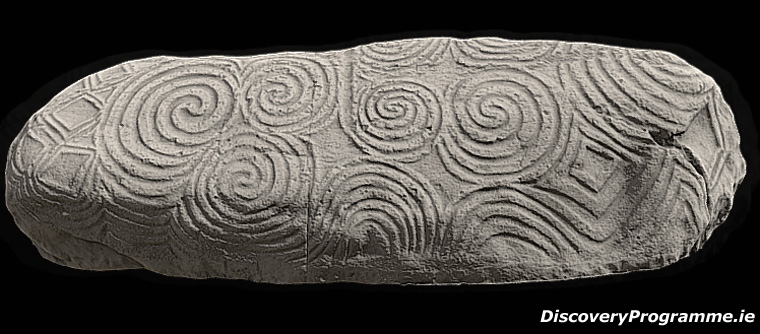 Digitised image of Newgrange entrance kerbstone by the Discovery Programme.
How the motifs work
The spirals, lozenges, arcs and cup-marks at Newgrange and Knowth are often treated as a code waiting to be read, a set of symbols whose meaning we have simply lost. Cochrane starts from a different place. He asks what the stones do to a spectator, not only what they might stand for. The carvings were not all cut in one campaign. Motifs were added, overlaid and replaced over time, so the decorated surfaces feel both lasting and unfinished.
Many societies do not divide the world into living people and dead objects. A stone can have a history, a temperament, even a kind of personhood, if people experience it that way. On that view the greywacke kerbstones, the quartz facade and the carved chamber stones at Newgrange are not mute decoration. They take part in the encounter. Hardness, colour, texture and setting all push back on the carver and on later visitors.
Dense patterns can also work on the eye itself. Tight grids, repeated curves and high-contrast lines can cause flicker, discomfort, even dizziness if they are fresh and strongly marked. Weathered carvings today are gentler than they would have been when first cut. Paint would have sharpened the contrast still further. There is little surviving pigment on Irish passage tombs, though paint does survive on some Iberian tombs, and Cochrane treats colour as a possibility rather than a proven fact. If paint was used, rain would have washed it, faded it and forced people to renew it, so the images would have changed with the seasons.
Water is the heart of the argument. Ireland is a wet country, and the Boyne Valley tombs sit in a landscape framed by river and rain. Newgrange was built to keep the passage dry, with grooves cut in the lintels to throw water aside, yet the kerbstones outside take the weather. When water runs over a carving the grooves darken, the stone's colour wakes, and the design seems to move. Inside the tombs, breath and condensation can make the walls look as if they are sweating. Cochrane suggests that the vertical channels on stones such as Kerbstone K1 and Kerbstone K52 may have helped liquids travel down the face of the rock.
The chambers themselves change how a body feels. Light fails, sound thickens, temperature drops. Stone basins in the recesses may have held bone, or mixtures that included liquids. Quartz, granite cobbles and green-grey greywacke were chosen and placed with care. Staring at the reconstructed quartz facade, Cochrane notes, can hold the eye in the same restless way as wet stone. None of this proves a single Neolithic belief. It does show that the monuments were built to be met with the senses, and that water is one of the agents in that meeting.
The three-spiral figure
Cochrane opens the paper with the three-spiral figure on orthostat C10 in the chamber at Newgrange Site 1. The carving is small, about 30 centimetres across, and sits on the left-hand stone as you enter the end recess. It is the best-known piece of megalithic art in Ireland, and a good place to begin because it is both a finished composition and a surface that still rewards close looking.
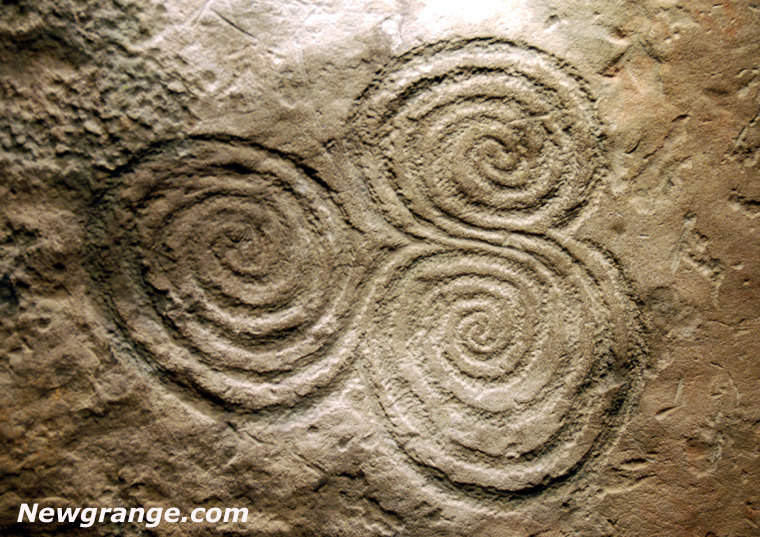 The three-spiral figure, orthostat C10, Newgrange Site 1.
Water on the entrance stone
Kerbstone K1 stands at the threshold of Newgrange, under the roof-box and in front of the passage. In the paper, Cochrane shows this stone with water running over it. The wet grooves darken, the colour of the stone comes up, and the spirals and lozenges seem to move.
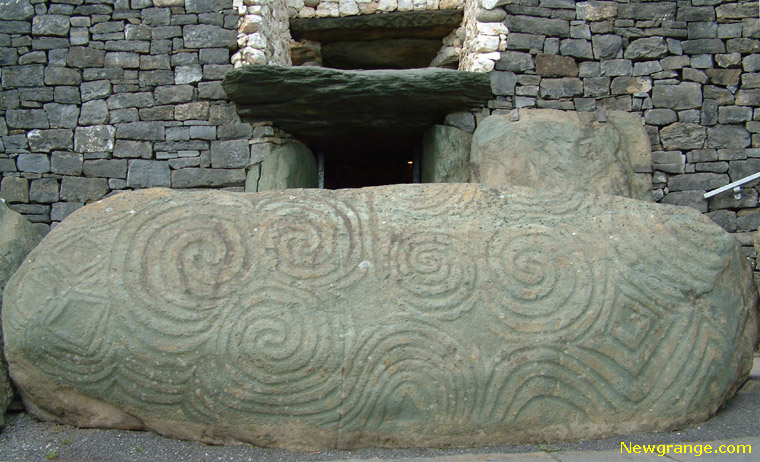 Kerbstone K1, Newgrange Site 1. In the paper Cochrane notes how the motifs are enhanced and suggest movement through the action of running water.
Newgrange Kerbstone 52
Kerbstone 52 stands on the far side of the mound, opposite the entrance. Like K1 it has a vertical line that divides the face, and a packed field of spirals, lozenges, ovals and cup-marks. Cochrane printed the stone twice: first as it is, then with some motifs digitally tinted, to show how pigment and contrast might have made the pattern more vibrant and more tiring to look at.
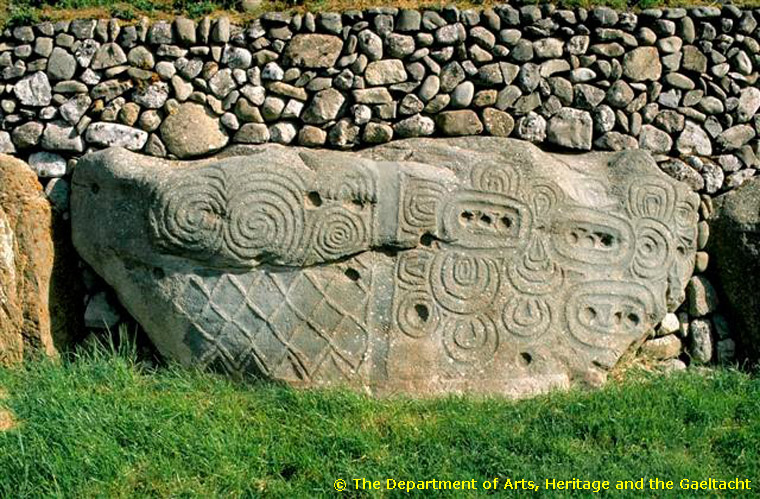 Newgrange Kerbstone K52.
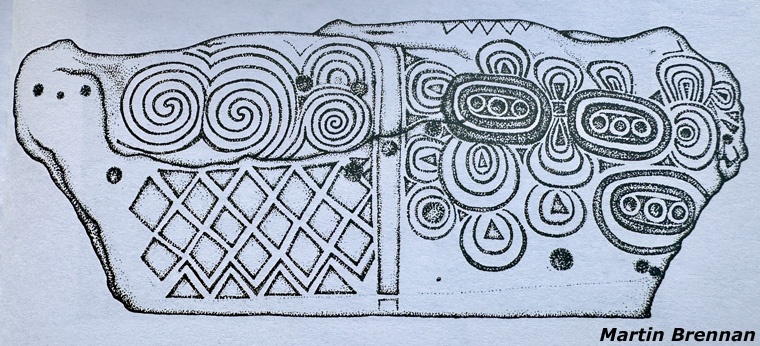 Line drawing of Newgrange Kerbstone K52 by Martin Brennan.
Summary of the paper
Some Stimulating Solutions argues that Irish passage tomb art is better understood as an active encounter than as a silent message. Cochrane looks at Newgrange and Knowth, at the materials used to build them, and at the way water, possible paint, quartz and enclosed space change what a person sees and feels. He does not claim to recover a single prehistoric religion. He asks us to take seriously the chance that stones, liquids and images helped make the world those people inhabited.
Read Some Stimulating Solutions (Andrew Cochrane, in Knappett and Malafouris, eds., Material Agency, Springer, 2008).
Further papers by Andrew Cochrane
- We Have Never Been Material
- A taste of the unexpected: subverting mentalités through the motifs and settings of Irish passage tombs