
Newgrange Orthostat C10
Orthostat C10, located on the right-hand side of the rear recess in the chamber at Newgrange, features the famous three-spiral motif. The intricate carving consists of three interconnected double spirals, measuring approximately 30 cm across. Much of the surrounding stone surface was subsequently pick-dressed using a pointed stone tool. In Michael J. O'Kelly's numbering system, the letter C identifies the upright stones of the chamber.
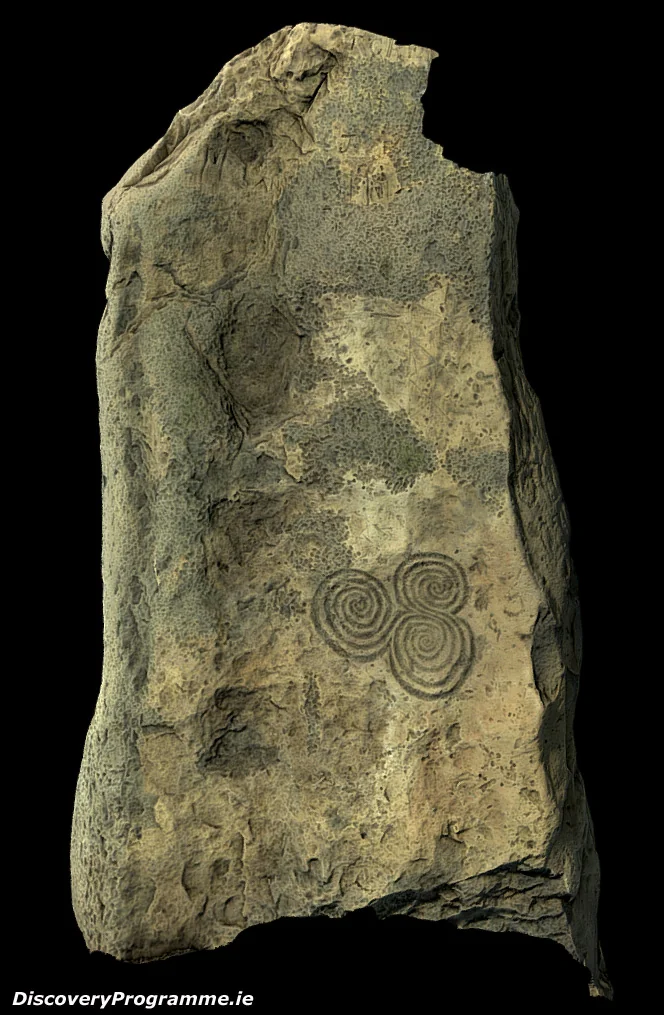 Orthostat C10 in the Discovery Programme model.
The Newgrange three-spiral
The front face of orthostat C10 features the famous Newgrange three-spiral, one of Ireland's best-known examples of Neolithic stone carving. Also described as the tri-spiral, triple spiral, triskele or triskelion, the design consists of three intricately arranged double spirals. Archaeologist Claire O'Kelly preferred the term three-spiral, noting that triple spiral is technically inaccurate because each of the three elements consists of two parallel coils. The complete motif measures approximately 30 by 28 cm (12 by 11 inches), considerably smaller than the spiral carvings on kerbstone K1.
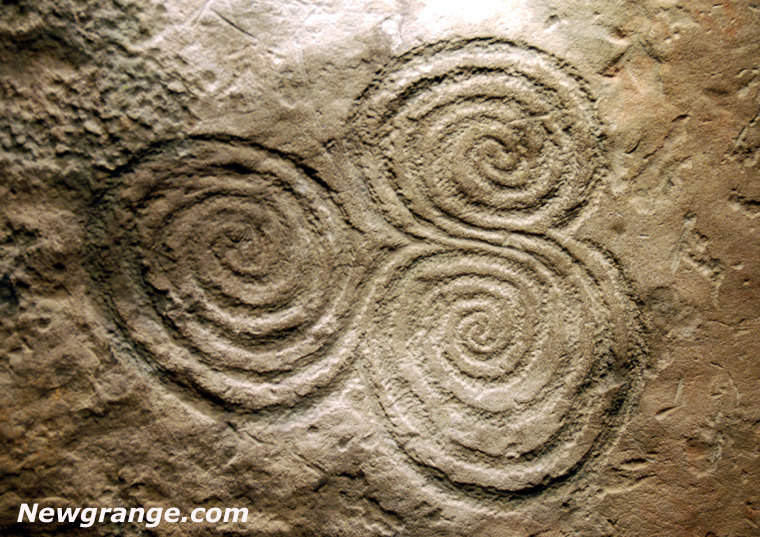 The three-spiral on orthostat C10.
People living near the mound told the O'Kellys that the rising sun used to light this stone in the end recess. That account is what led O'Kelly to watch the winter solstice sunrise.
A separate group of three spirals, set with chevrons, is carved on passage orthostat L19.
Pick-dressing and the other motifs
Much of orthostat C10 is covered with pick-dressing, created by repeatedly striking the stone with a pointed tool, possibly made from flint or quartz. The famous three-spiral motif was picked into an otherwise undressed area of the stone, forming broad, shallow grooves that leave the spiral bands standing in relief. The surrounding pick-dressing extends towards the left side of the design and partly encroaches upon it, while most of the spiral motif remains clearly preserved.
The southern face of orthostat C10 features several smaller carved motifs, including a spiral and an oval.
The Discovery Programme model
The Discovery Programme scanned Orthostat C10 on 14 July 2014 and reprocessed the scan in 2024 to make this model, as part of the 5Dculture project.