The 2020 Newgrange DNA Study
A major DNA study published in 2020 provided new insights into the people who built and used Ireland's great Neolithic passage tombs. Led by Lara M. Cassidy of Trinity College Dublin, the research found evidence of family connections between burial sites across Ireland and suggested that some individuals held privileged positions in society. The most striking discovery concerned a man whose remains were found in the chamber at Newgrange, whose parents were very closely related.
The study, A dynastic elite in monumental Neolithic society, was published in Nature on 17th June 2020.
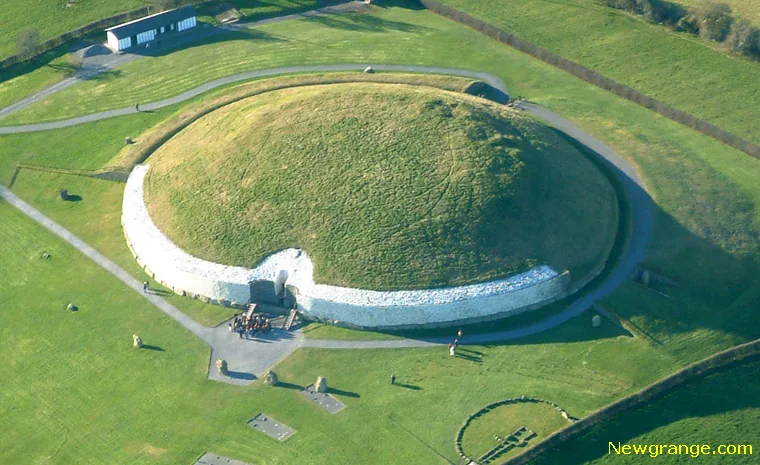 Newgrange, the passage tomb at the centre of the study.
Whose DNA Was Studied?
The researchers analysed ancient DNA from 44 people: two hunter-gatherers who lived during the Irish Mesolithic period and 42 individuals from the Neolithic. Their remains came from several types of burial site, including court tombs, portal tombs, passage tombs, Linkardstown type burials and natural burial locations.
Most of the DNA samples provided relatively limited genetic information, but four individuals were analysed in much greater detail. The researchers compared the results with other ancient genomes from Britain and continental Europe to investigate ancestry, family relationships and the organisation of Neolithic society.
The Arrival of Ireland's First Farmers
The earliest Neolithic remains examined in the study came from Poulnabrone portal tomb in County Clare. Their DNA showed that these individuals descended predominantly from early farming populations rather than Ireland's earlier hunter-gatherers. There was no evidence of close inbreeding among them.
The researchers found that Neolithic populations in Ireland and Britain were genetically very similar. Their early farming ancestry was most closely represented in the study by Neolithic populations from Spain. This supports the view that farming reached Ireland through substantial movements of people by sea, rather than simply through the adoption of new agricultural practices by the existing population.
 Poulnabrone, County Clare, where the earliest
Neolithic genomes in the study were found.
The Man Buried at Newgrange
One of the most remarkable discoveries concerned the remains of an adult man identified by the researchers as NG10. His unburnt bones, including parts of his skull, were found in the most elaborately decorated recess of the chamber at Newgrange. The remains were disarticulated, meaning that the bones were no longer joined together as a complete skeleton.
Newgrange is an exceptionally large monument, containing more than 200,000 tonnes of earth and stone. Its passage and chamber are aligned with the rising sun around the winter solstice. The researchers suggest that only a relatively small number of people could have witnessed the sunlight entering the chamber from within the monument.
Analysis of NG10's DNA revealed an exceptionally high degree of inbreeding. Approximately one-quarter of his genome contained long stretches of identical genetic material, indicating that his parents were either full brother and sister or parent and child. The genetic evidence could not distinguish between these two possibilities.
Such close relationships were highly unusual in the wider Neolithic population examined in the study. The researchers suggest that NG10 may have belonged to a powerful family in which relationships normally prohibited by society were permitted. They draw comparisons with ruling dynasties in ancient Egypt, Hawaii and the Inca Empire, where close-kin marriages sometimes helped preserve political and religious authority.
The prominent location of NG10's remains within Newgrange supports the possibility that he held a privileged position. However, the existence of a ruling dynasty, or the precise nature of its authority, cannot be established from DNA alone. This remains an interpretation of the combined genetic and archaeological evidence.
The study also draws attention to an intriguing connection with medieval Irish mythology. A story recorded in the Middle Ages describes a king who has a relationship with his sister in an attempt to restore the daily course of the sun. The old name associated with Dowth, Fertae Chuile, has been translated as the Hill of Sin or Hill of Incest.
Although the researchers consider it unlikely that an oral tradition could have survived unchanged from the Neolithic into the Middle Ages, they note the striking resemblance between the medieval story and the genetic findings at Newgrange. The resemblance does not establish a direct historical connection.
Family Connections Between Passage Tombs
The study also identified distant family connections between individuals buried at Newgrange, Carrowkeel, Carrowmore and Millin Bay. Carrowkeel and Carrowmore, in County Sligo, lie approximately 150 kilometres (93 miles) west of Newgrange. Their passage tomb traditions began several centuries before the construction of Newgrange, while burials at Carrowkeel continued into the later Neolithic.
NG10 was found to be distantly related to individuals buried at these other sites. Some of the relationships were estimated to be sixth-degree or more distant. Genetic comparisons also showed that individuals from Newgrange, Carrowkeel and Millin Bay formed a recognisable group within the wider Neolithic population of Ireland and Britain.
The researchers interpret these connections as possible evidence of families maintaining relationships across considerable distances. Such connections may have required a relatively sophisticated level of social organisation, particularly if certain family groups held influence at several major burial centres.
There are important qualifications to this interpretation. Many of the individuals buried outside passage tombs were from earlier periods, so some genetic differences could reflect changes in population over time rather than social status. The researchers acknowledge that further DNA sampling from the later Neolithic is needed.
The study also examined chemical evidence preserved in human bones. Individuals buried in passage tombs showed patterns consistent with a diet containing more meat and other animal products. This may indicate privileged access to certain foods, although broader changes in diet during the Neolithic could also have contributed.
Different Tombs, Different Communities
The researchers also examined people buried in court tombs and portal tombs, which generally lack the extensive stone carvings and prestigious grave goods associated with the great passage tombs.
At Poulnabrone in County Clare and the nearby court tomb at Parknabinnia, approximately 10 kilometres (6 miles) away, differences were found in both diet and the paternal genetic lines of the men buried there. Neither tomb contained evidence that its occupants belonged exclusively to one small, closely related family.
The researchers suggest that these differences may reflect distinct communities or social groups, with family descent through the male line playing an important role.
Further evidence came from the individual Linkardstown type burials in southeastern Ireland, where a relatively rare paternal genetic lineage, known as H2a, appeared in two individuals. Another lineage, I-M284, was particularly common among Neolithic males in Ireland and Britain.
Ireland's Earlier Hunter-Gatherers
The study also investigated the people who lived in Ireland before the arrival of farming. DNA from two Mesolithic hunter-gatherers showed that Ireland's earlier population had been genetically isolated for a considerable period.
These individuals were distinguishable from contemporary hunter-gatherers in Britain and continental Europe. Their DNA contained unusually strong evidence of an earlier reduction in ancestral population size, consistent with prolonged isolation on the island.
Despite this isolation, there was no evidence of recent close inbreeding. The researchers suggest that hunter-gatherer communities maintained sufficient contact within Ireland to avoid relationships between close relatives, even though the island's total population may have numbered only 3,000 to 10,000 people.
The genetic evidence indicates that the arrival of farming brought a major change in Ireland's population. Incoming farming communities largely replaced the earlier hunter-gatherer population, although some mixing between the two groups did occur.
One individual buried at Parknabinnia, identified as PB675, had a notably high proportion of ancestry from Irish hunter-gatherers. The researchers estimated that this ancestry entered his family within approximately four generations. A distant relative was also buried in the same tomb, suggesting that he was integrated into the community.
Another significant discovery concerned an infant boy buried at Poulnabrone, identified as PN07. His DNA showed that he had an additional copy of chromosome 21, the genetic condition associated with Down syndrome. The researchers described this as the earliest definitive genetic identification of the condition known at the time of publication. Chemical analysis of his bones was also consistent with breastfeeding.
What the DNA Tells Us About Neolithic Society
The 2020 study demonstrated how ancient DNA can reveal much more than the origins and movements of prehistoric populations. It can also provide evidence of family relationships, marriage patterns and possible differences in social status among people who left no written records.
The findings revealed distant family connections between major passage tomb complexes, possible differences in diet and the exceptional parentage of a man buried in the chamber at Newgrange. Cassidy and her colleagues interpreted these discoveries as evidence that some families may have held considerable status and influence within Neolithic Irish society.
The researchers suggest that these communities displayed some of the characteristics of increasingly hierarchical societies, including the concentration of power among particular family groups. However, the precise nature of leadership and political organisation in Neolithic Ireland remains uncertain.
Download a PDF copy of the original research manuscript, A dynastic elite in monumental Neolithic society. This is a manuscript version of the study, not the final published version in Nature.
Alison Sheridan's News and Views article in the same issue of Nature provides further discussion of the findings. A 2025 critique of the interpretation of NG10's remains and a separate 2025 study of kinship offer additional perspectives on the evidence for social hierarchy. The June 2020 news report records the National Monuments Service's response to the original research.