Newgrange Kerbstone K7
It is one of the 97 kerbstones numbered in Professor Michael J. O'Kelly's record of the monument. Walking clockwise from the entrance stone (K1), K7 is six stones away from the entrance.
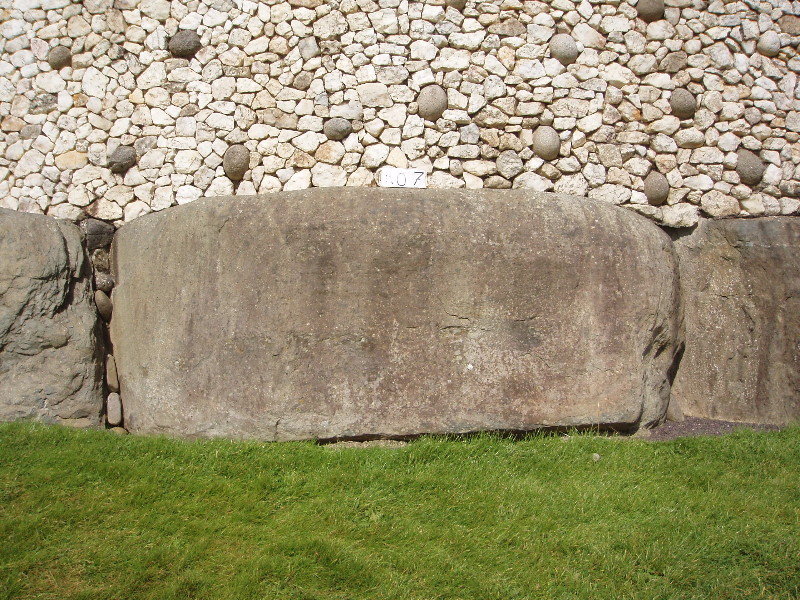 Newgrange Kerbstone K7.
Megalithic art on Kerbstone K7 is recorded in Claire O'Kelly's corpus, illustrated in Michael J. O'Kelly's Newgrange: Archaeology, Art and Legend.
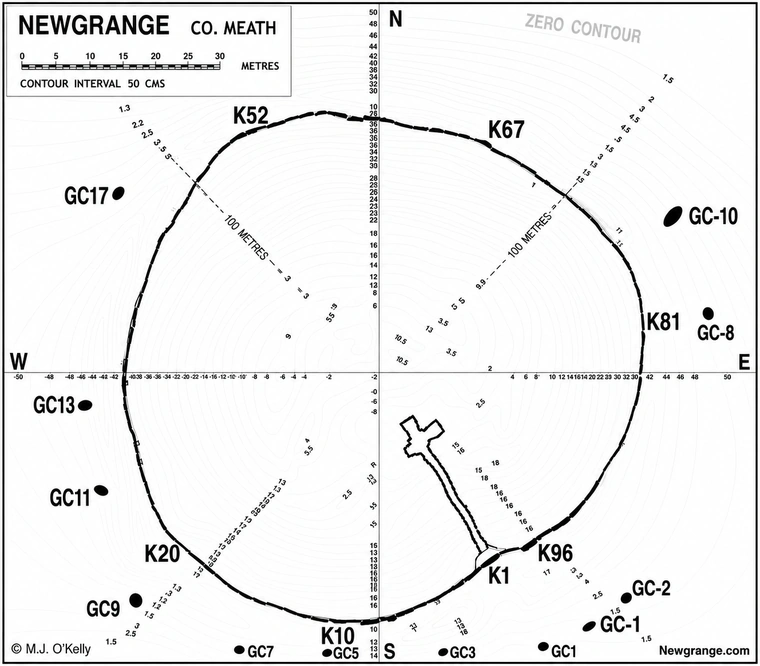 Plan of Newgrange Mound adapted from Newgrange - Archaeology, Art and Legend.
Newgrange – Archaeology, Art and Legend
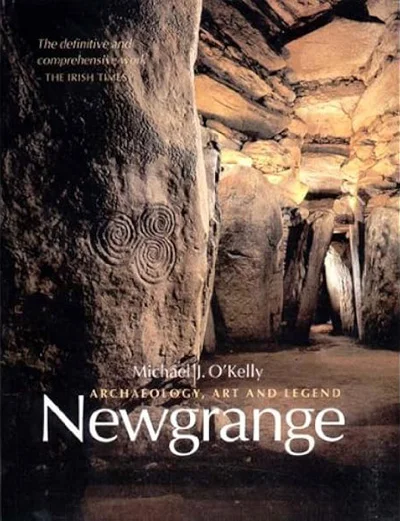
Newgrange – Archaeology, Art and Legend by Professor Michael J. O'Kelly and Claire O'Kelly is the definitive archaeological study of Newgrange and one of the most important books ever published on an Irish prehistoric monument.
Based on Professor Michael J. O'Kelly's excavations between 1962 and 1975, the book explains the construction, chronology, megalithic art and winter solstice alignment of Newgrange. O'Kelly also describes the excavation, interpretation and restoration of the great passage tomb using detailed archaeological records and architectural analysis.
Richly illustrated throughout, the volume includes the important contribution of Claire O'Kelly, who collaborated closely in the excavation and recording of the site from its earliest seasons.
First published in 1982, with a paperback edition in 1988, the book remains an essential reference for anyone interested in the archaeology, megalithic art and wider significance of Newgrange and the Boyne Valley.
Purchase at Amazon.com or Amazon.co.uk
Newgrange | Brú na Bóinne
The Boyne Valley has been a focus of ritual and burial for more than five thousand years. Newgrange represents the apex of passage-tomb architecture in the region, combining structural ambition with selective, often hidden, megalithic art.
Martin Brennan and others have argued that kerb carvings and standing-stone shadows encode calendrical observations; mainstream archaeology treats such claims cautiously while accepting that alignments and art placement were deliberate.
The date of the Great Circle remains debated. It has often been assigned to a later Bronze Age phase, but Ken Williams's 2023 study argues that the stones were erected during the construction or use of the Neolithic passage tomb. Several kerbstones interact visually with circle stones at particular sunrises.
Tour groups walk clockwise around the mound from the entrance, passing kerbstones in numerical order where they are exposed, before returning to the quartz façade and Visitor Centre beyond.