
Newgrange Kerbstone K8
It is one of the 97 kerbstones numbered in Professor Michael J. O'Kelly's record of the monument. Walking clockwise from the entrance stone (K1), K8 is seven stones away from the entrance.
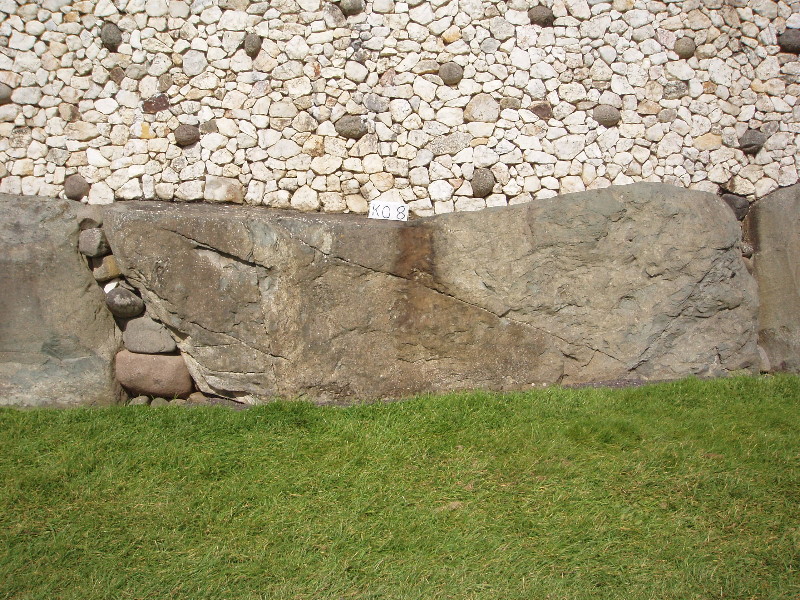 Newgrange Kerbstone K8.
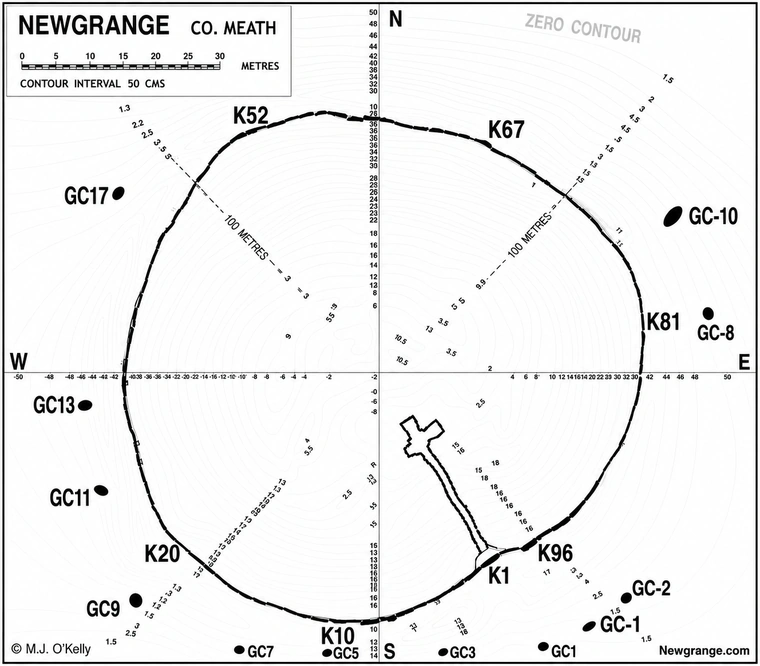 Plan of Newgrange Mound adapted from Newgrange - Archaeology, Art and Legend.
Newgrange – Archaeology, Art and Legend
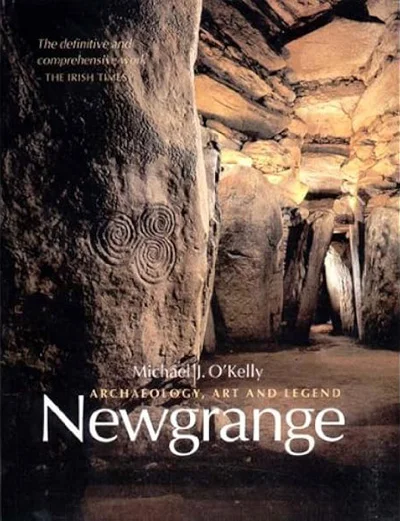
Newgrange – Archaeology, Art and Legend by Professor Michael J. O'Kelly and Claire O'Kelly is the definitive archaeological study of Newgrange and one of the most important books ever published on an Irish prehistoric monument.
Based on Professor Michael J. O'Kelly's excavations between 1962 and 1975, the book explains the construction, chronology, megalithic art and winter solstice alignment of Newgrange. O'Kelly also describes the excavation, interpretation and restoration of the great passage tomb using detailed archaeological records and architectural analysis.
Richly illustrated throughout, the volume includes the important contribution of Claire O'Kelly, who collaborated closely in the excavation and recording of the site from its earliest seasons.
First published in 1982, with a paperback edition in 1988, the book remains an essential reference for anyone interested in the archaeology, megalithic art and wider significance of Newgrange and the Boyne Valley.
Purchase at Amazon.com or Amazon.co.uk
Newgrange | Brú na Bóinne
Newgrange's mound covers roughly one acre, enclosed by kerbstones that originally helped contain the cairn of stones and define the monument's edge on the old ground surface.
Claire O'Kelly traced carvings onto plastic sheets at the Netterville Institute near Dowth, then reduced them for publication. Her drawings remain the standard reference for every decorated surface at the site.
Solstice sunrise enters not through the main doorway alone but through the roof-box, a feature O'Kelly discovered during excavation. Graffiti on chamber stones prior to excavation showed long-standing public fascination with the interior.
Kerb art at Newgrange is often fragmentary: chevrons, circles, cupmarks and arris motifs rather than the large panels seen on Knowth kerbstones. Three kerbstones, K1, K52 and K67, are exceptions with full-face compositions.