Newgrange Kerbstone K9
It is one of the 97 kerbstones numbered in Professor Michael J. O'Kelly's record of the monument. Walking clockwise from the entrance stone (K1), K9 is eight stones away from the entrance.
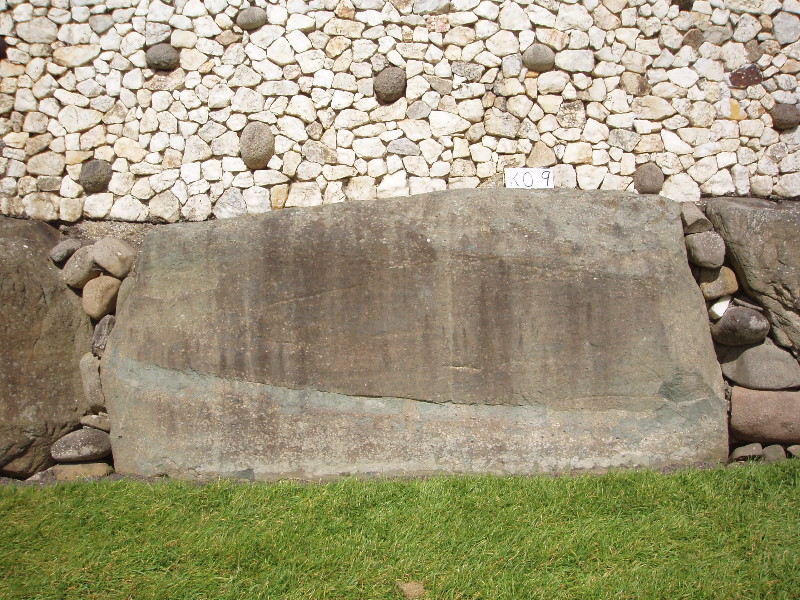 Newgrange Kerbstone K9.
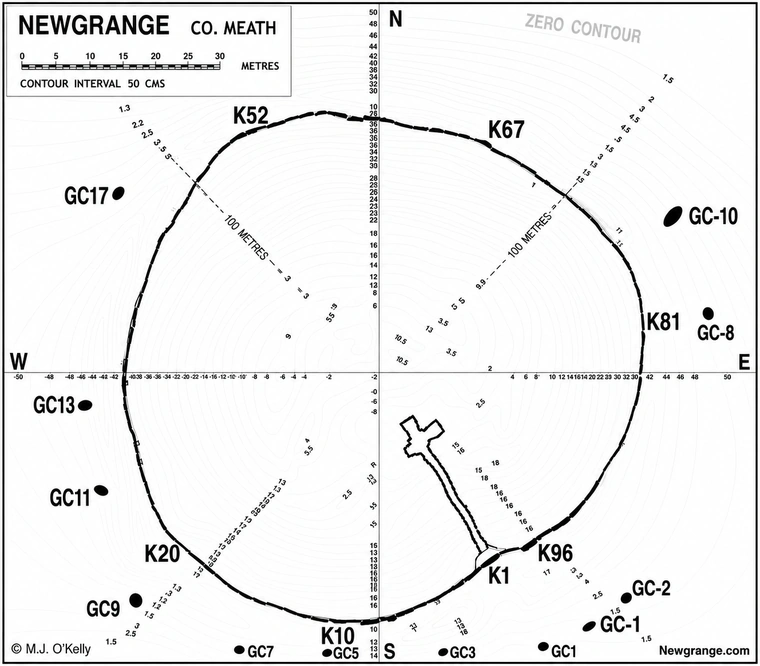 Plan of Newgrange Mound adapted from Newgrange - Archaeology, Art and Legend.
Newgrange – Archaeology, Art and Legend
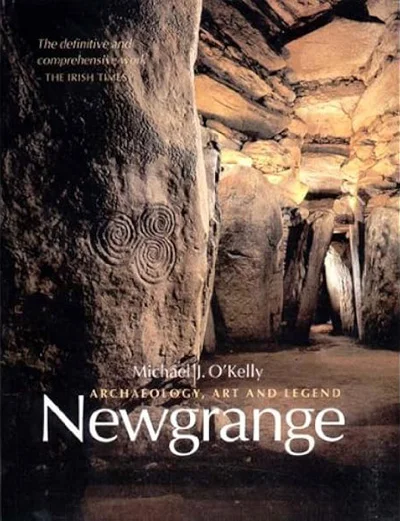
Newgrange – Archaeology, Art and Legend by Professor Michael J. O'Kelly and Claire O'Kelly is the definitive archaeological study of Newgrange and one of the most important books ever published on an Irish prehistoric monument.
Based on Professor Michael J. O'Kelly's excavations between 1962 and 1975, the book explains the construction, chronology, megalithic art and winter solstice alignment of Newgrange. O'Kelly also describes the excavation, interpretation and restoration of the great passage tomb using detailed archaeological records and architectural analysis.
Richly illustrated throughout, the volume includes the important contribution of Claire O'Kelly, who collaborated closely in the excavation and recording of the site from its earliest seasons.
First published in 1982, with a paperback edition in 1988, the book remains an essential reference for anyone interested in the archaeology, megalithic art and wider significance of Newgrange and the Boyne Valley.
Purchase at Amazon.com or Amazon.co.uk
Newgrange | Brú na Bóinne
Passage tombs like Newgrange were communal burial places, used over generations. Bone deposits in the chamber were disturbed in antiquity, but the architectural shell survives intact enough for guided access.
The River Boyne itself appears in myth as Boann, whose flooding may echo seasonal rises that shaped valley settlement. Prehistoric farmers chose elevated ground above the flood plain for the great tombs.
Brú na Bóinne Visitor Centre interprets all three main mounds; access to Newgrange and Knowth is by guided tour from the centre, while Dowth has a separate public road and chamber access on a more limited basis.
Photographs of individual kerbstones, numbered K1 to K97, document stones exposed at different stages of excavation and restoration. Partly buried kerbstones still show only their upper portions above modern ground level.