Newgrange Kerbstone K97
It is one of the 97 kerbstones numbered in Professor Michael J. O'Kelly's record of the monument. Walking counter-clockwise from the entrance stone (K1), K97 is one stone away from the entrance. During Professor Michael J. O'Kelly's restoration, the reconstructed quartz façade was brought only as far as the eastern side of K97, mirroring the arrangement at Kerbstone K2 on the west. The visitor access ladder crosses the top of K97.
 Newgrange Kerbstone K97.
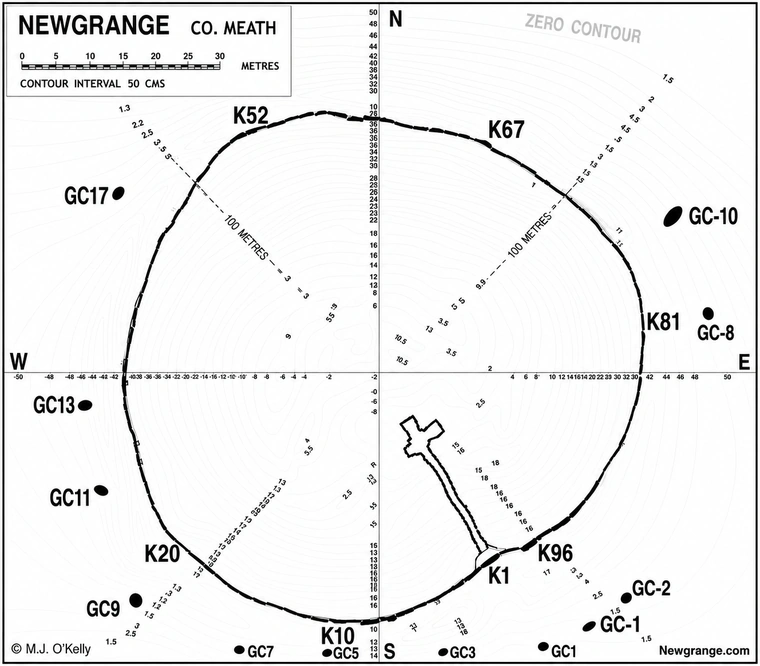 Plan of Newgrange Mound adapted from Newgrange - Archaeology, Art and Legend.
Newgrange – Archaeology, Art and Legend
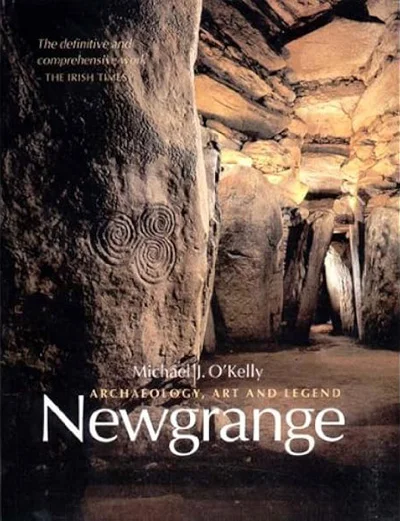
Newgrange – Archaeology, Art and Legend by Professor Michael J. O'Kelly and Claire O'Kelly is the definitive archaeological study of Newgrange and one of the most important books ever published on an Irish prehistoric monument.
Based on Professor Michael J. O'Kelly's excavations between 1962 and 1975, the book explains the construction, chronology, megalithic art and winter solstice alignment of Newgrange. O'Kelly also describes the excavation, interpretation and restoration of the great passage tomb using detailed archaeological records and architectural analysis.
Richly illustrated throughout, the volume includes the important contribution of Claire O'Kelly, who collaborated closely in the excavation and recording of the site from its earliest seasons.
First published in 1982, with a paperback edition in 1988, the book remains an essential reference for anyone interested in the archaeology, megalithic art and wider significance of Newgrange and the Boyne Valley.
Purchase at Amazon.com or Amazon.co.uk
Newgrange | Brú na Bóinne
Newgrange (Sí an Bhrú) stands in the Boyne Valley as the best-known monument of Brú na Bóinne. The great passage tomb was constructed around 3200 BC, predating Stonehenge and the pyramids of Giza, and remains one of the most carefully studied Neolithic buildings in western Europe.
Visitors are drawn above all by the winter solstice phenomenon, when sunlight passes through the roof-box and reaches the chamber floor. The alignment was restored and confirmed during Professor Michael J. O'Kelly's excavations between 1962 and 1975.
The Brú na Bóinne landscape combines major passage tombs, henges, standing stones and settlement evidence spanning several millennia. UNESCO World Heritage status reflects the density and quality of surviving prehistoric monuments in the valley.
The kerb ring defines both the physical edge of the cairn and a symbolic boundary between the world of the living and the passage leading to the chamber. Claire O'Kelly recorded megalithic art on 31 of the 97 kerbstones, illustrated in Newgrange: Archaeology, Art and Legend.